SOURCING GUIDES / CHOOSING AN AGENT
How to Find a Reliable China Product Sourcing Agent
Practical questions, evidence to request and decisions to make before you hire a sourcing partner in China.
How do you find a reliable China sourcing agent?
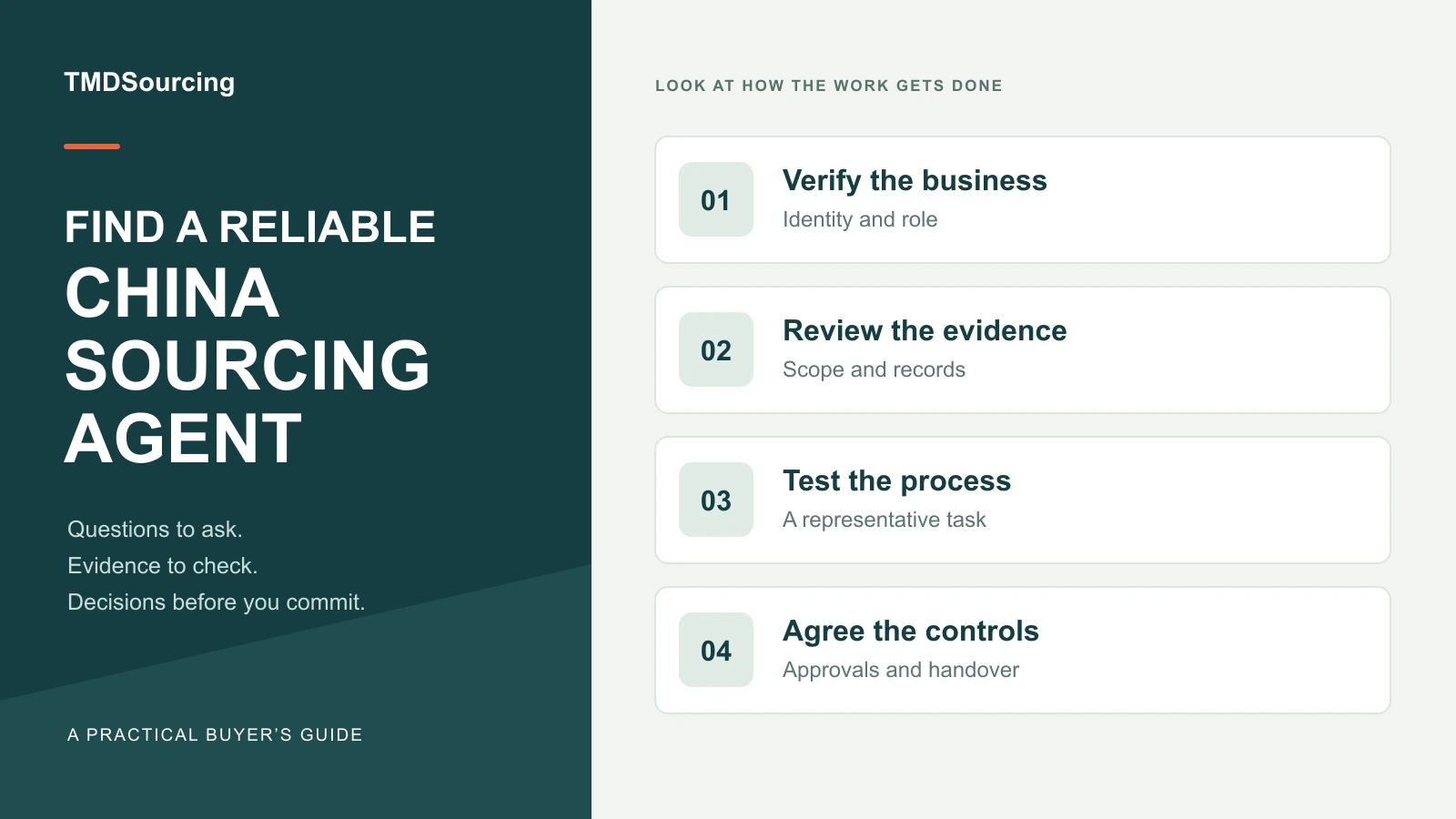
Start with the work you need, then ask candidates to show how they would deliver it. Verify the contracting business, compare fees against the same scope, and review evidence of supplier selection, sample approval and quality checks. Before a broader commitment, test a representative piece of work with clear deliverables.
A reliable China product sourcing agent should be able to explain who does the work, what you will receive, which decisions need your approval and what happens when something goes wrong. A polished website or a low commission cannot answer those questions on its own.
Define the sourcing help you actually need
“Sourcing agent” can describe several different services. One provider searches for factories from a specification; another purchases items from links you supply. A trading company may sell products to you directly, while a procurement team coordinates suppliers, production, inspection and shipping.
These arrangements can all be useful. What matters is whether the provider’s role matches your project and is clear in the quotation and agreement.
- Need a new supplier? Ask about product research, factory selection and comparison deliverables.
- Already have a supplier? Specify the negotiation, order follow-up or inspection support you need.
- Developing or customizing a product? Include specifications, samples, tooling and approval stages.
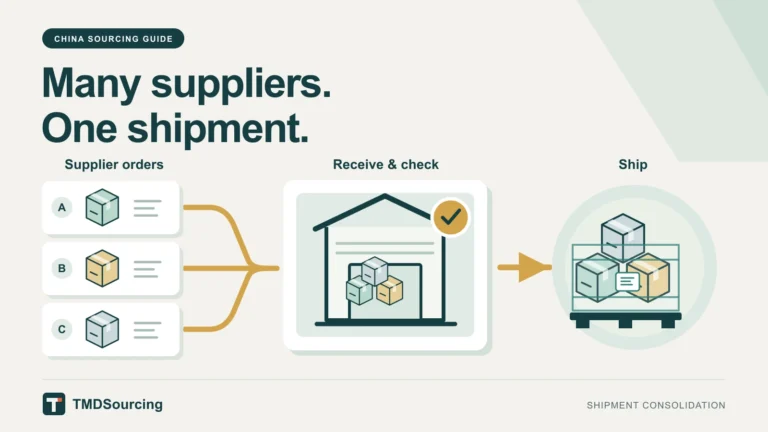
- Managing several suppliers? Identify receiving, packing and shipment coordination responsibilities.
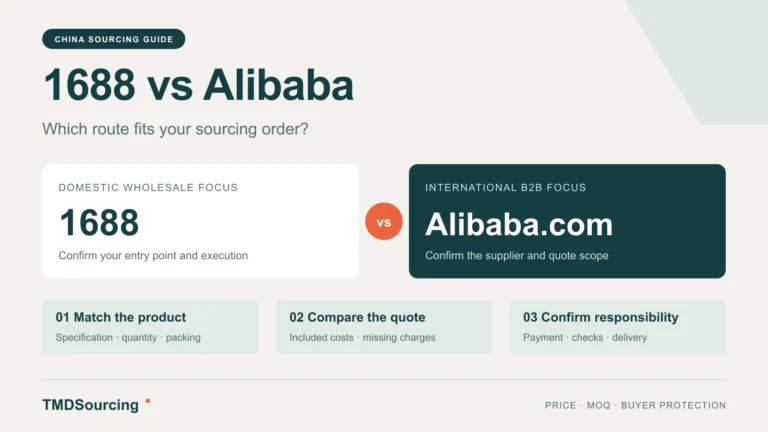
Write a short brief with your product reference, quantity, destination and main constraints. If you are still choosing a buying route, our guide to Alibaba vs a sourcing agent explains the work each route involves.
Where to find candidates worth comparing
Start with referrals from importers in your product category, targeted searches, relevant trade shows and professional networks. A referral is more useful when the person can explain what the agent handled, which problems arose and how they were resolved.
Search by your product and task as well as location. An agent’s office city does not tell you whether they can assess your manufacturing process or follow up at the factory. Ask how they cover the relevant production area and whether work is performed by employees or outside providers.
Build a manageable shortlist and send the same brief to each candidate. Search visibility, directory badges, social activity and reviews can help you discover providers. They do not replace checking the business and watching how it works.
10 checks before hiring a China sourcing agent
For each check, record the answer, supporting material and unresolved questions. Request permission-cleared, redacted examples rather than another customer’s confidential files.
1. Verify the business and its role
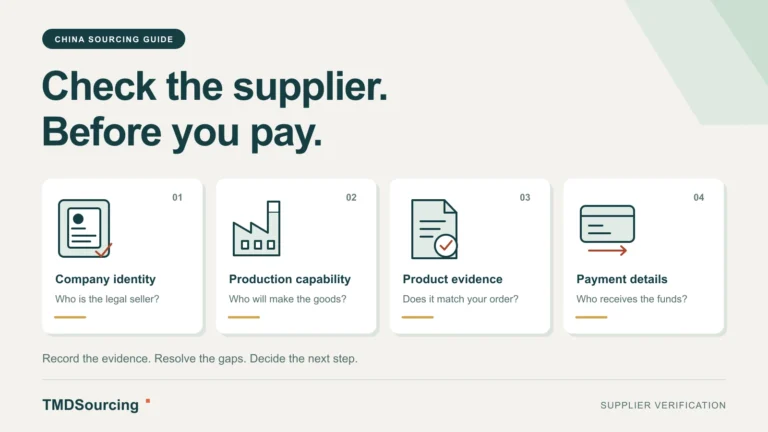
Ask for the legal company name, registration identifier and jurisdiction of the business you will contract with. Compare those details with the quotation, agreement and payment instructions. For mainland entities, use the official SAMR query services; for a Hong Kong entity, use the appropriate company-register channel.
Look for: a clear explanation of the contracting party, seller, executing team and any separate payment recipient. Registration helps establish identity, not technical competence or financial security. If the relationships remain unclear, resolve them before paying.
2. Check experience against your actual product
“We source everything” tells you little about your project. Ask how the agent would evaluate your materials, manufacturing process, intended use, quantity and destination-market requirements. Relevant questions from the agent are often more informative than a broad product catalogue.
Look for: a sample brief, comparison or report relevant to the work, with a named project lead and backup contact. The provider should identify limitations and explain when a specialist is needed. Team size, English fluency and office photographs alone do not establish that capability.
3. Understand how suppliers are recommended
Ask how candidates are found, why a supplier is recommended and what alternatives were considered. A useful comparison explains specification fit, capacity, minimum quantities, lead time and quality concerns alongside price. Our supplier comparison guide gives you a practical starting point.
Look for: reasons you can question and a clear statement of supplier-side payments or related-party relationships relevant to the recommendation. There may be a good reason for a limited shortlist. An unexplained preference or undisclosed conflict needs clarification; it is not enough to hear that a factory is “trusted.”
4. Make the fee basis and exclusions explicit
Ask what amount a percentage applies to, whether a minimum fee applies, and when charges become payable. Clarify samples, inspection, testing, packaging, storage, currency conversion, payment processing and freight. Ask how additional work is approved.
Look for: a written scope with included work, exclusions and costs still to be confirmed. A service-fee model and a resale price offer different levels of cost visibility. Agree what pricing information you receive instead of assuming every provider discloses its internal margin. Compare the complete proposed service, not the headline percentage.
5. Identify the project owner and approval rules
Confirm who will run your order after the sales conversation. Agree working hours, update points, a backup contact and an escalation route. A useful update shows progress, open questions, decisions required and the next milestone.
Look for: written approval rules for changing the supplier, material, specification, packaging, cost or delivery plan. For example, a proposed factory change should trigger an explanation and any necessary sample review. Do not leave the agent guessing which changes it may make without you.
6. Follow the sample through to the production specification
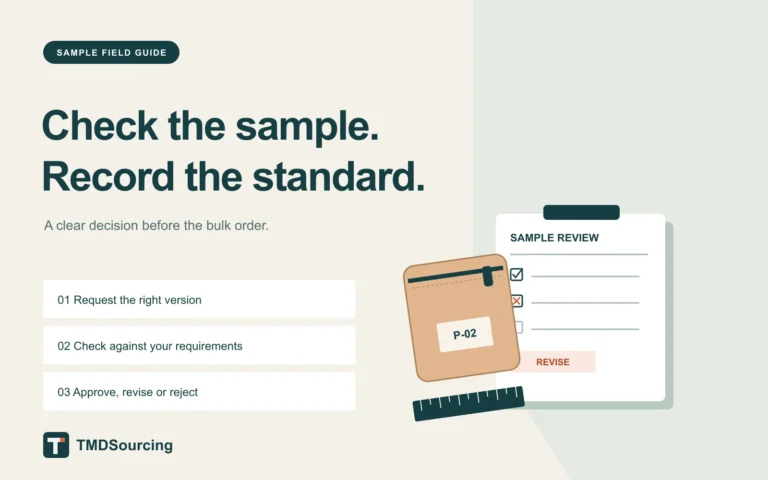
Ask how samples are identified, reviewed and linked to the bulk order. A photograph of an attractive sample is less useful than a record showing the specification version, measurements, deviations, approval date and person approving it.
Look for: a consistent reference in the sample record and purchase order, with outstanding issues clearly separated from approved details. Confirm who retains reference samples and when a change requires renewed approval. Our guide to ordering and approving samples from China explains this process. An approved sample does not establish the quality of every production unit.
7. Define quality checks and shipment release
Ask who performs checks, what they cover, how results are reported and whether you can appoint an independent provider. Counting cartons, taking warehouse photographs, inspecting products and laboratory testing serve different purposes. ISO’s conformity-assessment overview distinguishes testing, inspection and certification.
Look for: a report tied to the product and batch, agreed criteria, inspection coverage, findings and action on failures. Confirm who can approve shipment after a problem. Use a pre-shipment inspection checklist to discuss scope; do not assume the same sampling plan or full inspection suits every order.
8. Map payments and custody of goods
Establish who collects product payments, service fees and third-party charges, and when supplier payments are released. If different entities are involved, ask for the relationship and authority to be documented. Also confirm who receives goods, records inventory and authorizes movement or dispatch.
Look for: agreed payment milestones and a separate verification step for changed bank details. The FBI’s business-email-compromise guidance recommends verifying payment changes through trusted channels. Use a previously established contact, rather than relying only on the email announcing the change.
9. Ask what happens when an order has a problem
Discuss a concrete situation: the supplier misses the date, goods differ from the approved sample, or inspection finds defects. Who preserves evidence, informs you, contacts the supplier, proposes options and arranges any recheck? Which work or costs fall outside the fee?
Look for: an exception report or process that separates coordination duties from the seller’s, factory’s and third parties’ responsibilities. “We will take care of it” leaves too much undefined. A clear process is more credible than a promise that nothing will go wrong or that every loss will automatically be reimbursed.
10. Clarify information access and handover
Ask which supplier identities, quotations, order records and technical files you receive during the project. Discuss confidentiality, any limits on direct factory contact, and what happens if either side ends the relationship.
Look for: agreed access and transfer terms for the information and assets important to continued supply. Owning a design, having permission to use it and holding the editable file are different things. The same applies to tooling ownership and physical custody. Settle these questions while comparing proposals, before the project depends on one provider.
Mark each item “ready to compare,” “needs clarification” or “hold commitment/payment.” An unresolved payment identity or unauthorized substitution should remain visible even if the agent performs well elsewhere.
Compare quotations with the same scope
Ask candidates to quote against the same product brief and work package. Record the fee basis, minimum, included deliverables, extra charges, payment terms and validity. Keep unquoted items marked “to confirm”; a blank is not a zero.
The example below uses invented figures to show why scope matters. It is not a market benchmark or a TMDSourcing quotation.
| Quoted item | Proposal A | Proposal B |
|---|---|---|
| Service fee | 5% = US$100 | 8% = US$160 |
| Same inspection scope | US$100 | US$100 |
| Agreed coordination work | US$80 extra | Included |
| Service subtotal | US$280 | US$260 |
On a narrow screen, swipe the table horizontally. Product payment, freight and destination charges are excluded from these subtotals.
This does not make a higher commission better. If scope and other costs are equal, a lower fee can be better value. The useful question is what you receive for the total you will pay.
For TMD’s published terms, see our sourcing service fees. Initial consultation and quotation are free; the project scope and charges are confirmed before commitment.
Test the working process before expanding the commitment
Choose a representative first work package: a supplier-search assignment, a sample round, or a limited part of a production project. Its size should reflect the product, complexity and exposure. A custom product may need a technical review before a useful sample can even be made.
The trial can be paid. Agree the deliverables, expenses, timing, dependencies and acceptance criteria first. Watch how the agent works, including what happens when the answer is inconvenient.
- Does the agent ask relevant questions before recommending a supplier?
- Are quotations and samples compared against the same specification?
- Are limitations, delays and defects raised early with evidence?
- Are extra costs and changes approved before they occur?
- Can you follow the decisions through the records provided?
Finish with a short review: accepted work, unresolved points, action owners and the next decision. Expand the assignment when the process meets your needs. One clean trial is useful evidence, but future production still requires order-specific specifications and checks.
Agree the handover before the relationship starts
Exit arrangements protect continuity even when nobody expects to leave. List the items needed to continue an order or move it elsewhere, then record the owner, permitted user, custodian, location and transfer conditions for each.
- Supply information: supplier contacts, quotations, purchase records and open issues.
- Product references: drawings, editable files, approved samples and specification versions.
- Physical assets: tooling, remaining materials, unused packaging and finished inventory.
- Work in progress: open orders, balances, outstanding charges and movement approvals.
Agree who prepares the handover, what fees or obligations remain, and when the transfer happens. Do not assume that paying an invoice settles every access, ownership or custody issue. For valuable tooling, confidential designs or significant liability, have the relevant terms reviewed for the actual arrangement.
Keep the list proportionate. A straightforward repeat purchase needs a different level of documentation from a custom development program.
A first enquiry you can adapt
You can start with a product link or photos, target quantity and destination. Add technical details as they become available. Use this original template to open a useful conversation:
Subject: Sourcing support for [product/project]
Hello,
We need help with [finding suppliers/purchasing/production coordination]. Our product reference is [link or photos], target quantity is [quantity and variants], and destination is [country]. Our main requirements are [specification, packaging, timing or current problem].
Please confirm whether this fits your service and explain:
- Which company and project lead would handle the work?
- How would you select suppliers, and what comparison records would we receive?
- What is your fee basis, minimum and list of excluded costs? Are there relevant supplier-side payments or relationships?
- How are samples, changes, inspections and shipment release approved?
- What first work package do you recommend, and what access and handover terms would apply?
A permission-cleared, redacted example is sufficient. We do not need another customer’s confidential information.
Thank you,
[Name/company]
Frequently asked questions
Is a sourcing agent the same as a trading company?
Not necessarily. An agent may provide procurement services while a trading company sells goods to you. Some businesses offer both arrangements. Check the role for your order, who signs the sales contract and what price, supplier and project information you will receive.
Should I always receive factory contacts and original quotations?
That depends on the service model and agreement. If direct access or quotation visibility matters to you, make it a selection requirement and agree it before paying. Ask about confidentiality restrictions and whether contact or transfer rights change when the relationship ends.
Does a low commission mean an agent is unreliable?
No. A percentage alone does not establish quality or honesty. Check the calculation basis, minimum, additional costs, supplier-side incentives and work included. Compare complete proposals against the same requirements rather than treating any rate as a universal standard.
Can an ISO certificate replace inspection or testing?
No. A quality-management-system certificate is different from product certification and does not establish that every unit meets your specification. Check the certificate’s subject and scope, then define the product checks and testing needed for the actual order.
Can an agent help with a supplier I already found?
Some providers offer order coordination, verification or inspection support separately. Ask which tasks they accept and how responsibility is divided. If you need to assess the supplier itself, use our guide to verifying a Chinese supplier.
When should I pause the selection process?
Pause a payment or wider commitment when important identity, payment authority, specifications or approval rights remain unresolved. Request a clear explanation and supporting material. A warning sign is a reason to investigate; it is not automatically proof of wrongdoing.
Discuss your sourcing requirements with TMDSourcing
TMDSourcing has supported China procurement since 2012 and is based in Lishui, Zhejiang. Tell us what you want to source and where you need support, from finding suppliers to order coordination.
Send a product reference, target quantity and destination to start a free initial consultation and quotation. We will clarify the requirements and proposed scope with you.
Discuss your sourcing projectOr email service@tmdsourcing.com. Learn more about our product sourcing services.