SOURCING GUIDES / QUOTES & SHIPPING
EXW vs FOB: Which Works Better When Buying from China?
Compare the origin costs, delivery points and responsibilities behind your supplier’s price.
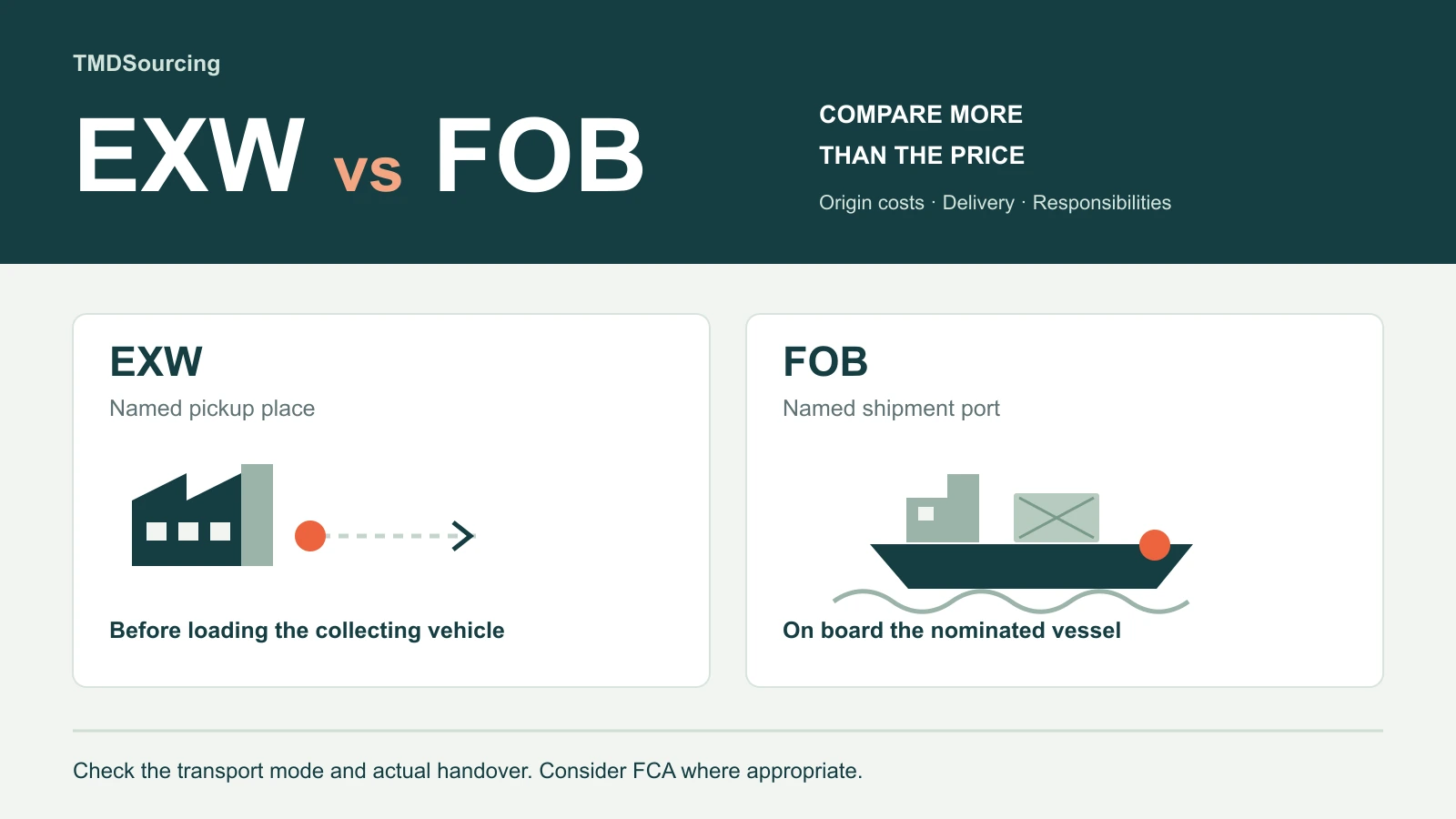
What is the difference between EXW and FOB?
EXW usually puts the buyer in charge of collection and export arrangements from a named place. FOB puts origin transport, export clearance and delivery on board the nominated vessel with the seller. Both leave the buyer arranging the main transport. The useful choice depends on the actual handover, transport mode and complete quotation—not simply the lower factory price.
For air freight, courier deliveries or containers handed to a carrier before vessel loading, ask whether FCA describes the arrangement better. This guide uses Incoterms® 2020 and focuses on commercial purchases from China.
EXW vs FOB at a glance
The comparison below describes the usual allocation between buyer and seller. Read it alongside the named place or port and any clearly agreed variations.
The delivery point changes the work behind the price
| Question | EXW — Ex Works | FOB — Free On Board |
|---|---|---|
| Where does the seller deliver? | At the agreed place, with goods available to the buyer, before loading the collecting vehicle. | On board the buyer-nominated vessel at the named shipment port. |
| Who arranges origin work? | The buyer arranges collection, loading and onward movement. | The seller arranges the work needed for delivery on board. |
| Who handles export clearance? | The buyer, with the seller’s required assistance. | The seller. |
| Who arranges main carriage? | The buyer. | The buyer, including timely vessel and loading instructions. |
| Which transport modes? | Any mode; international use needs careful origin planning. | Sea or inland waterway transport with delivery on board. |
| What should the quote name? | The precise delivery address and point. | The shipment port and relevant loading point. |
| What does the label leave open? | Payment terms, ownership, product acceptance, detailed service quotations and applicable regulatory requirements still need separate attention. | |
On a smaller screen, swipe the table sideways to compare both columns.
Neither term means delivery to your final warehouse. A freight quotation must still explain its own scope, including destination handling and final delivery where requested.
What an EXW quote leaves you to arrange
An EXW price can be a useful starting point when a supplier mainly serves domestic buyers or your own logistics team wants to coordinate collection. It becomes workable only when someone accepts responsibility for the steps after the agreed delivery point.
Start with the address. “EXW China” is too vague for a pickup plan. Ask for the collection site, warehouse or gate, contact, opening hours and how the cargo will be presented. A workshop address on a sales profile may differ from the actual dispatch location.
Confirm loading before sending a truck
Find out whether the goods will be loose cartons, pallets, crates or another format. Identify who supplies loading labor and equipment, who books the collection slot, and what waiting or failed-collection charges could apply.
A factory may offer to help load as a practical courtesy. Record that arrangement and its risk allocation instead of assuming that helpful staff have changed the sales term. ICC’s EXW and FCA explanation discusses this loading distinction.
Establish the export route and required cooperation
Ask who will arrange export formalities, which entity and representative will be involved, and what information the supplier must provide. An EXW label does not make an overseas buyer able to perform every local formality independently.
Get the practical arrangement confirmed before collection. Match the commercial invoice, packing information and other required records to the actual goods. If a necessary document or responsible party is unresolved, keep it on the open-items list rather than treating the pickup booking as approval to proceed.
What FOB includes—and what you still need to confirm
Under FOB, the seller’s delivery obligation reaches the nominated vessel at the agreed shipment port, with export clearance completed where applicable. Merely arriving at a port or leaving cartons at a freight warehouse is not the same event.
ICC’s FOB rules and explanatory notes set out that distinction. They also make FOB specific to sea and inland waterway transport.
Ask what is included in the seller’s number
Request a quotation showing the product specification, quantity, packaging, named port, currency and validity. Confirm which origin operations the seller has included and whether any separately listed charge changes the offer you thought you were accepting.
Then ask your forwarder where its service begins. A shipping invoice might collect a charge from one party even though the sales contract allocates the underlying cost differently. Compare the two agreements before deciding that a charge is missing, duplicated or payable by you.
Supply the booking information on time
The buyer still has work to do under FOB. Agree who communicates the vessel, loading point, cargo cutoff and required instructions, and how booking changes are passed to the supplier.
Missing notices or a vessel that does not take the goods can affect costs and risk under the rules. Do not treat “FOB” as a promise that every delay before sailing is automatically the seller’s expense. Review the relevant event and agreed conditions before accepting an additional bill.
When FCA is a better question to ask
Sometimes the right answer to “FOB vs EXW?” is to clarify a third option: FCA, or Free Carrier. It provides a seller-cleared export arrangement with delivery to the carrier or other person nominated by the buyer at a named place.
For container cargo, the supplier often hands goods to a terminal or consolidation facility before they are loaded onto a vessel. FCA can align the contractual delivery point with that earlier carrier handover. ICC Academy’s FCA and FOB comparison explains the issue.
Consider the same question for air, road, rail or courier movements. “FOB airport” may be used loosely in conversation, but it does not describe FOB under Incoterms® 2020. Ask the supplier to explain the actual handover and confirm a suitable term in writing.
If discussing FCA, specify whether delivery is at the seller’s premises or another place. Loading and unloading arrangements differ with that choice. Get the location, responsible carrier and handling scope clear; replacing three letters without resolving those details does not improve the plan.
For several suppliers delivering into one consolidation plan, agree each supplier’s delivery arrangement as well as the consolidator’s receiving scope. Our guide to consolidating orders in China covers receiving and shipment coordination.
Compare EXW and FOB prices on the same basis
An EXW price may look lower because it stops earlier in the journey. That does not establish a saving. Before comparing, make sure both offers refer to the same goods, specification version, quantity, packaging, currency and quotation date.
Choose a common cost boundary, then add only the work not already included. Keep unquoted items marked “to confirm.” For broader commercial checks, use our supplier quotation comparison guide.
A hypothetical origin-cost comparison
Assume the same order can use a sea delivery arrangement appropriate for FOB. The supplier offers EXW goods at US$4,000 or a FOB price of US$4,350. The buyer’s origin provider supplies the separate figures below.
These are fictional teaching figures, not current freight rates or TMDSourcing quotations. The comparison ends at delivery on board at the same shipment port.
Goods plus the agreed origin work only
| Cost item | EXW route | FOB route |
|---|---|---|
| Supplier quotation | US$4,000 | US$4,350 |
| Origin loading | US$40 | Included in the agreed seller scope |
| Pickup transport | US$150 | Included |
| Export coordination and documents | US$70 | Included |
| Handling and onboard operations | US$180 | Included |
| Comparable subtotal | US$4,440 | US$4,350 |
The EXW route adds US$440 of origin work to the US$4,000 goods price. The FOB route is US$90 lower at this boundary. Change any quotation or included operation and the result changes.
This is not a complete landed cost. It excludes main freight, any purchased insurance, destination charges, import duties and taxes, unquoted services and contingencies. Calculate those separately using our landed cost guide.
Check a possible duplicate before changing the total
Suppose the forwarder also lists US$180 under an origin-handling heading for the FOB option. Do not immediately add it to the goods price—or cross it out.
- Ask which operation, location and shipment that charge covers.
- Ask the seller whether that exact operation is included in its US$4,350 offer.
- Confirm who will be invoiced and how any collection or reimbursement will work.
- Amend the comparison only after the parties resolve the overlap in writing.
Two similar charge names can cover different services. Conversely, the same operation can appear under different names. A short written description is more useful than arguing over a label such as “local charges.”
For LCL or multi-supplier cargo, pay particular attention to receiving, handling, repacking and consolidation work. Some services may sit outside the supplier’s original delivery scope. Ask for the basis and exclusions rather than assuming one port-fee figure covers the whole arrangement.
Confirm the pickup and export handover
A workable order connects the supplier’s sales terms to the carrier’s instructions and service scope. Keep one handover record shared with the relevant parties, with an owner and confirmation date for each open item.
A short record to complete before collection
| Confirm | What to record |
|---|---|
| Delivery arrangement | Chosen rule, exact place or port, version and any agreed variation. |
| Cargo and timing | Carton count, dimensions, gross weight, packaging, readiness and collection appointment. |
| Loading and receiving | Responsible party, equipment, receiving location and condition/count records. |
| Export coordination | Responsible entity or representative, required documents, providers and deadlines. |
| Costs and exceptions | Included work, separately billed services, waiting/storage triggers and approval contact. |
Keep product release separate from transport arrangements. A collection booking does not mean that quality checks have passed or that a balance payment is approved. Likewise, a warehouse receiving note records what was received; it should not silently become approval of every product requirement.
Where company roles or the proposed beneficiary are unclear, resolve them through supplier verification before committing funds. Confirm who sells, who produces and who supports export, rather than assuming one company performs every role.
A message you can adapt
Hello [contact],
Please confirm the delivery term and exact named place or port for [product/order]. We are comparing the supplier quotation with the origin transport quotation.
Could you identify who handles loading, pickup, export arrangements and origin handling, and show which charges are included or separate? Please flag any overlap with the forwarder’s attached scope.
We also need the collection address, cargo details, required documents, handover record and any waiting or storage conditions. Please list unresolved items before we approve the plan.
For multiple suppliers, maintain a separate row or record for each pickup. One consolidated shipment does not automatically settle every supplier’s documents, delivery obligation or charge allocation.
Choose the arrangement you can actually manage
Start with the proposed journey and handover, then compare responsibilities and cost. Your company’s size is less useful than knowing who can carry out the necessary work.
- Considering EXW? Confirm capable origin support, loading arrangements, lawful export coordination and a complete quotation.
- Considering FOB? Check that sea or inland-waterway delivery on board fits the cargo, that the seller can perform its origin scope, and that booking instructions will arrive on time.
- Handing goods to a carrier earlier? Discuss FCA at a precise location before settling on either alternative.
You can ask for alternatives without knowing the final answer. Send the same product and route information to the parties involved, ask them to identify assumptions, and compare the resulting plans. A slightly higher supplier price can be worthwhile when its scope and handover fit your order better.
EXW vs FOB FAQs
Is EXW always cheaper than FOB?
No. A lower supplier price can leave more origin work to purchase separately. Compare equivalent goods at the same delivery boundary, then complete the onward budget. Include loading, collection, export coordination and handling where relevant, and ask about exclusions before treating a price difference as a saving.
What if my supplier only offers EXW?
Ask for the dispatch address, cargo details and required cooperation, then obtain a workable origin-service proposal. Find out who can arrange export and provide the necessary records. You can also ask whether the supplier can quote FCA or another suitable arrangement. Do not book collection while a critical responsibility remains unassigned.
Can FOB be used for air freight?
FOB under Incoterms® 2020 is for sea or inland waterway transport. If an air quotation says “FOB airport,” ask what it actually includes and replace the loose shorthand with an agreed, appropriate delivery arrangement. The price basis and physical handover both need to be clear.
Should container shipments use FCA instead?
Consider FCA when the seller hands cargo to a carrier before vessel loading, as commonly happens at a terminal or consolidation facility. It can match that handover more closely. Confirm the precise location and handling obligations rather than changing the acronym alone. Review an existing FOB proposal with the actual transport plan in front of you.
Does EXW require full payment before pickup?
The term itself does not set a payment percentage or deadline. Nor does it decide when ownership transfers. Those matters belong in the sales agreement. ICC’s introduction to the rules explains these limits. Agree payment triggers and product acceptance separately from transport delivery.
Do EXW or FOB automatically include cargo insurance?
No. Neither rule requires either party to arrange cargo insurance for the other. Decide whether to purchase coverage, and check its route, start point, insured value, exclusions and claims process with the provider. Having a forwarder arrange transport does not establish that suitable insurance has also been purchased.
Can I ask for the goods to be inspected before pickup?
Yes, you can discuss an inspection and release step under either arrangement. Define the checks, timing, access and approval authority before collection. A transport term does not supply a quality-control plan. Make sure the supplier and pickup provider understand any release condition so a scheduled vehicle does not trigger an unapproved handover.
Plan the sourcing and shipping around your order
Have an EXW or FOB quotation but unclear origin charges? Send TMDSourcing your product reference, quantity, supplier location, destination and current quote. Our Zhejiang-based team can help clarify the sourcing requirements and coordinate purchasing and shipping around the agreed scope.
Discuss My OrderInitial consultation and quotation are free. Specific services and additional work are confirmed before you commit. Learn about our door-to-door shipping support.