SOURCING GUIDES / SUPPLIER VERIFICATION
How to Verify a Chinese Supplier Before You Pay
Check company records, factory claims, product evidence and payment details—with a supplier request email and a practical decision checklist.
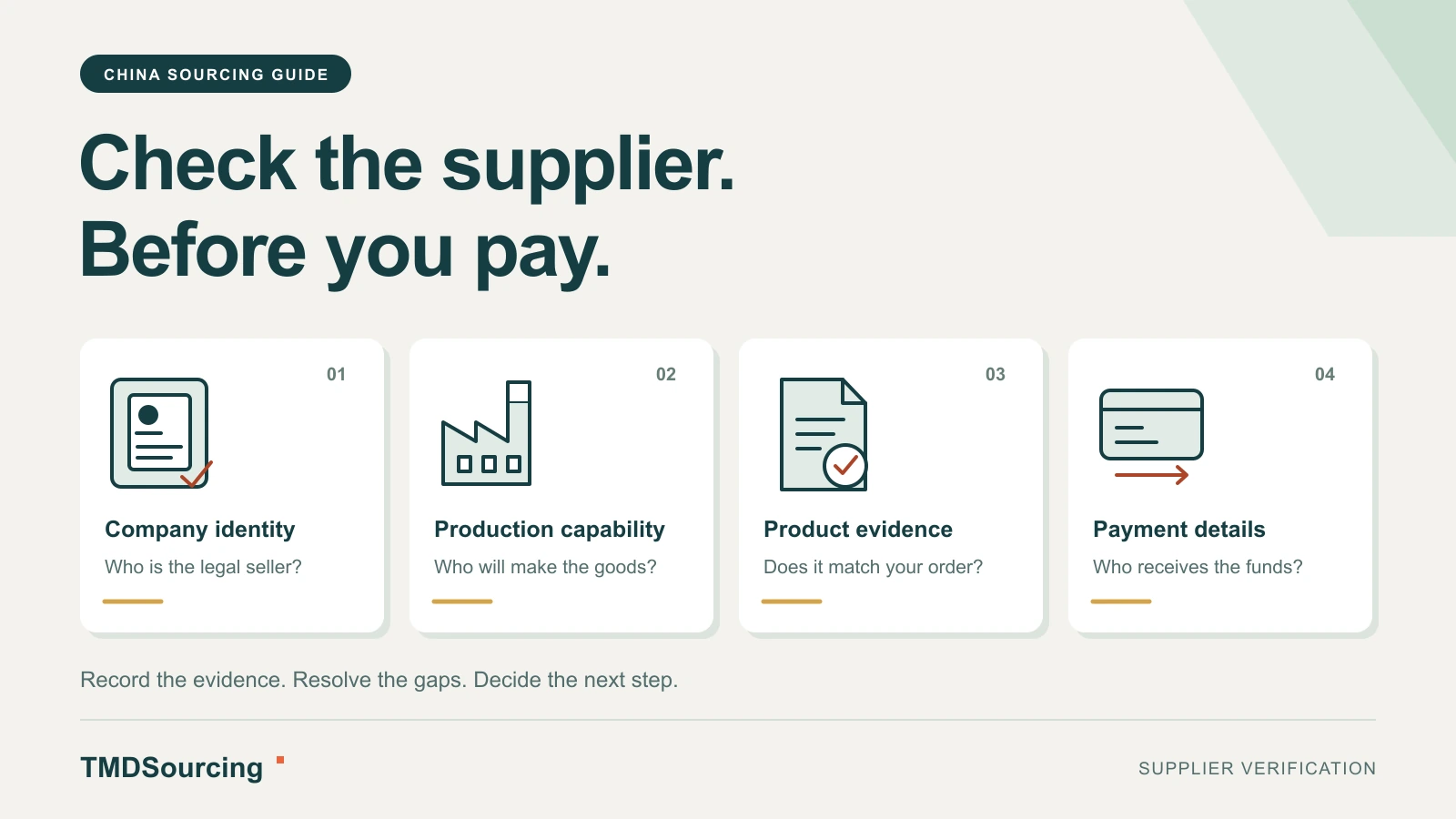
How do you verify a Chinese supplier before paying?
Check four things: who the registered seller is, who will make your goods, whether the evidence matches your product, and who will receive your payment. Request the supplier’s Chinese business name and licence, cross-check the registration, map any separate factory or exporter, and review relevant capability and product records. Reconfirm payment instructions through an independently established contact channel. Record unresolved issues before approving a deposit.
A registered company, a platform badge and a good sample answer different questions. Use them together to decide the next step; none guarantees successful delivery.
Supplier verification and product inspection answer different questions
Start with the decision you need to make. Establishing that a company exists does not establish that it controls a factory, can meet your schedule or has made an acceptable production batch.
Choose the check that answers your question
| Check | Main question | Important limitation |
|---|---|---|
| Registration review | Which legal entity are we dealing with? | Does not establish production capability or future performance. |
| Factory capability review | Can this site perform the required work? | Scope and date matter; production may change. |
| Sample assessment | Does this identified sample meet the agreed specification? | Does not establish the quality of every production unit. |
| Batch inspection | What does the agreed inspection find in this batch? | Results depend on access, sampling and the inspection scope. |
| Compliance testing or assessment | Does the relevant product evidence address applicable requirements? | Must match the product and destination; separate technical work may be needed. |
A trading company can be a suitable supplier. The useful question is whether its role, factory arrangements and responsibilities are clear.
1. Request the supplier’s core records
Ask for the full registered Chinese company name, unified social credit code, clear business licence copy and the storefront or website you have been using. An English brand name alone may not identify the legal seller.
Also obtain a current quotation or pro forma invoice (PI), your specification version and the proposed production address. Identify the companies responsible for selling, manufacturing, exporting and receiving payment. Keep dated copies so later changes are visible.
Use this email as a starting point. Replace the brackets and tailor the evidence request to your product.
Subject: Company and order details for [PRODUCT / QUOTATION REFERENCE]

Hello [CONTACT],

Before we finalize this order, please help us confirm:
1. Your full registered Chinese company name, unified social credit code and a clear business licence copy.
2. Which company will sell/invoice, manufacture and export the goods, and the current production address. Please explain any separate entities or outsourced operations relevant to our product.
3. A current quotation or PI referring to [SPECIFICATION VERSION], quantity, packaging, currency, payment milestones and agreed delivery terms.
4. The beneficiary's legal name and its relationship to the seller if different. We will independently confirm payment instructions before approval; please notify us of any change in advance.
5. Relevant capability evidence and full certificates/test reports for the exact model/material/version and destination, including issuer and report references. Please identify anything not yet available.

Please list any exceptions rather than substituting documents for another product or company. We will agree any additional sample, site or product inspection work separately.

Thank you,
[BUYER / BUSINESS CONTACT]
Request business records relevant to the order, rather than personal identity documents. A complete-looking folder is only the starting point: the next task is to check what each document actually supports.
2. Cross-check the Chinese company registration
For a mainland Chinese company, start with the exact Chinese name and the 18-character unified social credit code. Preserve letters and leading characters. A Hong Kong company requires the relevant Hong Kong records; do not treat a mainland registration search as a check of that separate entity.
The State Administration for Market Regulation’s official query directory provides an entry to the National Enterprise Credit Information Publicity System. Compare the supplier’s licence with the current record you can access, and save the source and checking date.
Chinese fields worth recording
| Field | What to compare |
|---|---|
| 名称 / 企业名称 | Registered company name against the licence and seller named in the order. |
| 统一社会信用代码 | Exact code, including letters. |
| 登记状态 | Current registration status; investigate unfamiliar or concerning entries. |
| 住所 / 经营场所 | Registered address and its relationship to the stated office or production site. |
| 经营范围 | Recorded business activities and questions they raise about the proposed role. |
Review any visible abnormal-operation or serious-illegality information and seek an explanation where relevant. An unfamiliar status needs interpretation, not a guess. A large registered capital figure, long operating history or broad business scope does not prove that the company can fulfill your order.
If the system is inaccessible, record “not checked—access unavailable.” That is different from “no matching company found.” For a failed search, first recheck the exact name and code; if the identity remains unresolved, obtain appropriate independent assistance before relying on it.
3. Connect the seller, factory, exporter and payment beneficiary
Several companies may legitimately participate in one order. The problem is an unexplained relationship or an unclear obligation. Map the parties before assuming the name on a factory photograph is the company responsible for your purchase.
A simple order-party map
| Role | Record | Clarify |
|---|---|---|
| Seller | Legal name on the contract or PI. | Who owes the agreed goods and handles defects? |
| Manufacturer | Production operator and site address. | Which processes happen here, and which are subcontracted? |
| Exporter | Entity handling the export arrangement. | How does it relate to the seller and shipping documents? |
| Beneficiary | Legal account name in the payment instructions. | Why is this party authorized to receive payment for this order? |
A registered office and a production site can have different addresses. A seller may also use an export company or an affiliated payment recipient. Ask for documents supporting the relationship, the agreed payment arrangement and the allocation of obligations. Reconcile these with the order records and independent confirmation; a chat message saying “same group” is insufficient by itself.
An unfamiliar English spelling may be a translation issue, but do not silently correct it. Have the parties explain and reconcile the names. If the arrangement remains unclear, pause the affected approval.
For price, MOQ and delivery comparisons between otherwise suitable candidates, use our separate guide to comparing supplier quotations.
4. Test capability against your actual order
“We can make it” needs detail. Ask how the supplier will produce your particular material, finish, quantity and packaging by the required date. Identify the operations done in-house and the subcontracted steps, especially those that affect performance or consistency.
Useful questions include:
- Which equipment and processes are needed for this specification?
- Who purchases and checks the critical materials?
- What is the proposed production schedule, including existing commitments?
- Where are defects detected, recorded and corrected?
- Who approves a material, component or production-site change?
Request relevant evidence: a process explanation, current production information and records or examples that can be shared without exposing another customer’s confidential information. A photograph shows what is pictured; it does not establish ownership, current capacity or that your goods will be made there.
A live walkthrough can help connect the contact to a site and discuss specific operations. Agree the route and questions beforehand. It still leaves gaps that may require an independent site visit, technical review or capability assessment with an agreed scope.
Approve a traceable product sample against your specification and record any remaining changes. Then plan checks on the actual goods using a pre-shipment inspection checklist. Neither step is replaced by a registration match.
For Alibaba.com suppliers, download the assessment behind the badge. Alibaba’s Verified Supplier explanation describes third-party assessments of company profiles, capabilities and processes. Check the report’s date, entity, site and scope rather than treating the badge as approval of your order.
5. Check that certificates and reports match the product
Ask for complete documents, including attachments and the referenced product details. Review the holder, covered location, issuer, report or certificate number, standard, date and current status where applicable. Then compare the model, materials, components and version with your ordered specification.
A genuine report for a different fabric or electrical component may not support the version you intend to buy. Ask the supplier and, where necessary, the issuing body or a qualified technical specialist to explain the coverage. Do not assume a similar photograph establishes equivalence.
A quality-management certificate is not product approval. An ISO 9001 certificate concerns a management system within its stated scope; it does not certify every item or batch made by the holder. IAF CertSearch’s verification guidance explains certificate-number searches and status checks. Missing results can reflect database coverage or other restrictions, so ask the issuer rather than immediately calling a document forged. Access conditions and charges may apply.
Market requirements also differ. For example, the EU’s CE-marking guidance applies to covered product categories; CE is not a universal quality certificate. Determine the requirements for your actual product and destination, then establish the relevant documentation, testing and responsibilities.
If the evidence does not match, record the precise gap and the work needed to resolve it. A supplier’s assurance that “all our products have certificates” does not close that gap.
6. Reconfirm payment instructions independently
Before approving a transfer, reconcile the latest order or PI, payment milestone, amount, currency, beneficiary and account instructions. Check that the receiving party fits the documented arrangement. A legitimate seller can still have an email account compromised, so earlier identity checks do not authenticate a new payment request.
A new bank account or beneficiary is a reason to pause and recheck. Confirm the request using a previously established, independently verified contact route. Do not rely only on replying to the same email thread or calling the number supplied in the change message.
The FBI’s business email compromise guidance recommends independently checking payment requests and account changes. Keep a record of who confirmed the instructions, through which channel and when.
For a changed instruction:
- Hold the transfer and identify exactly what changed.
- Contact the established company representative independently.
- Obtain the revised written instructions and supporting explanation.
- Reconcile the beneficiary relationship and update the approval record before proceeding.
A smaller deposit or test transfer does not establish that an unexplained beneficiary is authorized. If you suspect an already-sent payment was diverted, contact your financial institution immediately and use the relevant reporting channels in your jurisdiction.
For an Alibaba.com order, review the current Trade Assurance conditions, what the specific order records and the required platform payment route. Do not assume an off-platform transfer has the same protection, or that a dispute will automatically produce a refund.
A worked example: one resolved issue does not clear the order
This is a fictional teaching example, not a TMDSourcing customer case or an actual company check. A buyer plans to order 500 textile storage bags to specification SPEC-R2. The seller is Mainland Supplier A, production is proposed at Site A1, and the PI requests payment to Hong Kong Affiliate B.
Assume the licence and a dated registry result consistently identify Supplier A. That supports the identity record. The operator of Site A1 still needs confirmation, and there is no documented explanation for B receiving payment. Separately, the supplied test report identifies Model-R1 with a different fabric.
Separate findings need separate actions
| Finding | Next action | What remains open? |
|---|---|---|
| A’s identity records match. | Record the source, date and matched details. | Factory arrangements, product evidence and payment authorization. |
| B’s relationship is unexplained. | Hold payment; obtain and independently reconcile the relationship and payment arrangement. | Authority to receive this order’s payment. |
| The report covers different fabric. | Clarify the product correspondence and obtain relevant technical evidence or testing. | Evidence for the ordered SPEC-R2 version. |
Now assume B’s relationship and instructions are adequately documented and independently reconciled. That may resolve the payment-structure question. It does not make the Model-R1 report apply to SPEC-R2, establish Site A1’s capability or approve the deposit.
The buyer records the remaining issues, the evidence required and the next permitted step. A high overall score should not cancel a material unresolved identity, payment or product issue.
Your China supplier verification checklist: deposit, balance and repeat orders
Keep a short decision record with each question, entity or product reference, supplied evidence, independent source, checking date, finding and limitation. Add an action owner, target date, status, next permitted step and approval. “Document received” and “claim supported” are different statuses.
Recheck what matters at the next payment stage
| Stage | Review before approval |
|---|---|
| Before the deposit | Seller identity, party relationships, capability, specification, relevant product evidence, payment instructions and unresolved exceptions. |
| Before the balance | Changes since approval, agreed inspection results, defect resolution, quantities, packing and the payment milestone. Reconfirm changed instructions. |
| Before a repeat order | Any change in entity, contact, account, factory, material, specification or destination; previous performance and time-sensitive evidence. |
Decide which unresolved items prevent the next approval and which require a separately agreed action. Do not let “urgent dispatch” silently replace the acceptance conditions you recorded earlier.
Copyable verification record fields
Question / claim:
Company or product reference:
Supplier document and date:
Independent source / method and checking date:
Supported finding:
Limitation / unresolved issue:
Status: not checked / open / supported within stated scope
Action owner and target date:
Next permitted step:
Approval by / date / conditions:
Chinese supplier verification FAQs
Is a Chinese business licence enough to trust a supplier?
No. It is a starting point for identifying a registered entity. Cross-check it and separately assess the production arrangements, product evidence and transaction. A matching registration does not guarantee acceptable goods or on-time delivery.
Is a trading company always a bad choice?
No. A trading company may coordinate suitable factories and export arrangements. Establish who makes the product, who is responsible for the sale and how quality and changes will be managed. Judge the documented arrangement and capability.
Does an Alibaba Verified Supplier badge replace my checks?
No. Read the underlying assessment for its entity, site, date and scope. Use it as relevant evidence alongside your order-specific checks, sample assessment and production inspection plan.
What if the bank beneficiary differs from the supplier?
Pause until the relationship and authorization for this order are documented and independently reconciled. An affiliate or exporter can be legitimate, but an unexplained mismatch should not be accepted simply because a salesperson requests it.
What if I cannot access the Chinese registry or find a certificate?
Record the limitation. Check the exact identifying details and try the relevant official source or issuer. Inaccessible records and missing database results are not proof of fraud; they also leave the claim unconfirmed.
When should I recheck a supplier I have used before?
Recheck material changes, including a new beneficiary, company, contact, factory or product version. Review the records relevant to each payment milestone. Previous successful orders are useful experience, but do not authenticate new instructions.