SOURCING GUIDES / ORDER PLANNING
Chinese New Year 2027 Factory Shutdown: An Importer’s Order Planning Guide
Confirm supplier dates, connect product and packaging milestones, and build a workable plan around your required arrival.
When is the Chinese New Year 2027 factory shutdown?
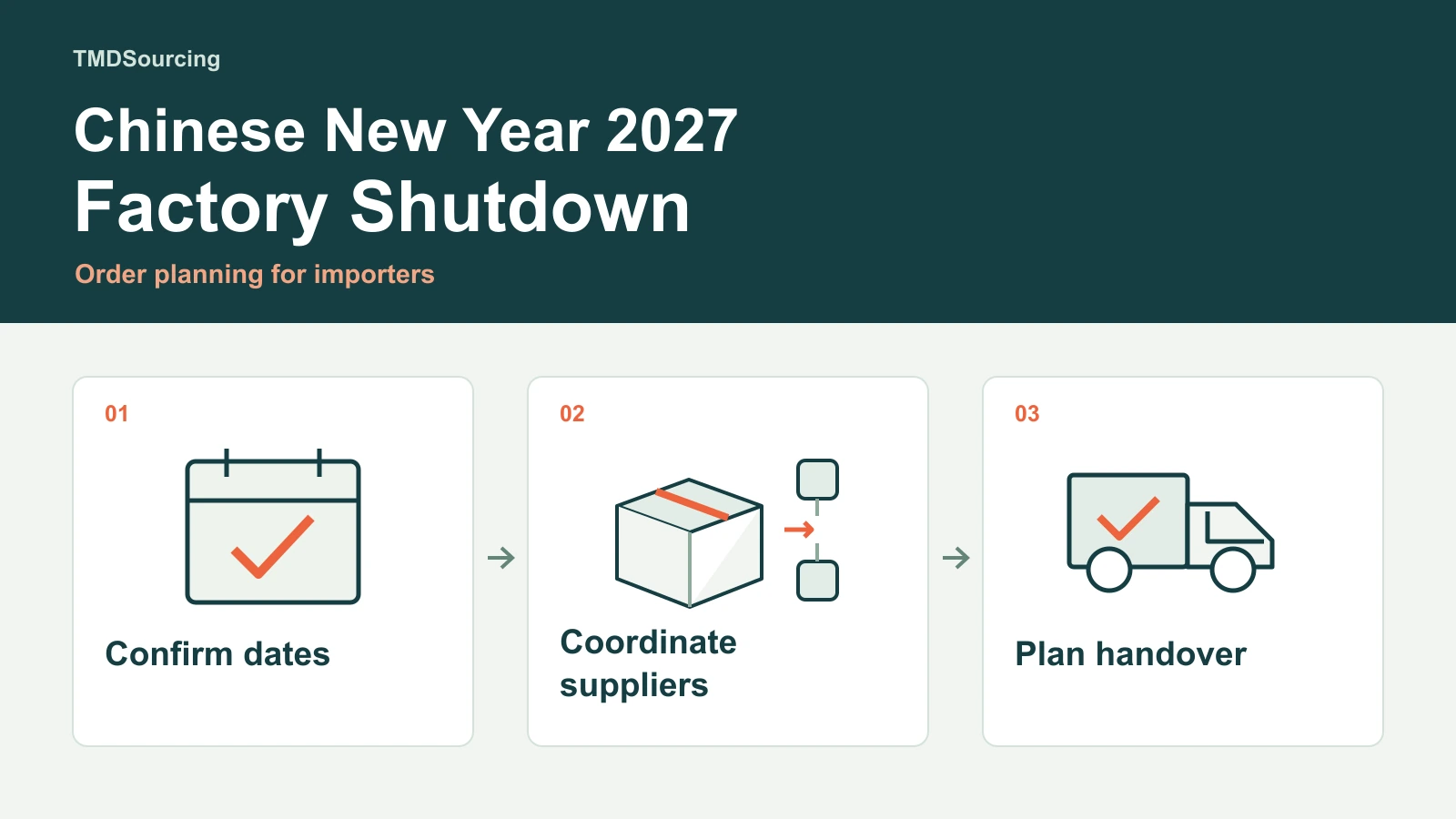
Chinese New Year falls on Saturday, February 6, 2027. Each factory sets its own production, closing and reopening schedule, so that festival date cannot tell you when your order will be ready. Confirm the dates for your product supplier, packaging partners, assembly site and logistics provider, then work backward from the day you need the goods.
This guide shows how to build that linked plan, keep estimates separate from confirmed dates and reassess the order when one component is late.
1. Separate the festival date from the factory calendar
The Hong Kong government’s official 2027 calendar confirms Lunar New Year’s Day as February 6. New Year’s Eve is February 5. These are calendar references; Hong Kong’s holiday arrangements do not establish mainland factory operating dates.
| Date or schedule | Current position | Use in your plan |
|---|---|---|
| Lunar New Year’s Eve | February 5, 2027 | Festival reference, not a universal last working day. |
| Lunar New Year’s Day | February 6, 2027 | Verified calendar date. |
| Mainland 2027 adjusted holiday schedule | Not independently verified at our November 3, 2026 check. | Recheck the current official annual notice. |
| Your factory and service partners | Confirm individually. | Record the actual production, receiving, inspection and dispatch dates. |
On a smaller screen, swipe the table sideways to read all columns.
The mainland statutory framework and the annual adjusted break are also different. An official government explanation confirms that Spring Festival statutory leave became four days from January 1, 2025: New Year’s Eve and the first three lunar days. That framework alone does not give the complete 2027 days-off and make-up-workday arrangement.
A supplier may have different dates for accepting work, finishing production, shipping completed goods and restarting a particular line. Ask for each relevant milestone rather than copying a general “China closes for X weeks” calendar.
2. Ask for dates that apply to your product and quantity
Give every partner the purchase order, SKU references, quantities, current specifications and required destination arrival. Ask whether the response covers this order or only the factory’s general holiday plan. An office answering messages does not establish that the relevant machines, materials or packing operation are available.
Check the production starting conditions. Does the quoted lead time begin after sample approval, final artwork, material availability or another agreed requirement? Record any missing condition before relying on a completion date. Our sample ordering and approval guide explains how to keep sample review and permission to produce separate.
A supplier message you can adapt
Subject: CNY 2027 dates for [PO / SKUs / quantities]

Please confirm for this order:
1. Open specifications, samples or materials, and the date
   from which your quoted lead time starts.
2. Last date to accept this work before the break.
3. Planned production finish, packed-ready date and last
   dispatch date; identify estimates and confirmed dates.
4. Packaging/component partners that could change the plan.
5. Inspection, correction and collection availability.
6. Closing date, restart of the relevant process and this
   order's expected place in the restart schedule.
7. Responsible contact and next date for reconfirmation.

Our required warehouse arrival is [date / destination].
Please list exceptions and available alternatives if the
current plan cannot meet it.
Send the relevant questions to the packaging supplier and receiving site too. For a branded set, finished products alone are insufficient if cartons or insert cards are missing. The custom packaging guide covers the specifications and sample approvals behind those components.
Keep one dated record. Use confirmed for a specific commitment with its source and scope, estimated for a working assumption, and pending where you still need an answer. A confirmed date remains subject to the stated conditions and should be revisited when an input changes.
A compact date record
PO / SKU / quantity / plan version:
Party and milestone:
Planned date / local cutoff time / timezone:
Status: Confirmed / Estimated / Pending
Source or written confirmation / last checked:
Duration: calendar or working days / starting conditions:
Depends on / open items:
Owner / next confirmation date:
Action if at risk / buyer decision / actual completion:
3. Work backward through the whole order
Start with the date inventory must be available at the buyer’s warehouse. Obtain a realistic transport plan covering the intended origin, destination and delivery scope. Then work back through origin handover, checks and possible corrections, packing, usable components and production approval.
Production completion, cargo-ready date, origin collection, departure, destination arrival and warehouse receipt are separate milestones. A shipping estimate that ends at a destination port cannot be used unchanged as a warehouse delivery allowance.
Worked example: 600 notebook gift sets
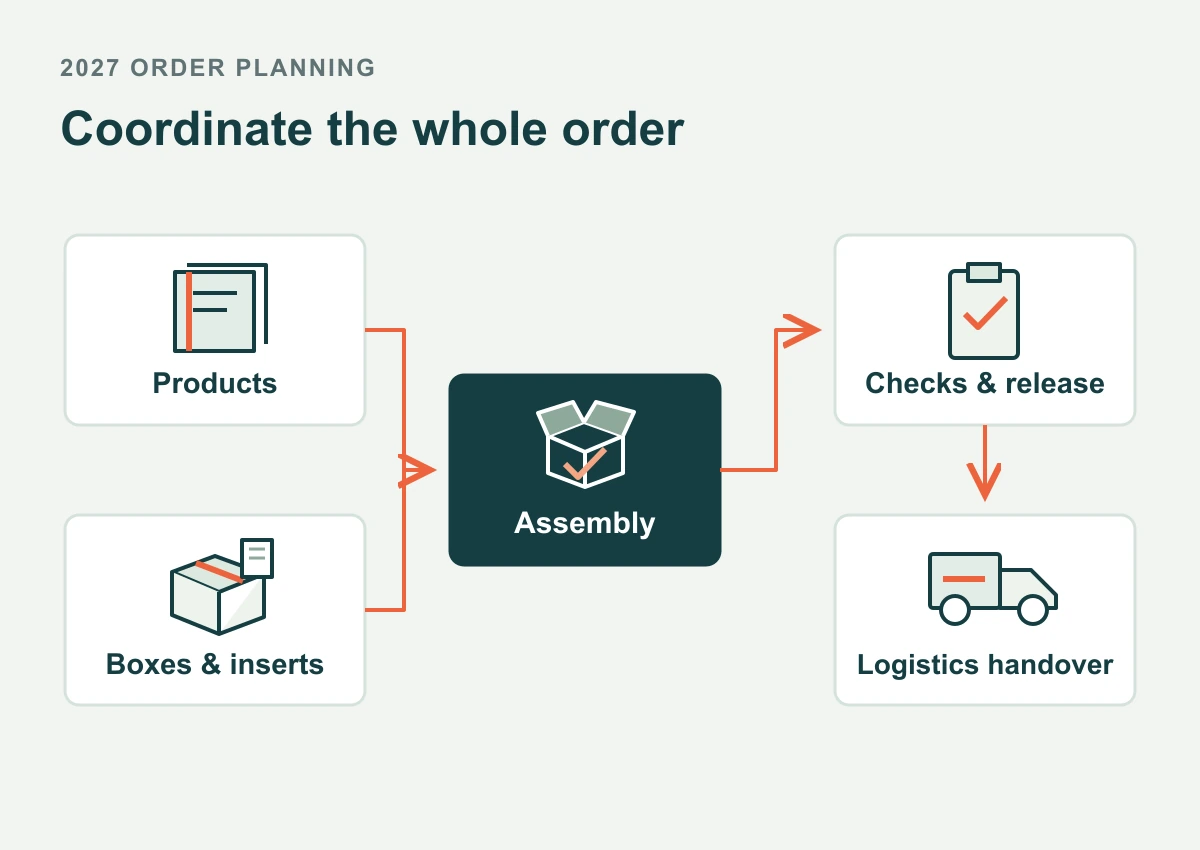
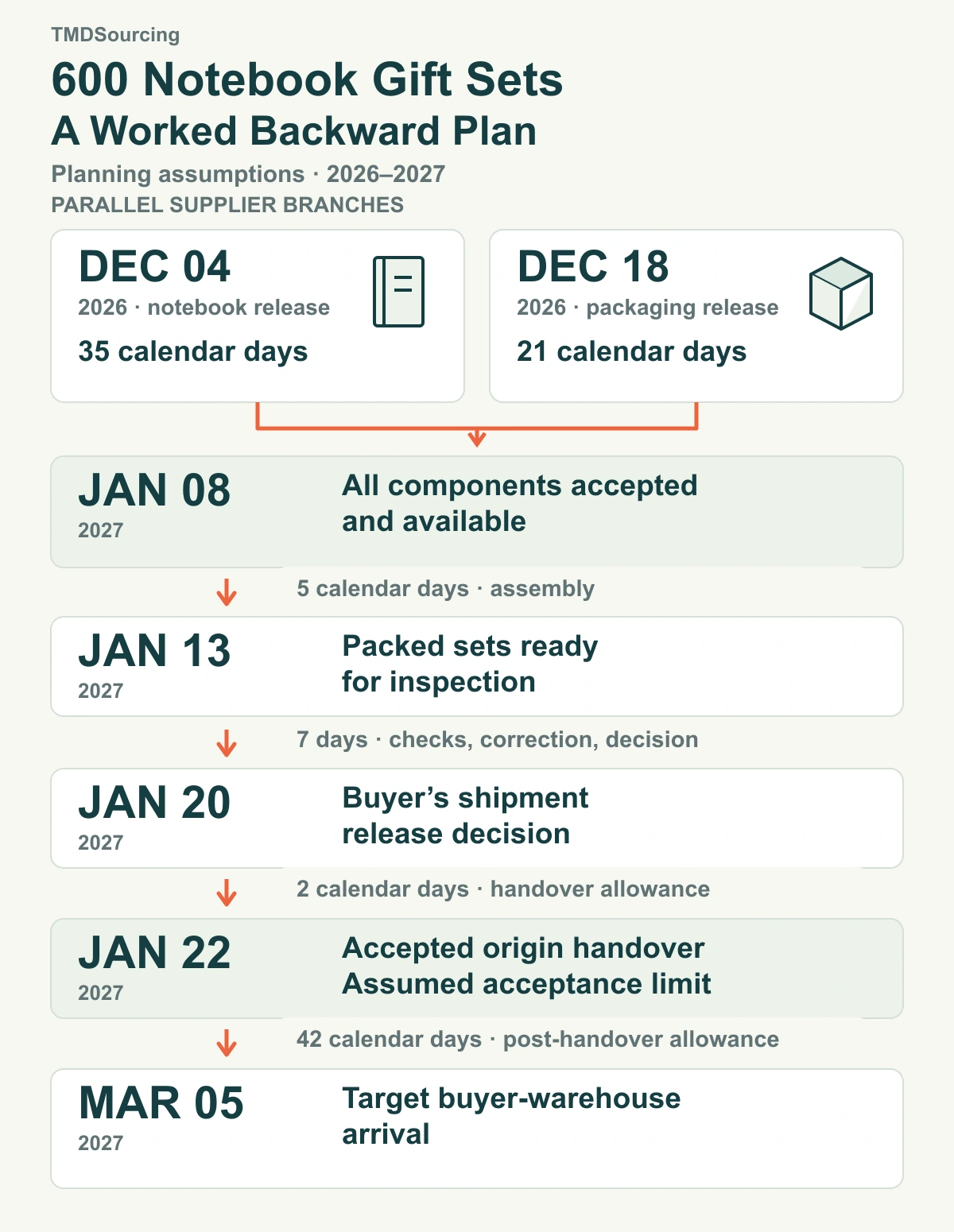
This is a fictional planning example, not a TMDSourcing customer order or a supplier commitment. Each sellable set needs one notebook, one printed carton and one insert card. All dates and durations below are teaching assumptions.
Suppose the buyer needs the goods on March 5, 2027. Assume 42 calendar days from accepted origin handover through transport, destination formalities and final delivery. Also assume the proposed logistics option accepts handover no later than January 22. Neither assumption is a route quotation or an actual booking.
| Milestone | Planned date | Assumed dependency |
|---|---|---|
| Release the notebook branch | December 4, 2026 | 35 days until usable notebooks are available at assembly. |
| Release cartons and insert cards | December 18, 2026 | 21 days until usable packaging is available at assembly. |
| All required components accepted and available | January 8, 2027 | Both supplier branches must meet this point. |
| Complete packed sets ready for inspection | January 13, 2027 | 5 days for the assumed assembly work. |
| Buyer’s shipment release decision | January 20, 2027 | 7-day window for checks, any correction/recheck and approval. |
| Accepted origin handover | January 22, 2027 | 2-day allowance after release; actual acceptance still needs confirmation. |
| Target buyer-warehouse arrival | March 5, 2027 | 42-day assumed post-handover allowance. |
On a smaller screen, swipe the schedule sideways to compare the dependencies.
The 35-day product branch and 21-day packaging branch run in parallel; do not add them together. Both intervals include their assumed supplier and transfer steps up to usable components at assembly. Development, artwork and relevant sample approvals must be completed before release, or their time must be added earlier.
The arithmetic uses differences between dates, not inclusive start/end counting. Calendar-day allowances include weekends; they do not mean every provider works daily. Replace them with actual operating calendars, starting conditions and appointments. Seven days is a reserved planning window, not a promise that every quality issue can be corrected in a week.
What changes if packaging is five days late?
Keep the notebooks at January 8, but move usable cartons and cards to January 13. Without reducing the remaining work, the plan becomes:
| Milestone | Baseline | Recalculated |
|---|---|---|
| All components usable | January 8 | January 13 |
| Packed sets ready for inspection | January 13 | January 18 |
| Buyer release decision | January 20 | January 25 |
| Origin handover | January 22 | January 27 |
| Arithmetic warehouse arrival | March 5 | March 10 |
On a smaller screen, swipe the comparison sideways to read both dates.
The revised handover misses the assumed January 22 limit. A January 27 transport option has not been established: obtain a new acceptance date, service and delivery plan before promising March 10. The calculation identifies the conflict; it does not create capacity.
4. Choose the next step for your order stage
If production is already running
Ask what is actually complete for each SKU, what remains and what evidence supports the packed-ready date. Check packaging, accessories, assembly and open quality issues alongside the product itself. A production percentage alone does not establish that goods can be released or collected.
Compare those dates with the receiving site’s, inspector’s and logistics provider’s availability. Flag the branch most likely to hold up complete sellable units, assign an owner and set the next confirmation date.
If you have not ordered or approved samples
Put specification decisions, sample revisions and materials ahead of the proposed production start. Ask whether the relevant line accepts this product and quantity within the required window. Payment acceptance by itself does not prove a reserved production slot.
Assess a supported pre-break plan alongside a realistic post-restart plan. A simpler configuration may help only if the supplier can deliver it and the buyer approves its product, packaging and market requirements. Avoid changing factories simply to obtain a faster unverified promise.
If a critical date is missed
First identify the affected quantity and the next feasible milestone. In the notebook example, three options deserve separate checks:
- Rebook the complete order. Obtain revised component, assembly and logistics dates, plus the full cost and inventory consequences.
- Assess an approved first batch. Shipping 400 complete sets first is an option only if 400 usable cartons and cards can actually meet the earlier schedule, the goods pass the agreed checks and the buyer can sell them independently. It cannot be inferred from all packaging being late.
- Review alternative packaging. Confirm availability and reapprove affected fit, protection, artwork, labels and assembly. Include review time; substitution does not automatically restore the original date.
Compare extra handling, separate freight, destination charges, storage and the effect of later stock. Keep the required checks in the plan. Our supplier consolidation guide covers the receiving and split-shipment decisions in more detail.
5. Confirm checks, cargo and document handovers separately
Book inspection around the actual state of the goods and agree what happens if findings need correction. Reserve time for the responsible supplier’s work, evidence, possible recheck and the buyer’s decision. A rushed dispatch does not resolve an open defect or missing component. Use our pre-shipment inspection checklist to define coverage.
Ask logistics partners to identify the milestone they need. Under Maersk’s LCL terms, the applicable service can require delivery to the origin warehouse by a stated cutoff or readiness for the confirmed pickup date. Those are shipment instructions, not one universal deadline for every China order.
For container shipments where verified gross mass applies, Maersk’s VGM guidance also distinguishes cargo and VGM deadlines in the booking confirmation. This is standing operational guidance, not a 2027 sailing announcement.
Confirm local cutoff time, timezone, appointments, required documents and who supplies them. Reconfirm the selected service if cargo readiness changes. An operating terminal alone does not establish trucking, warehouse, documentation or space availability for your shipment.
6. Confirm readiness for your order after the holiday
Ask about the relevant process and order, rather than accepting “we are open” as a completion update. Confirm whether materials and packaging are available, which operations are working and where your order sits in the production schedule. An assembly factory can be ready while a required component partner remains unavailable.
Resend the current specification, approved references and unresolved issue list. Request an updated production milestone, planned inspection-ready quantity and packed-ready date. For a paused order, establish what was completed before closure, how it was stored and which checks are needed before continuing.
Agree the inspection scope for resumed production according to the product, previous findings and remaining work. Do not substitute a general claim about holiday defect rates for an actual check. Update the logistics plan once the revised readiness is supported.
Keep the earlier plan and record what changed, who confirmed it and which buyer decisions followed. That record helps with the next reorder and the next holiday cycle. Our supplier management service connects communication, production follow-up, quality arrangements and shipment coordination around the project.
Chinese New Year 2027 factory shutdown FAQs
When is Chinese New Year in 2027?
Lunar New Year’s Day is Saturday, February 6, 2027; New Year’s Eve is February 5. Keep those dates separate from the current mainland adjusted holiday schedule and each supplier’s operating calendar.
When do Chinese factories close and reopen?
Confirm dates with each factory and relevant partner. Ask separately about the last production day, dispatch availability, restart of the required process and this order’s expected readiness. A general office reopening date cannot answer all four questions.
How long does the factory shutdown last?
There is no single operating window to apply to every order. Your plan may be affected before closure or during the restart. Measure the usable schedule from the supplier’s confirmed milestones, component availability and logistics requirements.
When should I place my 2027 order?
Work backward from required warehouse arrival using the actual service, component branches, assembly, checks and approval steps. Include sample development before production where needed. The example dates in this guide demonstrate arithmetic, not recommended cutoff dates for your order.
Can I place orders or request samples during the holiday?
You may be able to send an enquiry or approve information while production is unavailable. Ask what work the supplier can actually perform, when the relevant sample process resumes and how the request enters its queue. A reply is not proof of production availability.
Do Chinese ports and shipping services close?
Check the specific terminal, carrier, warehouse, trucking and documentation arrangements. Do not assume they all follow a factory’s dates. Confirm the booking, cargo acceptance and applicable cutoffs for the intended shipment.
What if packaging is later than the product?
Recalculate assembly, checks and handover from when the required packaging is usable. Assess a later complete shipment, a confirmed complete first batch or an approved alternative. Finished products without required packaging are not automatically ready-to-sell units.
What should I confirm after the factory reopens?
Confirm materials, the relevant process, order priority, current specifications, inspection readiness and the revised packed-ready date. Then reconfirm logistics. Keep the source, owner and date of each update in the order record.
Need help coordinating your order timeline?
Send TMDSourcing your product references, quantities, current order stage, destination and required arrival date. Include supplier dates already confirmed and any pending packaging, samples or checks, so we can discuss the next steps with you.