SOURCING GUIDES / PACKAGING & CARTON MARKS
Shipping Marks: Carton Examples, Templates and a Buyer’s Approval Checklist
Prepare clear carton instructions, review a physical proof, and keep marks accurate when packing details change.
What are shipping marks?
Shipping marks are the agreed text, numbers and references placed on transport packages to identify an order and its cartons. A practical carton mark often includes a buyer reference, purchase order, destination and carton number. Extra details depend on the shipment and receiving instructions.
When a supplier asks you to “send shipping marks,” send a written layout and a carton-by-carton information list. Confirm which other labels are needed separately, then approve a proof showing the information on the actual packed carton.
Shipping marks are not the same as every label on a carton
Carton shipping marks help a factory, consolidator, forwarder or warehouse recognize your goods. They also help connect a physical package with the relevant packing-list entry. Their layout is agreed for the project; there is no single universal shipping mark template that satisfies every destination, product and delivery channel.
“Main mark” usually means the principal identification block. “Side mark” commonly refers to additional information such as SKU, quantity, weight or dimensions. These are useful working terms, not instructions that every shipment must use the same faces or field arrangement.
| Information or label | Its job | What to confirm |
|---|---|---|
| Ordinary shipping mark | Identifies the buyer, order and carton. | Agreed references, numbering and receiving instructions. |
| Origin or product marking | Addresses applicable origin and product requirements. | Rules for the product and destination; an outer carton mark may not be enough. |
| SKU, GTIN or GS1 label | Identifies stock, trade items or a logistic unit. | The correct identifier and label system; these are not interchangeable. |
| Carrier, warehouse or FBA label | Routes or receives the specific shipment or box. | Instructions from the actual carrier or receiving program. |
| Handling or dangerous-goods marking | Communicates handling needs or regulated transport information. | Product and transport requirements, beyond ordinary order identification. |
For example, the GS1 Logistic Label Guideline distinguishes a logistic unit identified by an SSCC from a trade item identified by a GTIN. This does not mean every export carton needs an SSCC.
Likewise, ISO 780 concerns graphical symbols for handling and storage of packages; its scope excludes dangerous-goods-specific instructions. Do not select hazard labels from a general carton-mark example.
What should you put in a shipping mark template?
Start with the receiver’s instructions, not a mark copied from another importer. Agree a compact identification block, then add only the supplementary fields the project needs. Decide whether a reference represents one purchase order, several consolidated orders or a particular delivery.
| Field | Where the information comes from | What needs checking |
|---|---|---|
| Buyer or consignee reference | Buyer and receiving instructions. | Use the agreed identifier; a short mark is not a substitute for a full delivery address. |
| PO or shipment reference | The confirmed order or consolidation plan. | Which orders and carton group it covers. |
| Destination | Confirmed shipping and receiving instructions. | Use the agreed location; do not guess from the buyer’s billing address. |
| Carton number and total | Final packing allocation. | Unique carton references and a current total within the agreed numbering group. |
| SKU and quantity, if requested | Verified contents for each carton. | Pieces versus sets, mixed contents and partial cartons. |
| Weight and dimensions, if requested | Actual packed measurements. | Units, net versus gross weight, and which carton a measurement describes. |
Before packing is final, label figures as estimates in your working records. Do not turn an estimated carton size into an approved measured value simply by printing it. If dimensions are shown, specify the agreed order, such as length × width × height, and units.
A supplier instruction you can adapt
Order / carton group: [reference]
Receiver instructions: [attach current version]
Main block: [buyer reference / PO / destination / carton x of y]
Additional fields: [SKU / quantity / weight / dimensions, if requested]
Placement and method: [agreed faces, print or label]
Other labels: [handled separately under attached instructions]
Proof required: layout + photos of packed cartons
Version / date: [reference]
Approved by: [name and role]
Pending items: [list before approval]
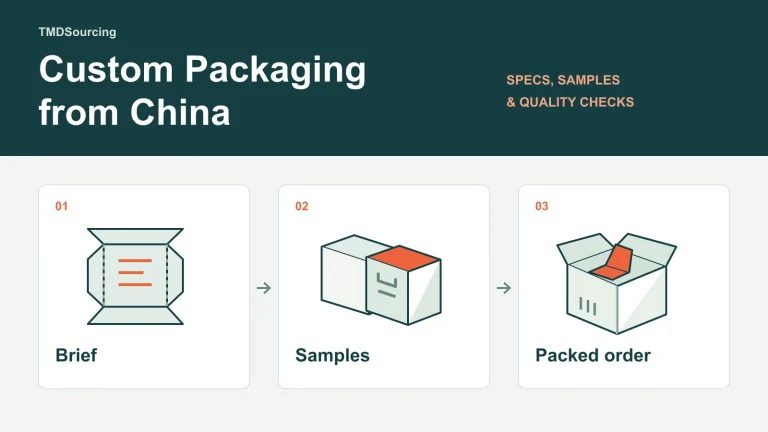
Specify legibility, placement and how the mark will be applied. A paper proof cannot show whether text will disappear under strapping or a label will lift from the carton. For box construction, artwork and samples, use the broader custom packaging from China guide.
Shipping marks on cartons: a filled example
The following teaching example uses a fictional buyer, order and packing figures. Suppose PO DEMO-S001 contains 240 navy pencil cases, SKU PC-NV, packed in 12 cartons of 20 pieces each. The agreed destination reference is Melbourne.
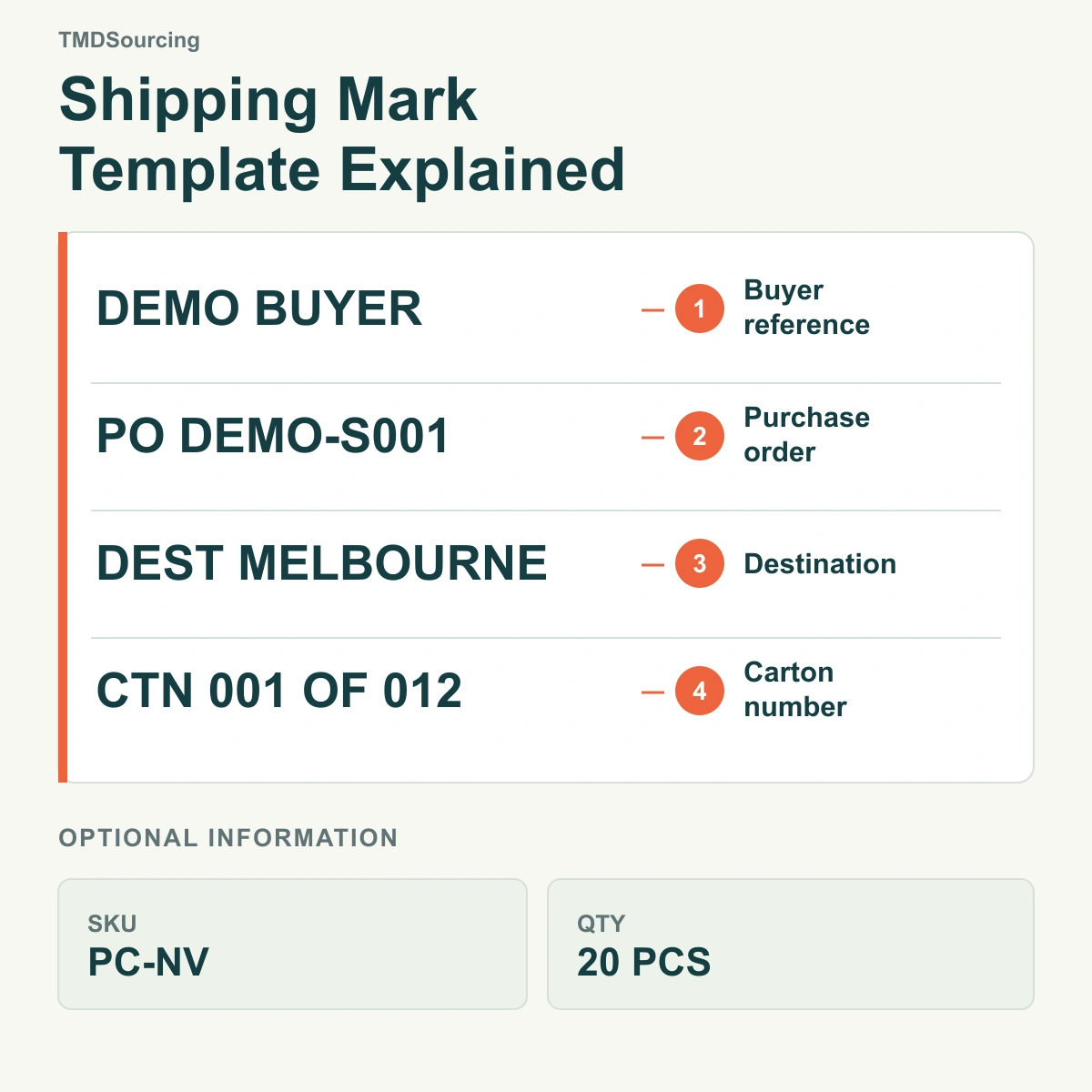
Main identification block
DEMO BUYER
PO DEMO-S001
DEST MELBOURNE
CTN 001 OF 012
Additional information
SKU PC-NV
QTY 20 PCS
N.W. 2.00 KG
G.W. 2.40 KG
DIMS 40 x 30 x 20 CM
The quantity is 20 pieces in this carton, not 240 pieces across the order. Net weight means the goods; gross weight includes packaging. The weights and dimensions here are illustrative assumptions, not a packaging specification or freight quote. An actual order needs its own packed measurements.
A matching packing-list line could read: cartons 001–012 / PC-NV / 20 pieces per carton / 240 pieces total, with the relevant weights and dimensions. Use a consistent mapping between cartons and records; do not copy every field into every transport document without checking that document’s instructions.
For a mixed-SKU carton, “QTY 20 PCS” alone does not tell the receiver what is inside. If it contains 10 navy and 10 sand pencil cases, record both SKU quantities against its carton reference. Agree whether that breakdown is printed on the box, provided through a separate contents label, or supported by the receiving records. See our China order consolidation guide for the wider receiving and traceability process.
What changes when 12 cartons become 13?
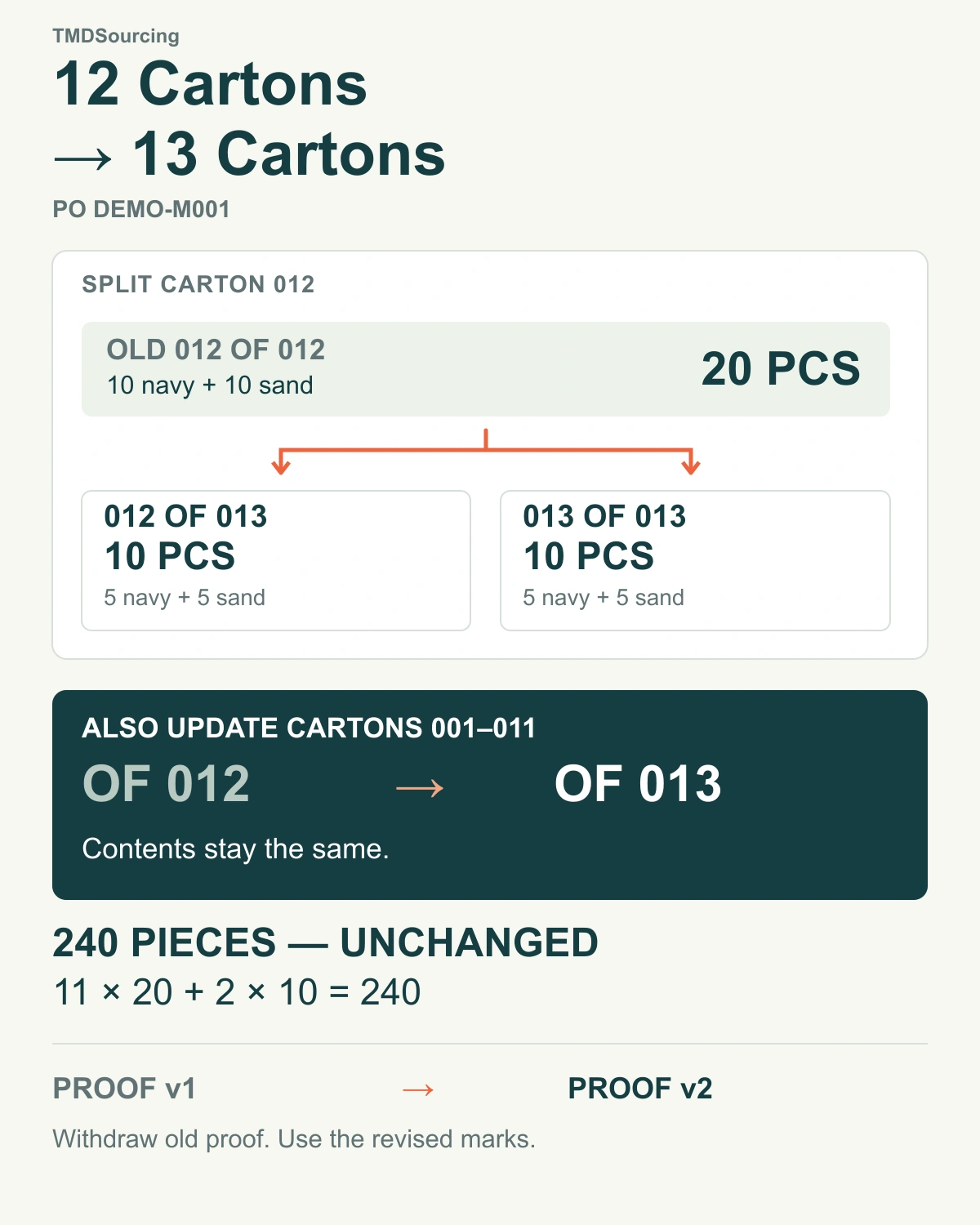
A correct-looking mark can become wrong after repacking. Consider a separate fictional order, PO DEMO-M001: 120 navy and 120 sand pencil cases, initially packed into 12 cartons. Each carton holds 10 of each color, or 20 pieces.
After packing, carton 012 is split into two smaller cartons. Cartons 001–011 still contain 20 pieces each. New cartons 012 and 013 contain five navy and five sand pieces each, or 10 pieces per carton. The order still contains 240 pieces.
| Affected group | Before | Corrected version |
|---|---|---|
| Cartons 001–011 | CTN 001–011 OF 012; 10 navy + 10 sand each. | CTN 001–011 OF 013; contents unchanged. |
| Old carton 012 | CTN 012 OF 012; 20 pieces. | Old mark withdrawn from use after the split. |
| New cartons 012–013 | Not present in the original proof. | CTN 012 OF 013 and CTN 013 OF 013; 5 navy + 5 sand, 10 pieces each. |
| Packing list and proof | 12-carton allocation; mark proof v1. | 13-carton allocation; proof v2; new packed measurements where affected. |
Changing only the two new boxes is insufficient for this agreed “x of y” format. The denominator on cartons 001–011 also changes from “OF 012” to “OF 013.” Any quantity, weight or dimensions printed on the split cartons must reflect their new packing. If only some cartons change size, do not overwrite measurements for the entire order with one new figure.
Reconcile the contents: 11 × 20 + 2 × 10 = 240 pieces. By SKU, 11 × 10 + 2 × 5 = 120 pieces of each color. The carton total increases; the product quantity does not. Gross weight can change because the packaging changes, so remeasure rather than assuming the old shipment total remains correct.
Close the revision before using the new marks
- Identify the change. Record the affected order, carton numbers, contents and reason for repacking.
- Replace the working version. Issue mark proof v2 and the revised packing allocation. Keep v1 in the history, clearly superseded, so staff stop printing or applying it.
- Check physical corrections. Request evidence covering the changed totals on cartons 001–011 and the new marks and contents records for cartons 012–013.
- Record a named decision. The authorized buyer or project lead confirms what was checked, what remains open and whether the relevant marking step may proceed.
If another label uses unique package identifiers, follow that label system’s rules as well. Do not assume editing the ordinary carton number automatically updates a carrier, warehouse or GS1 identifier.
A buyer’s checklist for approving carton marks
Review both the information and its physical application. Choose evidence coverage appropriate to the variation: a photo of carton 001 cannot demonstrate that every mixed carton has the correct contents.
- Confirm the current instructions. Identify the buyer’s proof version and any separate receiving or carrier instructions.
- Match the order. Check buyer reference, PO, destination and the numbering group against the approved packing allocation.
- Reconcile the cartons. Check sequence, total, mixed contents and partial cartons; investigate duplicates or missing references.
- Check printed measurements. Confirm requested units and actual packed values, especially after a split or repack.
- Inspect placement and readability. Ask for a whole-carton view and a readable close-up. Check seams, strapping, wrapping and nearby labels.
- Check the applied label. Confirm it is attached securely, is not obscured and does not leave conflicting obsolete routing information visible.
- Record coverage and approval. Save the proof, photos or inspection record, unresolved items and the approver’s decision together.
Follow the actual carrier’s label instructions. For instance, FedEx’s public package-label guide calls for a flat, visible label, avoiding edges and tape over labels or barcodes, and removing old shipping labels. Those are carrier-label instructions, not a universal rule that every export mark belongs on the same face. Do not remove other valid product, origin or receiving labels indiscriminately.
If barcodes are required, separate visual placement checks, data checks and any required technical barcode verification. A successful phone scan alone is not formal verification of print quality.
Mark approval also has a limited scope. It does not certify the goods inside, establish origin, prove product compliance or release the entire shipment. Keep broader findings and release decisions in the pre-shipment inspection process.
Shipping marks FAQs
What should I send when a Chinese supplier asks for shipping marks?
Send the agreed text layout, order reference, carton allocation, destination reference and receiver instructions. State which fields are final, identify pending measurements, and request a proof plus physical-carton photos before approving application.
What is the difference between main marks and side marks?
Main marks commonly carry principal identification; side marks carry supplementary details. Agree the information and placement for your project. The terms do not establish a universal requirement to print on two or four faces.
Are shipping marks the same as a shipping label?
Ordinary marks identify the order and carton. A carrier shipping label routes a particular package and may include tracking information. Both may be needed; one should not be assumed to replace the other.
Can mixed-SKU cartons use the same shipping mark?
They can share an order reference, but each carton needs its agreed identity and an accurate contents mapping. A common total quantity does not explain which SKUs are inside a particular box.
What if the carton count changes after printing?
Update every affected reference, including the total on unchanged cartons if the format uses “x of y.” Reconcile the packing list, correct physical marks, withdraw the old working proof and record the approval of the revision.
Can shipping marks be handwritten?
Confirm the method with the receiver and logistics provider. Handwriting may be acceptable in some arrangements, but readability, durability and consistency still matter. It does not replace required machine-readable or program-specific labels.
Do carton marks replace FBA labels or country-of-origin marking?
No automatic substitution applies. Follow the receiving program and applicable product and destination rules separately. For example, U.S. origin-marking rules have their own requirements and qualifications; an origin statement on an outer carton is not a universal solution.
Does a photo or barcode scan confirm the whole order?
No. A photo shows the packages and details within its coverage. A scan checks particular encoded data under particular conditions. Neither alone proves every carton’s contents, the full shipment quantity or compliance with all receiving requirements.