SOURCING GUIDES / BUYING OPTIONS
Alibaba vs Sourcing Agent: Which Makes Sense for a Small Order?
Compare the work, the fees and the responsibilities before deciding how much sourcing help your order needs.
Alibaba or a sourcing agent: which should you choose?
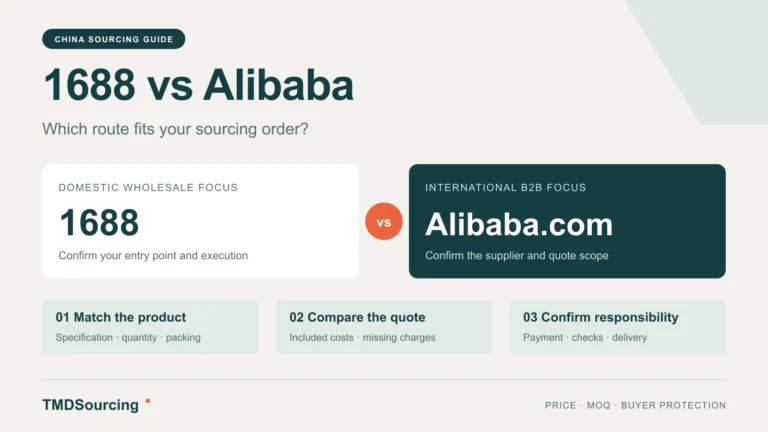
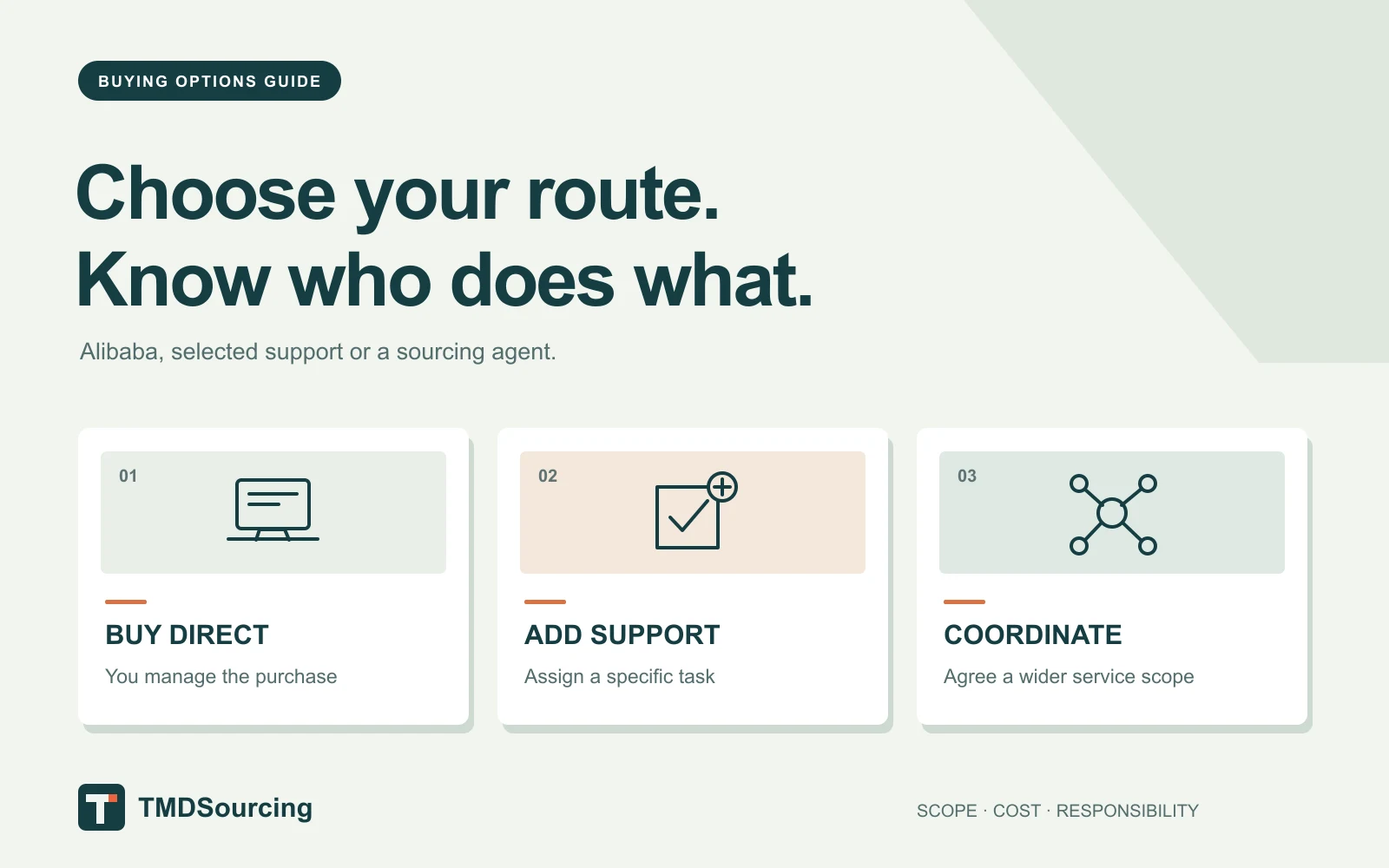
Buy directly when you can manage the supplier, specification and order yourself. Use an agent when you need someone to coordinate defined purchasing tasks. If only one task is missing, compare a quote for that support first. Alibaba vs sourcing agent is not a simple choice between two supplier lists: Alibaba.com is a marketplace, while an agent provides a service whose scope must be agreed. An agent may also work with a supplier you found on Alibaba.
1. Compare three ways to manage the same purchase
Start with the work your order requires: finding suppliers, comparing quotes, approving samples, following production, checking goods and arranging delivery. Then decide who will do each task. A product listing, a service percentage and a freight quote describe different parts of the purchase.
The table below compares ways to organize that work. It does not promise that every agent includes every service, or that buying directly means you cannot hire an inspector or freight provider.
Who manages what? Confirm the exact scope before paying.
| Task | Alibaba, buyer-managed | Direct buying + selected support | Agent-coordinated purchase |
|---|---|---|---|
| Supplier search and comparison | You shortlist and assess offers. | You keep the search, unless separately assigned. | The agent researches and compares within the agreed brief. |
| Specifications and sample approval | You communicate requirements and decide. | A provider can help with an agreed check; you approve. | The agent can coordinate samples and records; you approve. |
| Production follow-up | You track milestones and changes. | Only included if you purchase that support. | Updates and escalation follow the service agreement. |
| Inspection and shipping | You arrange or buy these services. | Named providers handle their contracted tasks. | The agent can coordinate them; scope and charges need confirmation. |
| Approvals and exceptions | You manage each decision. | You connect the supplier and service providers. | Agree what the agent may do and what requires your approval. |
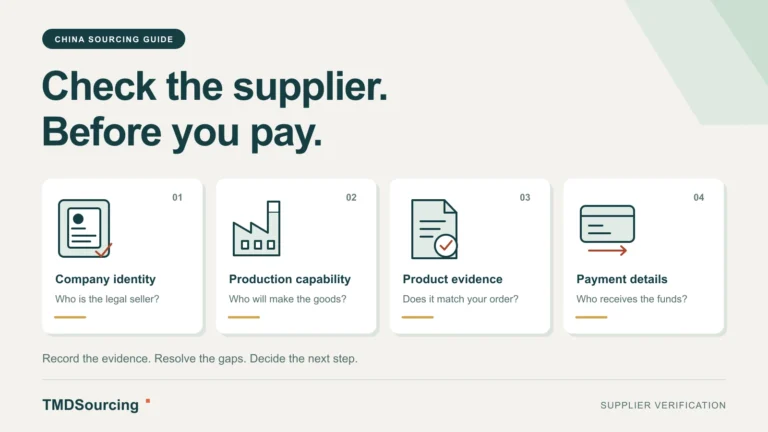
A sourcing agent is not automatically the manufacturer or the seller of the goods. Ask which company issues the product invoice, which company receives payment and whether the provider acts as an agent or resells the product. That affects the documents you receive and who handles a problem.
2. Choose the level of support your order needs
Buying directly can be reasonable
You have a clear specification, a manageable supplier shortlist and time to compare quotations, approve samples and follow up. A regular product from one responsive supplier can be suitable for this route. You still need a plan for quality checks and shipping; direct buying means you manage those decisions rather than paying someone to coordinate them.
Supplier identity and product suitability remain separate questions. A credible company can still quote the wrong material, size or packing. Use our supplier comparison guide to compare the same requirements across offers.
Selected support can fill a specific gap
Perhaps you are happy with your supplier but need a pre-shipment inspection, help clarifying packing dimensions or someone to follow up on a delayed production milestone. Ask for that task to be quoted with a clear deliverable. Paying for one inspection does not appoint the inspector to manage your supplier or negotiate every correction.
This route also requires a handover: provide the purchase order, approved specification, sample reference, supplier contact and deadline. Someone must connect the findings to the next decision. Our supplier management service describes the starting information needed for an existing order.
Broader coordination can be useful
Consider an agent when several purchasing tasks compete for your time, requirements need repeated clarification or changes must be tracked across sampling and production. Multiple suppliers add handovers and scheduling decisions, although a complex project needs its own scope and quote.
Order value alone does not determine the right route. A small customized order can take more coordination than a larger unchanged reorder. If the product or budget is still unclear, start with an initial discussion before commissioning paid work.
3. Compare costs for the same specification and delivery scope
There is no sound basis for assuming an agent always gets a lower product price. Ask both routes to quote the same material, quantity, color mix, packaging, sample requirements and destination. A cheaper quote for a different specification is a different offer.
Build the cash budget from these lines: product value, samples and development, service fees, inspections or testing, packaging, domestic transport, international freight, payment charges and applicable destination costs. Mark every missing amount “to be confirmed”. A blank inspection or freight line should not become zero in your comparison.
Keep your time separate from cash spending. Estimate the hours you expect to spend messaging suppliers, checking quote versions, arranging checks and resolving open questions. An agent may reduce coordination work, but you will still need to provide requirements and make approvals. Use your own realistic estimate; a generic claim of hours saved is not a quotation.
Illustrative comparison: the same product price
If both routes quote US$1,500 for the goods, a qualifying standard TMDSourcing project adds a US$120 sourcing fee. Compare the remaining services line by line before deciding whether the coordination is worth that amount. Do not invent a product-price saving to cancel out the fee, or assume either route includes free inspection and freight.
For the wider budget, see our small-order sourcing guide. If a lower unit price requires far more stock, also compare the total purchase commitment using our MOQ negotiation guide.
4. What does the service fee look like on a small order?
TMDSourcing’s published pricing, checked October 4, 2026, is 8% of product value, with a US$50 minimum for standard sourcing. A standard project is a clearly defined purchase of a regular product from one final supplier. The fee covers supplier sourcing, quotation comparison, sample communication, purchasing coordination and order follow-up for that scope.
The simple-repeat rate is 5%, with the same US$50 minimum, for unchanged products, suppliers and specifications previously managed by TMDSourcing. These are our service-fee examples, not market averages or complete delivered prices.
Fee = the percentage of product value or US$50, whichever is higher
| Product value | Standard sourcing: 8% | Eligible simple repeat: 5% |
|---|---|---|
| US$500 | US$50 minimum 8% calculation: US$40 | US$50 minimum 5% calculation: US$25 |
| US$1,500 | US$120 | US$75 |
| US$4,000 | US$320 | US$200 |
The US$50 minimum is not added on top of the percentage. At US$500 product value, the minimum makes the service fee equivalent to 10% of that value, which is worth considering for a very small purchase.
Samples, inspections, packaging, fulfillment, shipping and complex projects are quoted separately. Extensive customization or a multi-product, multi-supplier project should not automatically use the standard calculation. Having an existing Alibaba supplier also does not automatically qualify you for the repeat rate. Share the actual task so we can confirm the scope before any paid work begins.
5. Keep Trade Assurance and purchasing support separate
Alibaba’s official Trade Assurance overview describes starting an order with a supplier on Alibaba.com and paying through the platform. Its refund-policy page covers claims for issues such as orders not shipping, missing deliveries or product problems, with eligibility and time limits. Check the current conditions for your particular order rather than relying on a supplier badge or a general promise.
Record the specification, quantity, shipment timing and agreed requirements in the order documents. Keep sample approvals, messages and inspection evidence. Protection is easier to assess when the order clearly states what was supposed to be supplied.
If an agent participates, ask whose account places the order, who is named as buyer, where each payment goes and who would handle a claim. Do not assume a separate payment to a supplier or agent creates the same protection as your own eligible Alibaba order. Confirm the actual arrangement before paying.
Purchasing support and a platform claim process serve different purposes. Neither removes the need for clear specifications or checking goods. Use our sample request and approval guide to record what you expect, then agree the inspection scope for the production batch.
6. Ask an agent these questions before paid work begins
- What will you deliver? Ask for the tasks, reports, milestones and exclusions in writing. “Full service” alone does not define an inspection or a shipping arrangement.
- How are you paid? Clarify the fee basis, minimum, separate charges and whether any supplier-side payment or product markup applies. Ask what information will be visible in the quote.
- Who is the supplier relationship with? Confirm the legal seller, supplier contact access, invoice issuer, payment recipient and records you receive.
- Who performs the checks? Distinguish progress photos, warehouse counts, product inspections and laboratory tests. Agree the evidence and who approves the result.
- What needs my approval? Specify authority for samples, substitutions, additional charges, production release and shipment. Set an escalation contact for unresolved issues.
- What happens if the order changes or stops? Clarify work already charged, unused funds, sample or tooling arrangements and the handover of project records.
These are questions to resolve with any provider, not promises that every arrangement has identical terms. Compare answers against the quote, not only against the provider’s marketing page.
7. Test the plan against a delay or failed check
Imagine the goods are due to ship, but an inspection finds the wrong packaging. Under direct buying, you obtain the evidence, discuss correction with the supplier and decide whether to proceed. With selected inspection support, the inspector reports findings; correcting the goods and approving a recheck need assigned owners. With an agent, follow-up may be coordinated under the agreed scope, but extra work and shipment release still need clear decisions.
Ask who contacts the factory, who records the correction, who quotes a recheck and who may authorize shipping. Do the same for a missed production date. This exercise exposes gaps that a percentage comparison misses.
For an order already in progress, share the latest purchase order, payment status, approved sample and unresolved questions. A new coordinator needs to understand existing commitments before proposing a recovery plan. Supplier cooperation, extra charges and revised timing must be confirmed.
8. Use a one-page buying-route checklist
Choose the route after filling in the gaps, not before. Copy this outline into your project notes or use it to request a like-for-like quote. You can start with a product link and rough quantity; mark details you do not yet know as pending.
BUYING-ROUTE COMPARISON

Product link / model:
Specification version / customization:
Quantity / product-value budget:
Destination / required date:
Supplier already selected? Name and current order status:

TASKS — assign an owner and a deliverable to each
Supplier search / comparison:
Specifications / sample coordination:
Sample approval:
Production follow-up / change records:
Inspection or testing:
Packing / shipping coordination:
Final shipment decision:

QUOTE COMPARISON — direct / selected support / agent
Product specification and quantity match:
Product value:
Service fee and minimum:
Samples / customization:
Inspection / testing:
Packaging / domestic transport:
International freight and delivery scope:
Payment charges / destination costs:
Missing costs to confirm:
My estimated coordination time:

PAYMENT AND EXCEPTIONS
Seller / invoice issuer / payment recipient:
Who places the order and handles any platform claim:
Evidence and approval needed before shipment:
Owner for delays, failed checks and additional costs:
Records retained if the project stops:

Preferred route and reason:
Questions to resolve before paid work begins:
Keep managing the order yourself if the work is clear and manageable. Request a specific service if one gap remains. Discuss broader coordination when several connected tasks need support. Review the choice again if the supplier, specification or order complexity changes.
Alibaba vs sourcing agent FAQs
Is a sourcing agent always cheaper than buying on Alibaba?
No. An agent adds a service fee and may or may not obtain a different product quotation. Compare the same goods, services and delivery scope. The value can be coordination and clearer follow-up rather than a lower invoice total.
Can I use a sourcing agent for a supplier I already found?
Yes, an existing supplier can be the starting point for a support discussion. TMDSourcing reviews the documents, order status and supplier access before confirming tasks. The scope and rate are quoted for the work required; an existing supplier is not automatically a qualifying simple repeat.
Can I pay for inspection or shipping support separately?
You can ask for a quote for the particular service you need. Confirm feasibility, deliverables, timing, access and charges before booking. A single service does not automatically cover supplier management or every other stage of the purchase.
Does a small order need a sourcing agent?
Not necessarily. Consider the product, your experience, available time and coordination needs. For a very small straightforward purchase, the minimum fee may outweigh the help you need. An initial discussion can clarify the options without committing you to paid work.