Guangzhou Wholesale Market Guide: Where to Source and How to Order
Find the right market for clothing, fabrics or bags, then compare stall quotes, confirm your size mix and get the goods to a warehouse in China.
What Are the Guangzhou Wholesale Markets?
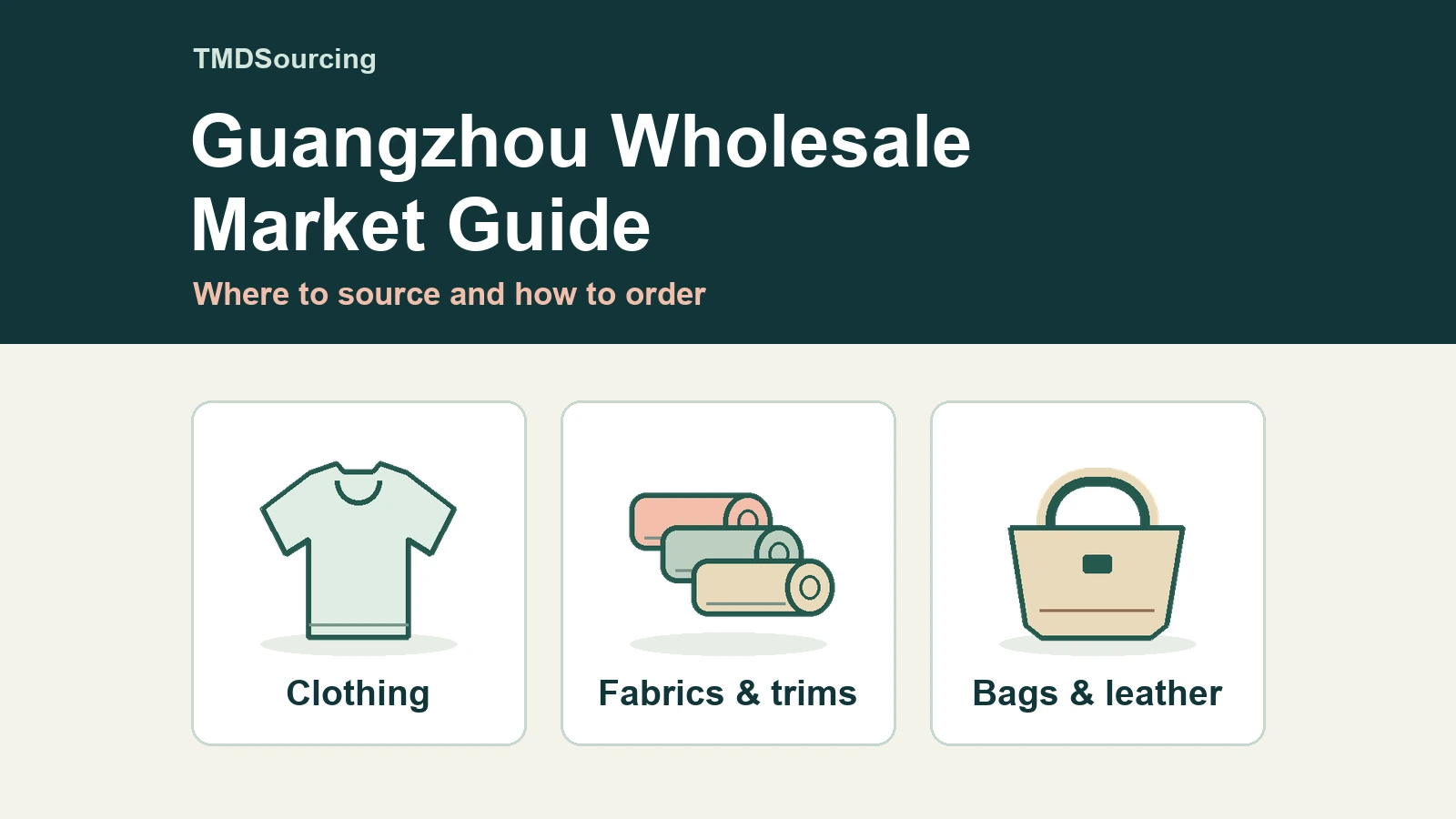
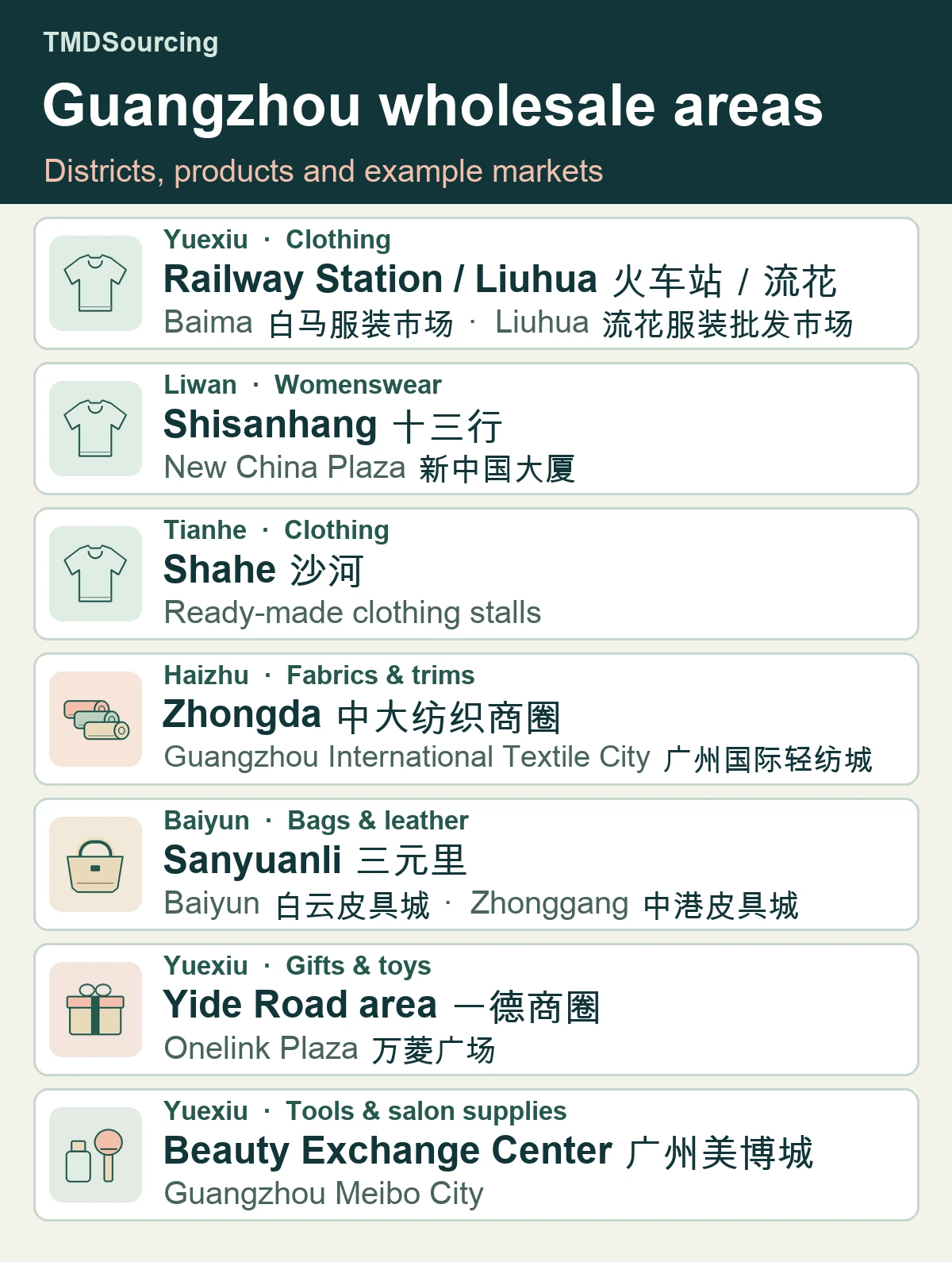
Guangzhou’s wholesale markets are grouped by product across several districts. For ready-made clothing, start with Baima and Liuhua near Guangzhou Railway Station, Shisanhang in Liwan or Shahe in Tianhe. For fabrics and trims, head to Zhongda in Haizhu. For bags and leather goods, try Sanyuanli in Baiyun. Pick the area that matches your product, then record the building, floor and stall for each quote.
If you’re visiting in person, bring a reference sample and use it to compare what sellers have on hand. If you’re buying remotely, send the same specifications and quantity list to each seller, then approve a sample before ordering where fit, material or finish matters. For either route, confirm the exact assortment and where the seller will deliver it.
Where to Buy Wholesale in Guangzhou by Product
A shopping area can contain several wholesale buildings. Save the Chinese name of the building you plan to visit, and confirm its hours and the stall’s location with the seller before you go. Guangzhou Bureau of Commerce’s market overview
Swipe or scroll to see the full table.
| What you’re buying | Area and market to look up | What to ask for |
|---|---|---|
| Ready-made clothing | Railway Station / Liuhua, Yuexiu. Try Baima Clothing Market 白马服装市场 or Liuhua Clothing Wholesale Market 流花服装批发市场. Yuexiu market listing | Style number, stock by color and size, and whether the quote is per piece or per pack. |
| Womenswear and ready-made clothing | Shisanhang 十三行, Liwan. Start at New China Plaza 新中国大厦, 1 Shisanhang Road. Shahe 沙河, Tianhe, is a separate clothing cluster. Liwan market guide · Tianhe market profile | Size chart, exact size mix available and whether the seller can supply the same version again. |
| Fabrics, trims and swatches | Zhongda Textile Business Circle 中大纺织商圈, Haizhu. Guangzhou International Textile City 广州国际轻纺城 is one market in the area. Haizhu textile market profile | Fabric code, composition, weight in GSM, usable width, dye lot and minimum per color in meters or rolls. |
| Bags and leather goods | Sanyuanli 三元里, Baiyun. Look up Baiyun Leather Goods City 白云皮具城 and Zhonggang Leather Goods City 中港皮具城. Sanyuanli market directory | Material, lining, dimensions, hardware finish and who can make or brand the approved version. |
| Gifts, toys and accessories | Yide Road area 一德商圈, Yuexiu. One option is Onelink Plaza 万菱广场, 39 Jiefang South Road. Yide market profile · Onelink address | Parts included, units per carton, packaging, and product identification for orders from several sellers. |
| Beauty tools and salon supplies | Guangzhou Beauty Exchange Center 广州美博城, Yuexiu. Yuexiu market profile | Exact model or sample and the documents available for your destination and intended use. |
Ready-made clothing
Take a reference garment or measurement chart for each style. A size M from one stall may measure differently from a size M from another. Ask the seller to measure the actual batch, and check whether you can buy the colors and sizes that fit your sales plan.
Fabrics and trims at Zhongda
Label each cutting with the seller’s fabric code and color before leaving the market. To match fabric for a production run, confirm how many meters are available from the same dye lot. Keep a swatch from that lot for comparison when the bulk material arrives.
Bags and leather goods in Sanyuanli
Compare the sample’s outside material, lining, stitching and hardware against what the seller will supply. For an own-brand run, clarify which product and packaging changes the seller quoted, and keep a sample or written specification that shows them.
When to Buy from a Stall and When to Work with a Factory
Decide what you need the supplier to deliver after the first order. An existing style for a one-time buy, a style you plan to reorder and a custom product each call for a different commitment.
- Ready stock. Ask the stall to count and reserve the colors and sizes you need. Check the sample against the batch available for sale, including measurement, material and labeling. Get a reservation deadline, a dispatch date and a written list of the quantities held for you.
- Repeat orders. Ask how the stall restocks the style and whether it can order the same specification again. Record the style number, measurements, fabric or material reference and color. Ask about the next batch’s minimum and lead time. If the trim, material or pattern changes, request a fresh sample for approval. See the China sample ordering guide.
- Custom production. For your own pattern, material, logo or packaging, confirm who will make the item, what changes they can handle and who will approve them. Ask for a quote against your specification, a pre-production sample process and minimums per style and color. Compare branding options in the private label vs white label guide.
A stall can introduce its workshop or arrange a production order. Get the company name that takes the order and the contact responsible for production and corrections. Then verify that party’s role before committing.
How to Source in Person or Remotely
Prepare one brief to send to every stall. Include a reference image, style or material requirements, quantity by variant, packaging, destination and target dispatch date. Give each style a short reference of your own. Use it to tie photographs, swatches and quotes back to the same line on your buying list.
At the market
Save the building name, floor and stall number alongside the contact and the seller’s legal or registered name. Ask for the supplier’s own style code. With permission, take a photo of the item and its tag together. Keep notes on any materials, colors or sizes you approved and any stock the seller has agreed to reserve.
When buying remotely
Ask for current photos or video of the quoted style, label and available stock. For apparel, get the actual measurements and ask which colors and sizes are ready. Confirm a physical sample when fit, fabric or finish matters, and identify the production or stock version the seller will supply. Verify who issues the order paperwork and who receives payment before placing the order. See how to verify a Chinese supplier.
Ask for quotes on the same terms
Have each seller use the same quantity, assortment, packaging and named delivery address in China. Ask whether the pricing unit is a piece, set, pack or carton. Request the number and mix of pieces in each pack, the minimum by style and by color, and separate lines for packaging and local delivery. Record stock availability, price validity and dispatch timing. If a minimum blocks your preferred mix, use these MOQ negotiation questions to ask about a different pack or a mixed order.
One 120-Piece Apparel Order, Two Stall Quotes
In this example, you want a single style in navy and ecru. Each color needs 20 small, 20 medium and 20 large, for 60 pieces per color and 120 in total. Both stalls quote against the same sample reference and requested warehouse address. These prices and pack sizes are illustrative. The merchandise subtotals exclude delivery to the warehouse.
| Order detail | Stall A | Stall B |
|---|---|---|
| Size mix per color | S 20 / M 20 / L 20 | S 24 / M 24 / L 12 |
| How it’s sold | Individual pieces | 12 packs per color, 5 pieces per pack (2 S / 2 M / 1 L) |
| Goods subtotal | 120 × ¥50 = ¥6,000 | 120 × ¥48 = ¥5,760 |
| Next step | Confirm reservation and restock terms | Ask for the exact size mix and its minimum |
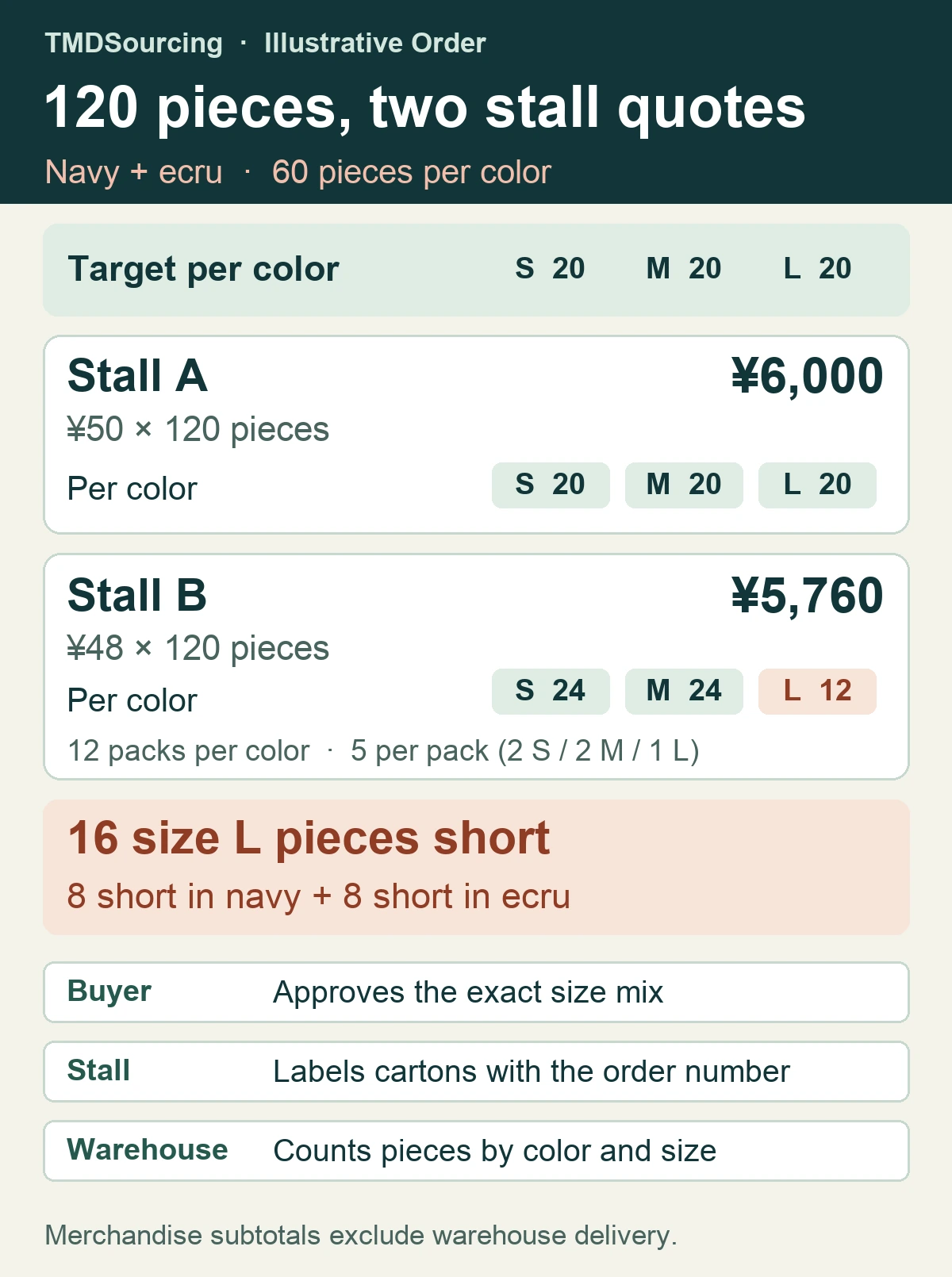
Stall B’s subtotal is ¥240 lower. Its packs leave you eight pieces short in L per color, or 16 pieces short in L overall. You would also receive eight extra S and eight extra M across the two colors. Stall A meets the requested size counts on paper. Ask it to reserve the batch and confirm that it matches the approved sample.
Ask Stall B whether it can quote 20 pieces per size and color and specify the minimum for that mix. Compare the revised merchandise price, the local delivery fee to the same warehouse and the confirmed dispatch date. If the mix is unavailable, approve any quantity change or split order in writing before the sellers ship. Record any promise to replenish this style separately, including the specification and the minimum for the next run. A seller who will open packs for the first order may want to sell intact packs again on a reorder. Get the next order’s size rules in writing.
Copy this bilingual stall order record
Order reference 订单编号
Market / building / floor / stall 市场/楼栋/楼层/档口
Seller’s registered name and payee 卖方经营主体及收款方
Style code, sample reference and material 款号、样品编号及材质
Quantity by color and size 按颜色及尺码列数量
Pieces per pack, size ratio and mixing rules 每包件数、配码比例及混批条件
Pricing unit, unit price and goods subtotal 报价单位、单价及货款小计
Stock reserved, dispatch date and reorder terms 预留库存、发货日期及补货条件
Warehouse address, local delivery fee and carton mark 仓库地址、国内运费及箱唛
Person checking discrepancies and buyer approval contact 差异核对人及买方确认联系人
How to Send Market Orders to a China Warehouse
- Before dispatch. Give each stall a separate purchase order number, the warehouse’s full address and contact, the delivery window and the agreed carton mark. Ask the seller to send the packing list, carton count and tracking or delivery details. Use the same order number on those records so the warehouse can identify the supplier and contents. See the shipping marks guide for carton-label fields.
- At receiving. Tell the warehouse exactly what to check. For the apparel example, ask it to record the actual counts for all six color and size combinations, check cartons for visible damage and reconcile discrepancies against the order record. If you need to check fit, measurements or workmanship against the sample, schedule the inspection and agree on its scope in advance.
- Before consolidation. Ask the warehouse to hold affected cartons and record any shortage, substitution or damage with photos. Decide whether the seller should replace the goods, correct the order or dispatch the accepted quantities. After approval, get the final packing list, carton dimensions and weights. Agree on who arranges export, international freight and the onward delivery before booking. The China order consolidation guide covers the next steps.
When several stalls deliver on different days, give the warehouse a list of open orders and deadlines. Before you book pickup, ask which orders are ready to release and when the missing cartons are due. If freight has to leave in parts, confirm which orders can travel separately and who will cover the extra freight.
Frequently Asked Questions
Can international buyers order from Guangzhou wholesale markets remotely?
Yes, if the seller can confirm and dispatch the goods to your receiving point. Ask for the style code, live stock confirmation and a sample where needed. A China-based sourcing team can collect samples and coordinate purchases from multiple stalls.
Do stalls have a minimum order, and can I mix sizes?
Minimums and assortment rules depend on the seller, style and available stock. Ask whether the minimum applies per style, color or pack, and whether the seller can quote your exact size mix.
Can I reorder the same clothing style later?
Ask whether the seller carries the style regularly or has access to the same production source. Keep the style number and approved sample. Confirm specifications, minimum and timing again for the new batch.
Should I source in Guangzhou or Yiwu?
Start with Guangzhou for apparel, textiles or leather goods. If your list spans general merchandise, gifts and accessories, compare the categories in the Yiwu wholesale market guide.
Are the Guangzhou wholesale markets the same as the Canton Fair?
The markets are trading locations across the city. The Canton Fair is a scheduled trade show. Use the markets for comparing available goods and the fair to meet exhibitors about current products or production requirements. Guangzhou Bureau of Commerce’s buyer program
Discuss Your Guangzhou Sourcing List
Send your product categories, reference photos, quantities per style, destination and target delivery date. TMDSourcing can help you decide which markets or suppliers to approach, compare quotes on the same terms and coordinate sample checks and delivery to a warehouse in China.