Private Label vs White Label: How to Choose for Your First Order from China
Compare two 500-unit quotes and see what to confirm about specifications, samples, and resale before you place the order.
What Is the Difference Between Private Label and White Label?
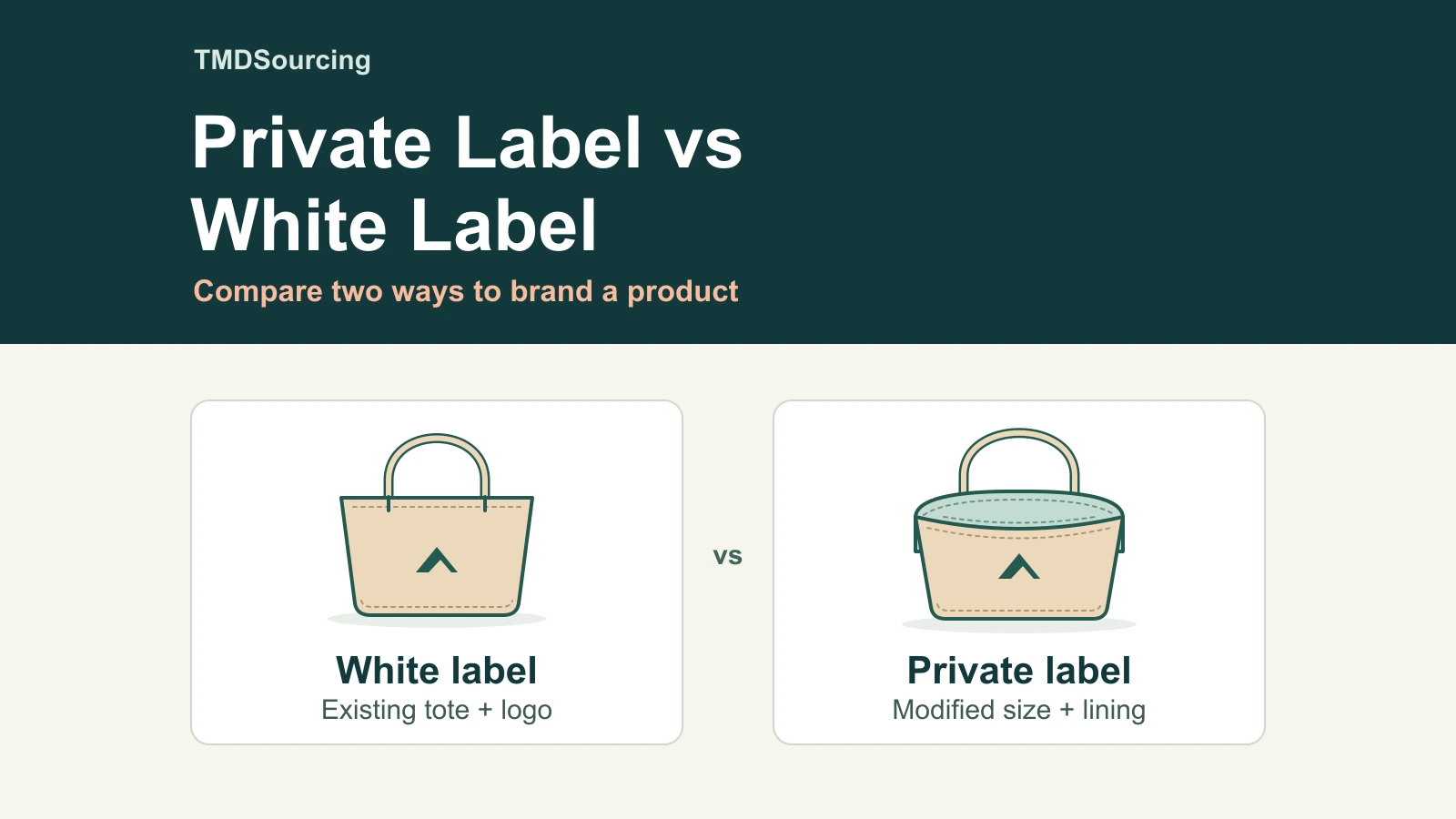
White label usually means buying a supplier’s existing product with your own branding. Private label can describe any product sold under a retailer’s own brand. In this guide, it means a branded product made to buyer-defined specifications, such as a different size, lining or closure.
Suppliers use the terms differently. For a first order from China, ask what changes on the product, where your brand appears and whether the supplier can sell the same specification to other buyers. Those three answers determine what to quote and what to approve.
Private Label vs White Label at a Glance
Both routes can put your name on the retail pack. The purchase order needs to identify the exact product that goes inside it.
Swipe to see all columns.
| What to check | White label | Private label with product changes |
|---|---|---|
| Starting product | Supplier’s catalog model or existing specification. | Buyer-defined specification, often adapted from an existing model. |
| Customization | Typically a logo, label or retail pack. Check which catalog variants are available. | May also change the material, dimensions, components or construction. |
| Sample to approve | Representative product with the agreed print and packaging. | Production-intent sample built to the agreed revision, with the agreed print and packaging. |
| MOQ and fees | Confirm product and branded packaging minimums, plus print setup. | Also check minimums for changed materials or components and any development fees. |
| Sales rights | The base model may be sold to other brands. | Any resale restriction depends on the scope agreed in writing. |
White label and private label describe the branding and product arrangement. OEM and ODM describe who brings the design to production. You can adapt a supplier’s existing design and sell the revised model under your own brand. Compare OEM and ODM manufacturing.
Which Route Fits Your First Order?
Start with the product your customer expects. Would the supplier’s standard item meet that expectation once it carries your brand? A different sleeve can tell a better brand story. A required lining, load capacity or fit changes what the factory needs to make and what you need to test.
- Start with a catalog product when the existing model meets the brief, you can use a standard option, and speed or testing demand is the priority. Ask the supplier to identify the model and show the exact product with your print or pack before committing to a branded run.
- Quote a revised product when customers need a measurable change, such as a wider opening or a specific material. Put it in the specification and allow time to approve a sample that uses the planned materials and construction.
- Check how reorders will work. Ask whether the base model and color will stay available, whether repeat runs have the same minimum and who must approve a material substitution. An affordable first run can be hard to repeat if its material or components were available only once.
One Canvas Tote, Two China Supplier Quotes
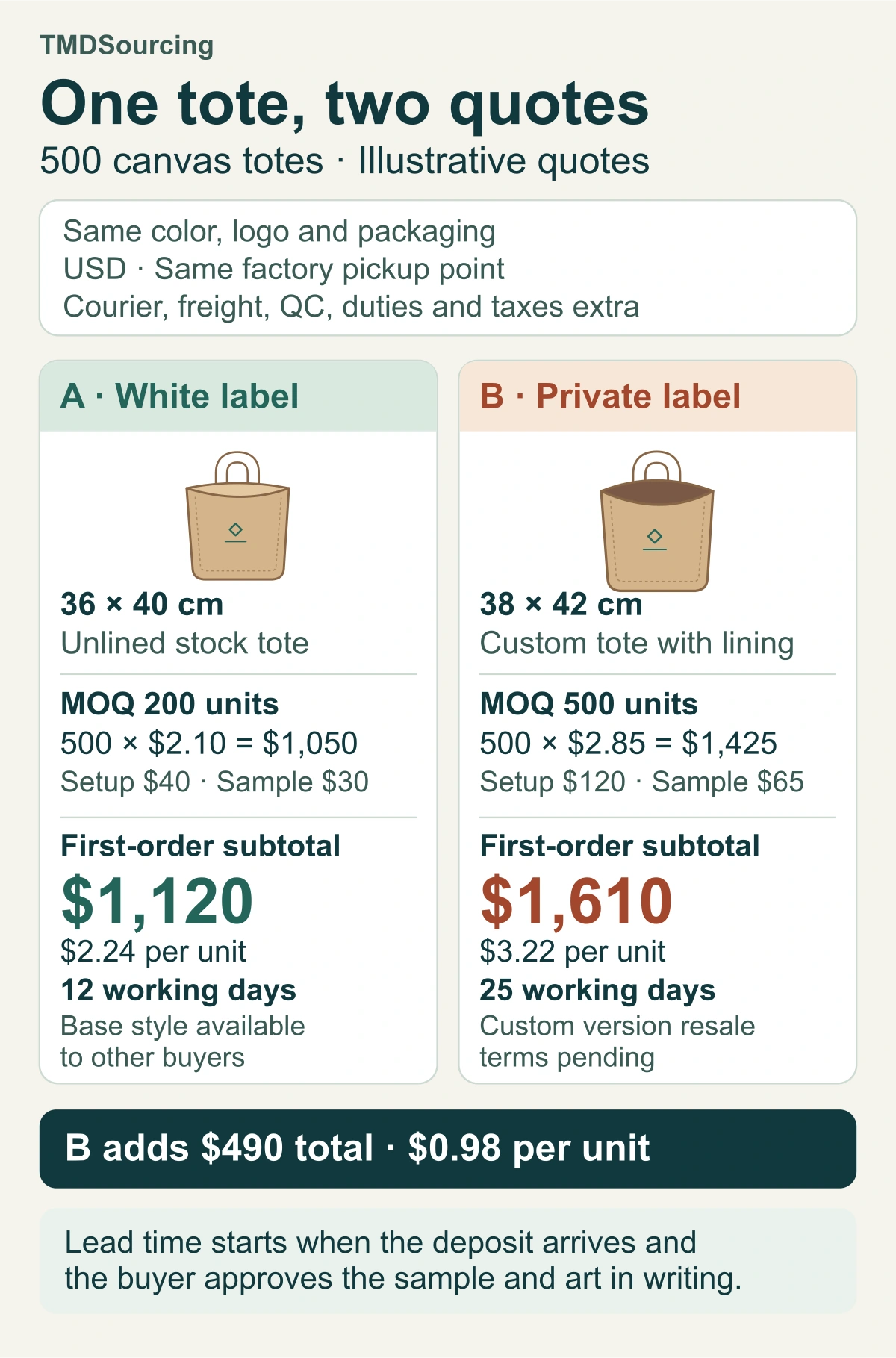
Suppose a retailer asks one factory for two ways to supply 500 canvas totes. Both quotes cover a single color, one SKU, the same logo print, paper retail sleeves and outer cartons. Both use US dollars and the same factory pickup point. The figures below are illustrative. Per-unit goods prices include the stated packaging, and neither sample fee is credited back.
Swipe to see all columns.
| Quote item | A. Catalog tote with logo | B. Larger tote with lining |
|---|---|---|
| Finished size and construction | 36 × 40 cm, unlined | 38 × 42 cm, lined |
| Product MOQ for this option | 200 bags | 500 bags |
| Goods at 500 units | 500 × $2.10 = $1,050 | 500 × $2.85 = $1,425 |
| Setup and sample | $40 print setup + $30 sample | $120 pattern and print setup + $65 sample |
| First-order subtotal | $1,120 · $2.24 per bag | $1,610 · $3.22 per bag |
| Factory production time | 12 working days | 25 working days |
| Approval sample | Catalog model with the agreed print and retail pack. | Revised dimensions, lining and stitching, with final print and retail pack. |
| Resale of the product specification | Unbranded base model remains available to other buyers. | Resale terms for the revised model await written confirmation. |
The revised tote adds $490 to the first order, or $0.98 per bag. The calculation spreads each route’s setup and sample fees across 500 bags. Sample delivery, transportation after factory pickup, inspection, taxes and duties sit outside the subtotal. Include those costs separately when you calculate landed cost.
In this example, the factory starts counting production days after it receives the deposit and written approval of the final sample and artwork. Work backward from your required delivery date using sample time, review time and freight time as separate steps.
If the lining is optional and the launch window is tight, A may fit. If the lining is a requirement, check that B’s approval sample can meet it and allow for the longer schedule. If your plan depends on exclusive sale of B in your market, keep the order pending while the two sides confirm which version the restriction covers and where, for whom and for how long it applies.
How to Request Both Quotes on the Same Basis
Use one request for quotation (RFQ) so both options start with the same buyer brief. Ask the supplier to itemize any separate packaging run. If the product MOQ is 500 and the printed sleeve MOQ is 1,000, establish who pays for the remaining sleeves, where they are stored and whether they can be used on the next order. Check product and packaging minimums.
Copyable dual-quote request
Please quote both versions of [product] for [target quantity and each color or SKU] for sale in [market].

A · Your existing model [SKU or reference]. Keep the product specification unchanged and add the branding below.
B · The same starting model with [specification changes]. Keep [features, colors and materials that must stay the same].

For both versions, please confirm:
• Model ID, specification revision, available colors and materials
• Logo location and artwork revision, retail pack and outer carton
• Unit price at the requested quantity and MOQ by product, color and branded component
• Setup, tooling and sample fees, possible credits, and treatment of surplus packaging
• Currency, named pickup or delivery point, included charges and quote validity
• Sample turnaround, production lead time, start conditions and payment milestones
• Reorder minimums, availability, change notice and any agreed resale restriction

Please mark any assumption or deviation next to the affected line and show the total amount at the quoted order quantity.
If one supplier can quote only at a higher minimum, record that price and order commitment separately. Ask both for a common quantity tier before comparing unit prices. Send the same brief to any additional suppliers you are shortlisting for production.
What to Confirm Before Bulk Production
Use the purchase order to tie the agreed quote to an approved product. The supplier should be able to identify what to make and the inspector should be able to check the same version.
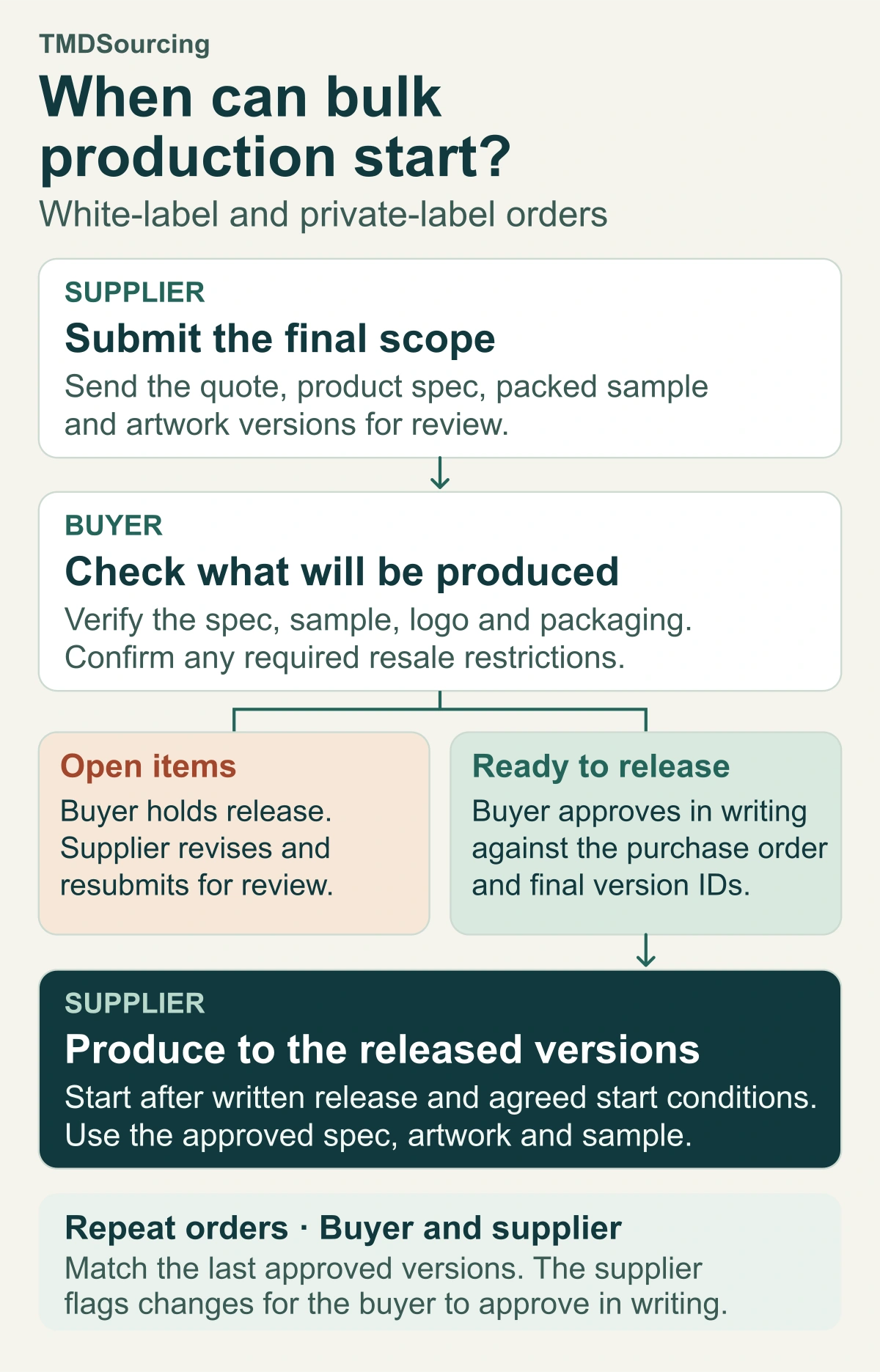
- Supplier sends the final scope. Match the quote and purchase order to the model or specification version, quantities, fees, packing detail and promised lead time. Confirm who packs the goods and who supplies the labels or evidence needed for the destination and sales channel.
- Buyer approves the physical sample and artwork. On the tote, check measurements, stitching, logo placement and finish, and the assembled retail pack. Check the lining on the revised version. Record the sample ID and artwork revision in the purchase order. If the measurements, print or sleeve fit fail, request a corrected sample before approval. Plan the right sample for each stage.
- Both sides confirm any rights that affect the order. Record who can use the branding, who owns or controls the underlying design or pattern and whether other buyers can order the same version. For a required exclusivity agreement, identify the product revision, region, sales channels, term, entities covered and any minimum order commitment. WIPO guide to assignment and licensing.
- Buyer releases the approved version in writing. Once the order’s start conditions are met, the supplier can schedule bulk production with the agreed sample, specification and pack. Carry those references into the inspection brief. On reorders, check that the same version and materials are still available and require review for any change. Review packaging and print approval steps.
Frequently Asked Questions
Does adding your logo make the product exclusive?
Adding a logo identifies your branded units. A factory may still sell the underlying model to other brands. Ask for a separate written restriction if your business depends on controlling sales of the same product or modified specification.
Does white label always have a lower MOQ?
A catalog item may be available in smaller quantities. Custom printing, colors or packaging can raise the usable order minimum. Ask for the minimum for each item and the minimum quantity the supplier will accept for the complete branded order.
Can you start with white label and switch to private label later?
Yes, if the supplier can produce your proposed changes and you approve the new specification, costs and sample. A revised product may need a new SKU, new packaging artwork or a fresh review of the documentation that covers it. Ask the supplier whether existing stock can still be replenished during the transition.
Is private label the same as OEM or ODM?
Private label describes how a product is sold under a buyer’s brand. With OEM the buyer typically brings the design or specification. With ODM the supplier typically contributes an existing or new design. Either route can produce a private-label item. Confirm the design rights, production scope and approval process separately.
Get Help Comparing Your Sourcing Options
Share a product photo or link, the estimated quantity, where you plan to sell it and when you need it. Tell us which features must change and whether exclusivity matters. TMDSourcing can help turn that brief into comparable supplier quotes and plan the samples you need to approve.