SOURCING GUIDES / CHINA SHIPMENT CONSOLIDATION
How to Consolidate Shipments from Multiple Suppliers in China
Coordinate supplier deliveries, preserve product identity and compare the complete cost before combining orders.
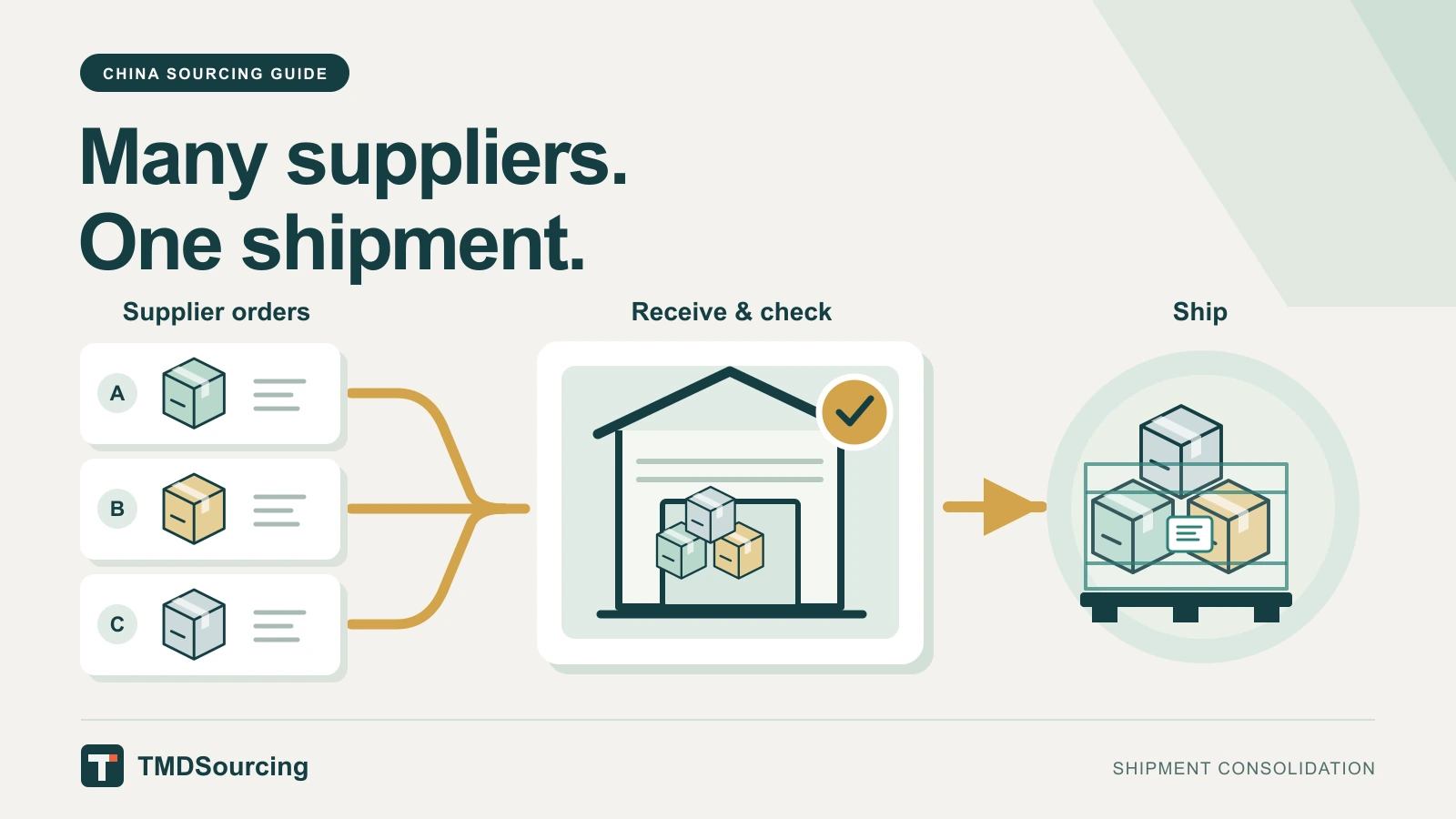
How do you consolidate shipments from multiple suppliers in China?
Confirm one receiving location, give each supplier a common delivery instruction, and track every delivery by supplier, purchase order and SKU. Arrange the agreed receiving checks, product inspection and packing work, then approve which goods can leave. Use the final packed dimensions, gross weight and destination to confirm the international shipping plan.
Consolidation can simplify the handover, but its value depends on supplier locations, readiness dates, cargo compatibility and the complete cost. Plan the shipment before suppliers dispatch; a shared warehouse address alone does not resolve those decisions.
1. What does shipment consolidation mean?
For a buyer purchasing from several Chinese suppliers, consolidation means bringing selected orders together under a coordinated receiving and outbound shipping plan. It can apply to samples, regular replenishment, a product launch or a bulk purchase.
Several different operations are often described as “consolidation.” Keep them separate when requesting a quote:
| Term | What it describes |
|---|---|
| Buyer’s consolidation | Bringing one buyer’s orders from different suppliers into a coordinated shipment. |
| LCL sea freight | Less-than-container-load transport: sharing container space with other cargo. Your consolidated goods can still travel by LCL. |
| Repacking | Changing outer packaging or combining packages. It does not automatically include product inspection. |
| Kitting or assembly | Combining specified components into a selling unit, such as a product, retail box and insert. |
The outbound mode may be express, air freight, LCL or FCL, depending on the shipment. DDP describes agreed delivery responsibilities; it is not a transport mode alongside air or sea.
2. When should you combine supplier orders?
Consolidation is worth assessing when goods share a destination and a workable shipping window, or when products and packaging need to meet before dispatch. It can also help a buyer organize different Alibaba, 1688 and direct-factory orders.
Start with four questions:
- Can the dates align? Compare packed cargo-ready dates and expected warehouse arrivals, rather than assuming production completion means immediate dispatch.
- Does collection make sense? Moving goods between distant supplier cities may offset the benefit of combining international freight.
- Can the goods travel together? Confirm acceptance and handling for batteries, liquids, fragile goods, temperature-sensitive items and any other special cargo.
- Must the products form a complete set? An inexpensive missing box or accessory can prevent a higher-value product from being prepared for sale.
Consider separate or split shipments when one order is urgent, suppliers are ready far apart, the destinations differ, or cargo needs incompatible handling. Do not force every purchase into the same batch just because it belongs to the same buyer.
3. Confirm the receiving location and responsibilities first
Choose a receiving point for the actual supplier locations, cargo and route. Obtain the confirmed address in Chinese, receiver’s name, telephone, delivery hours and appointment procedure. An office address or a warehouse used on a previous project is not a delivery instruction for a new shipment.
Before goods move, agree who books and pays for domestic transport, who unloads, which receiving records are provided, and what happens to damaged or unidentified cartons. Specify any product checking, labeling or assembly as separate tasks with defined requirements.
Ask how storage is billed and when the clock starts. If a free period is offered, confirm its conditions. Check whether cargo insurance is arranged, what it covers, and which parties must receive loss or damage notifications under the applicable contracts.
Each supplier’s sale terms still matter. Record the agreed Incoterms rule and named place, where used, alongside domestic delivery and document responsibilities. The ICC Incoterms checklist is a useful reference for allocating these responsibilities.
Name the buyer contact who can approve extra work, packaging changes and shipment release. This avoids a warehouse or supplier making commercial decisions simply to keep cargo moving.
4. Build one inbound plan for every supplier
Use a shared project reference and a separate record for each supplier lot. Include the PO, SKU, quantity, carton identifiers, estimated packed dimensions and gross weight, expected arrival, tracking reference, required checks and any special handling. Mark estimated data clearly and update it at receiving.
Illustrative project: 120 gift sets, each requiring one tote, one box and one insert
The following suppliers, dates and quantities are fictional planning examples. D0 is the project’s reference day, not a recommended universal lead time.
| Supplier / PO | Goods / original cartons | Arrival and current status |
|---|---|---|
| A, Yiwu PO-A-001 | 120 totes, TOTE-NAT A-01 and A-02: 60 pieces each | Received on D0. A-01: all 60 accepted under the agreed check. A-02: 20 accepted, 40 awaiting checking. |
| B, Ningbo PO-B-001 | 120 gift boxes, GIFT-BOX B-01 and B-02: 60 pieces each | B-01 received on D2 with a damp outer carton: held for review. B-02 now expected on D9. |
| C, Wenzhou PO-C-001 | 120 inserts, CARE-INSERT C-01: 120 pieces | Received on D2; accepted under the agreed text, version and count check. Approved for kitting only. |
Every outer carton needs an agreed reference, such as PROJECT-01 / SUP-A / PO-A-001 / TOTE-NAT / 01 OF 02. Include required handling and regulatory marks separately. A reference label does not replace them.
A delivery instruction you can copy
Fill the placeholders with the supplier and receiving provider before dispatch. This compact note establishes the handover; attach the SKU packing list and any agreed inspection requirements.
Subject: Delivery instructions for [PO NUMBER]

Hello [SUPPLIER CONTACT],

Please confirm these instructions before dispatch:

RECEIVING
Confirmed warehouse address in Chinese: [ADDRESS]
Receiver / telephone / delivery hours: [DETAILS]
Appointment procedure and arrival window: [DETAILS]
Project reference / supplier code / PO: [REFERENCES]

GOODS AND CARTON MARKS
SKU, variant, quantity and units per carton: [DETAILS]
Mark every carton: [PROJECT / SUPPLIER / PO / SKU OR MIXED / CARTON X OF Y]
Attach the matching packing list with carton contents, external dimensions, gross weights and handling information. Preserve required labels and batch references.

DISPATCH PRE-ALERT
Send the packed-ready date, planned dispatch, expected arrival, tracking or vehicle details, carton count, packing list, carton-mark photo and current inspection status to [CONTACT]. Flag batteries, liquids or other special cargo before dispatch; acceptance must be confirmed.

RESPONSIBILITIES AND APPROVAL
Domestic transport booked by: [PARTY]; paid by: [PARTY]
Loading / unloading and agreed sale term with named place: [DETAILS]
Dispatch approver: [NAME]; contact if the window is at risk: [NAME]
Permitted packaging changes: [PRECISE ACTIONS / NONE]
Do not substitute goods, change packing or dispatch outside the agreed window without approval.

Report missing, damaged or inconsistent cartons. Warehouse receipt is not product acceptance or international shipment release. Any approved repacking must preserve original-to-new carton and SKU quantity records. Final shipment requires [NAMED APPROVER]'s release.

Please confirm the address, window, marks, quantities and responsibilities, or list any exceptions.

Thank you,
[BUYER NAME / CONTACT]
Have each supplier confirm the instruction and send a pre-alert before goods leave. A courier’s delivery notification is useful tracking evidence, but it does not confirm quantities, condition or product approval.
5. Keep receiving, inspection and release separate
Use three distinct checkpoints. Receiving identifies a delivery and records the agreed carton count, outer condition, marks and measurements. Product inspection checks goods against the agreed specification and scope. Release records authorization for a particular next step, such as kitting or international shipment.
A photograph of sealed cartons does not establish that the products inside meet specification. If you need unit counts, model verification, functionality checks or testing, arrange that work explicitly. Use a pre-shipment inspection checklist to define the requirements.
Keep shortages, damage and unresolved product issues identifiable. Record the discrepancy, supporting photos, responsible contact and decision before moving affected goods into approved stock.
Preserve the link from original cartons to new cartons
In the gift-set example, the proposed packing plan allocates 40 sets to each new carton. It must retain the source of every component:
| New carton plan | Original carton allocation | Current decision |
|---|---|---|
| KIT-01 40 sets | A-01: 40 totes B-01: 40 boxes C-01: 40 inserts | Hold: boxes await condition and packaging approval. |
| KIT-02 40 sets | A-01: 20 + A-02: 20 totes B-01: 20 + B-02: 20 boxes C-01: 40 inserts | Hold: some boxes have not arrived; received boxes remain unapproved. |
| KIT-03 40 sets | A-02: 40 totes B-02: 40 boxes C-01: 40 inserts | Hold: totes await checking and boxes have not arrived. |
This is an allocation plan, not a completed packing record. After approved work, record actual quantities moved, new carton contents, photos, measurements and the packing-list version. Here, no finished gift sets are released for international shipment.
6. What if one supplier misses the cutoff?
Separate the supplier’s packed-ready date, warehouse receiving deadline, inspection or correction deadline, and outbound handover and documentation cutoffs. Confirm each with the responsible party and work backward from the delivery need. There is no universal “send everything seven days before shipping” rule.
Suppose the example’s warehouse receiving deadline is D5, but B-02 will arrive on D9. Ask for options before the deadline:
| Option | What to confirm | What to compare |
|---|---|---|
| Wait for all goods | Reliable revised arrival; time for checks and preparation; new outbound availability. | Storage, schedule changes and the effect on stock or launch timing. |
| Ship an approved part first | Which goods can be sold independently or as complete approved sets. | Additional freight and destination charges versus the value of earlier delivery. |
| Move the late lot to a later batch | Suitable storage and a realistic next shipment plan. | Storage, later handling and future transport charges. |
Check component dependencies before choosing. An approved tote is not an approved finished gift set without its box and insert. Alternative packaging or shipping loose components needs the buyer’s decision. The cheapest-looking freight option may not meet the selling requirements.
7. Compare the complete cost of each plan
Request separate-shipment and consolidated quotes using the same goods, quantities, destination, delivery scope, checking requirements and cargo information. Clarify which costs are included so handling or final delivery is neither omitted nor counted twice.
For sea LCL, DHL’s cost-driver guide explains why origin, destination and handling charges matter alongside the main freight rate. A lower ocean rate alone does not establish a lower complete shipment cost.
Example A: dates align and consolidation reduces the total
All amounts below are hypothetical USD figures for teaching arithmetic, not TMDSourcing rates or market averages. The same three lots, quantities, delivery, inspection scope and insurance protection are compared. Product prices and actual duties/taxes are excluded from both columns; no tax saving is assumed.
| Non-overlapping cost item | Separate | Consolidated |
|---|---|---|
| Domestic transport / collection | $240 | $300 |
| Receiving and identification | $0 | $90 |
| Storage | $0 | $30 |
| Packing and preparation | $80 | $120 |
| Agreed product inspection | $180 | $180 |
| Origin handling and documents | $180 | $100 |
| International transport | $900 | $700 |
| Destination handling and delivery | $300 | $160 |
| Equivalent insurance protection | $30 | $30 |
| Total | $1,910 | $1,710 |
Under these assumptions, consolidation saves $200. The direct shipments bypass central receiving; both options still include the same agreed product checking and equivalent packaging protection.
Example B: extra collection and waiting reverse the result
If domestic collection rises by $130 and storage by $190, the consolidated total becomes $2,030—$120 more than separate shipments. Evaluate delivery delay’s business effect separately; do not add it twice as a freight charge.
For actual quotes, ask whether receiving is charged per supplier, delivery, carton or PO; whether a split delivery creates another fee; and how storage units, minimums and free periods work. Confirm materials, relabeling, unloading, special handling and destination exclusions. Compare the appropriate express, air, LCL or FCL options without a fixed global volume threshold.
8. Repack, measure and confirm the outbound plan
Agree what may be changed before cartons are opened. Removing excess outer packaging may help, but preserve necessary protection, retail presentation, approved labels and batch identity. A tighter carton is not an improvement if goods become vulnerable or fail the destination’s receiving requirements.
For a bundle, confirm the SKU and quantity of each component, approved artwork, label version and packing reference. The packaging and order preparation plan should connect incoming components to finished units and final cartons.
After the final packing changes, provide:
- Final carton, pallet or crate count.
- External dimensions and gross weight for each package type.
- Stackability, fragile or oversized pieces and special handling.
- Released quantities, goods description and destination receiving requirements.
DHL’s chargeable-weight guide explains gross and volumetric weight, including packaging and pallets. Ask which calculation and minimum charges apply to the selected service; do not assume one divisor applies to every carrier and mode.
Use estimates for early planning or provisional booking, clearly labeled as estimates. Update the final freight and loading confirmation when packed data, cargo acceptance and release status are known. Repacking does not automatically lower the chargeable total.
9. Prepare documents that remain traceable
Combining the transport does not change the underlying purchases. Retain each supplier’s invoice and packing information, and connect the final carton record to product descriptions, quantities, values, origins and applicable product documents.
Name who supplies information, who assembles the shipping set and who verifies it with the forwarder or customs broker. Reconcile final quantities, carton references, gross weights and dimensions before release. If a lot is excluded or delayed, update the documents to match the goods actually shipped.
For LCL, DHL’s documentation and cargo-safety guide describes preparation considerations. Required documents and cargo acceptance depend on the actual products, route and destination.
One shipment does not automatically guarantee one invoice, one bill of lading, one customs entry or lower duties. Where a combined document is used, preserve the underlying SKU and supplier records. Confirm export and import arrangements, cargo restrictions and included destination costs for the chosen service.
Frequently asked questions
Can I combine orders from Alibaba, 1688 and direct factories?
They can be assessed under one receiving plan if the providers accept the goods and the dates, documents and delivery arrangements work. Keep each purchase identifiable. For the buying stage, see our guide to buying from 1688 outside China.
Can samples and bulk orders be consolidated?
Yes, where their timing and handling are compatible. Keep sample references separate from bulk stock. Samples needed for approval may be better sent earlier rather than held for the production shipment.
Does warehouse receiving include product inspection?
Only the agreed work is included. Counting outer cartons or recording visible damage is different from checking product units, specifications or performance. Define the inspection scope before arrival.
What if one supplier is late or has a quality problem?
Identify the affected lot and compare waiting, releasing an approved portion or moving it to a later batch. Account for complete-set requirements, added charges and delivery priorities. Record the buyer’s decision.
Can I use my own freight forwarder?
This may be possible when the receiving provider and nominated forwarder agree the handover. Confirm collection, cutoff, packed-data requirements, documents and responsibilities before suppliers dispatch.
Will consolidation always reduce shipping costs?
No. Domestic collection, processing, storage and waiting can outweigh lower international freight or fewer repeated charges. Compare complete quotes on the same basis, with the delivery timing you actually need.