FCA vs FOB for Imports from China
Compare three quotes for the same shipment from Yiwu. See where risk passes, which origin charges to check, and what to put on your purchase order.
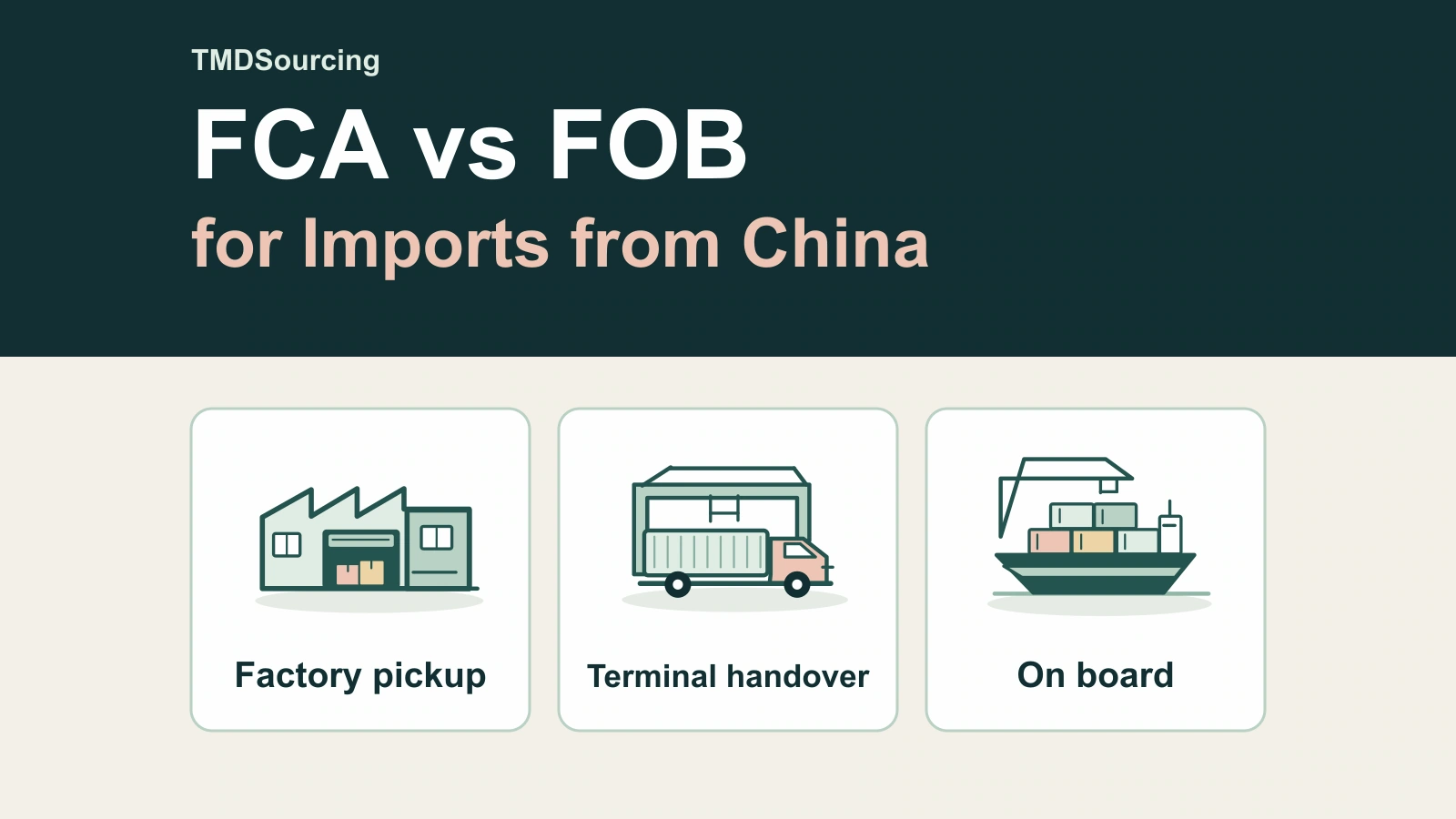
Under FCA (Free Carrier), the seller delivers to the buyer’s nominated carrier or receiver at an agreed place. Under FOB (Free on Board), delivery happens on board the buyer’s nominated vessel at the named port of shipment.
For container cargo handed over at a factory or terminal before it goes aboard, consider FCA. To compare prices, get both your supplier and forwarder to quote the same cargo, then add the buyer-paid charges needed to reach the same point.
FCA vs FOB at a Glance
The comparison below follows Incoterms® 2020 and assumes that both parties meet their delivery and notice obligations. FCA has two different delivery procedures. Which one applies depends on whether the named point is at the seller’s premises or somewhere else.
| Item | FCA Seller’s factory | FCA Named terminal | FOB Named port |
|---|---|---|---|
| Transport | Any mode | Any mode | Sea or inland waterway |
| Delivery and risk | Seller loads buyer’s pickup vehicle | Seller’s vehicle at agreed point, ready to unload | Goods on board buyer’s nominated vessel |
| Truck leg to port | Buyer arranges from factory | Seller delivers to named terminal | Seller arranges transport to port |
| Export clearance | Seller | Seller | Seller |
| Main carriage | Buyer | Buyer | Buyer |
| Import clearance | Buyer | Buyer | Buyer |
Under either term, the buyer usually arranges main carriage and handles import formalities. If one party books a service for the other, write down who instructs the carrier and who bears the charge. Agree insurance cover from the point you take on risk. Set ownership and payment terms separately in the sales contract. ICC Academy’s FCA and FOB comparison · Incoterms and the sales contract
If the factory offers EXW as a fourth option, ask who will load the pickup vehicle and handle export clearance. Those responsibilities can change the services you need to buy. EXW vs FOB for buying from China
Where Delivery Happens and Risk Passes
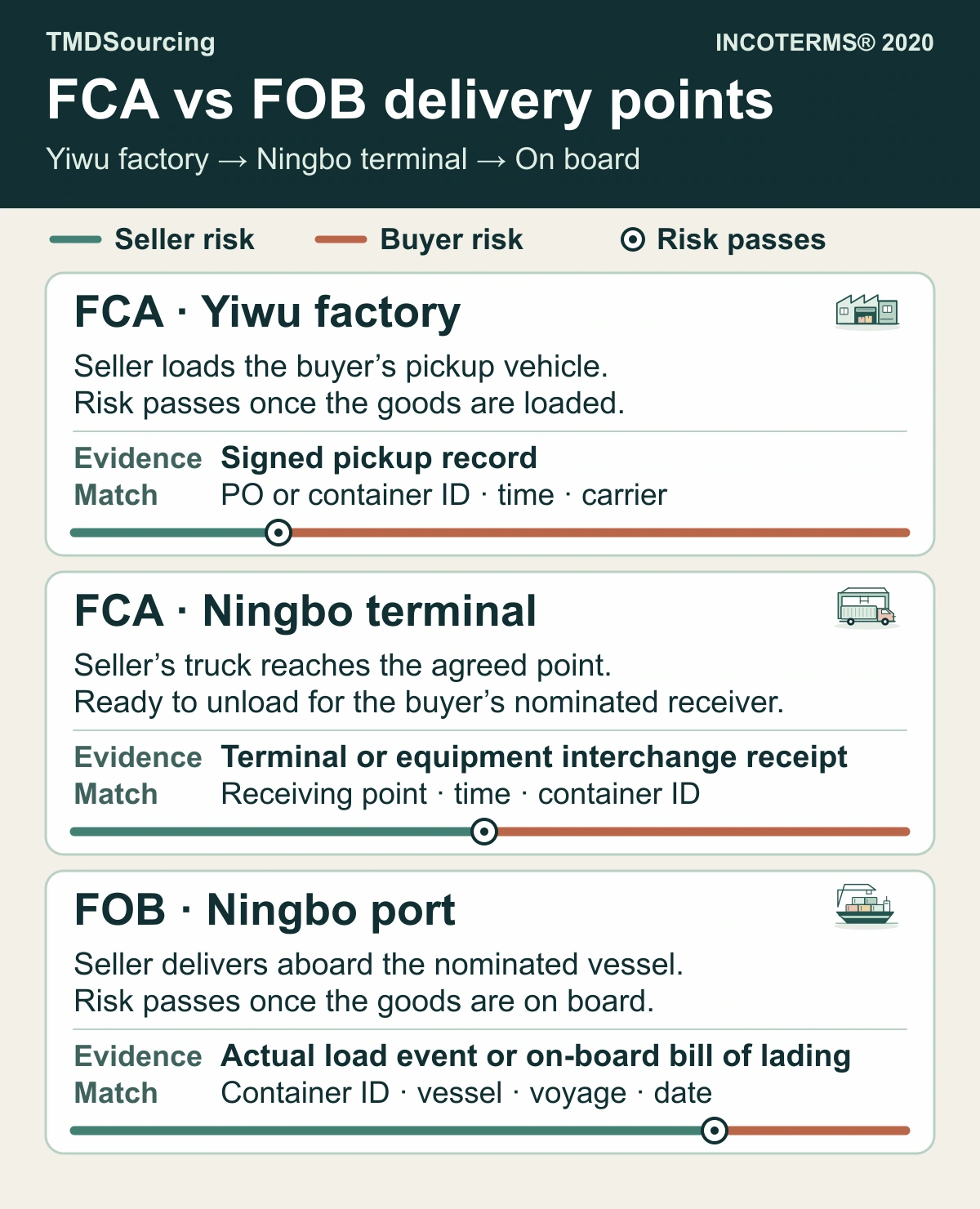
Picture a container leaving a Yiwu factory, reaching its assigned Ningbo terminal on Monday and going on board on Wednesday. Each quote puts delivery at a different point on that route. Ask who can give you a dated record for the event specified in your purchase order (PO).
FCA at the Yiwu factory
The supplier loads the buyer’s collecting vehicle. Record when loading finishes, who collected the goods and which PO or container went on the truck. Ask the collecting party for a signed pickup record or its digital equivalent.
FCA at the named Ningbo terminal
The seller’s truck reaches the agreed point and the goods are ready to unload at the disposal of the buyer’s nominated carrier or receiver. Confirm the terminal and receiving point in advance. Match the terminal receipt or equipment interchange receipt (EIR), where issued, to the place, time and container number. Maersk shipping glossary
FOB at Ningbo
In normal performance, risk passes when the goods are on board the nominated ship. Ask for the carrier’s actual load event or a transport document with on-board details. Check the container number, vessel, voyage and date. If a vessel nomination or cargo notice fails, review the agreed deadlines and the rule’s exceptions. DCSA track and trace standards
Suppose a handling incident damages the goods on Tuesday, between Monday’s completed terminal handover and Wednesday’s loading. In this example it falls after delivery under FCA at the named terminal and before delivery under FOB. Ask for the actual event times and any condition report to establish when the damage occurred. The risk allocation between buyer and seller and any claim against the carrier are separate questions.
If a bank requires an on-board bill of lading (B/L) under FCA, first agree the optional A6/B6 arrangement. The buyer instructs the carrier to issue the document to the seller after loading. Confirm the carrier’s process and the bank’s requirements before signing. Risk still follows the agreed FCA delivery point. ICC’s FCA bill of lading update
One Yiwu Shipment, Three Quotes
Here’s a hypothetical quote comparison for one 20-foot container of home organizers from a Yiwu supplier. Keep the products, quantities, packing, equipment, vessel and Ningbo loading port the same in all three options. The comparison ends on board in Ningbo. In this example, the supplier includes the applicable export formalities in each quote, and both parties have agreed how the container will be collected and loaded at the factory.
| Delivery term | Supplier quote | Buyer-paid add-ons | Total on board |
|---|---|---|---|
| FCA Yiwu factory | $8,000 | $420 trucking$210 handling | $8,630 |
| FCA Ningbo terminal | $8,380 | $210 handling | $8,590 |
| FOB Ningbo | $8,620 | $0 after check | $8,620 |
The FCA factory price leaves the buyer to add the $420 truck leg to Ningbo and the $210 terminal handling line. At the named FCA terminal, the seller includes the truck leg, so $210 remains to be added. The FOB supplier confirms that its price already covers the same $210 service. The buyer’s add-on for that line falls to $0 after the forwarder confirms the billing arrangement.
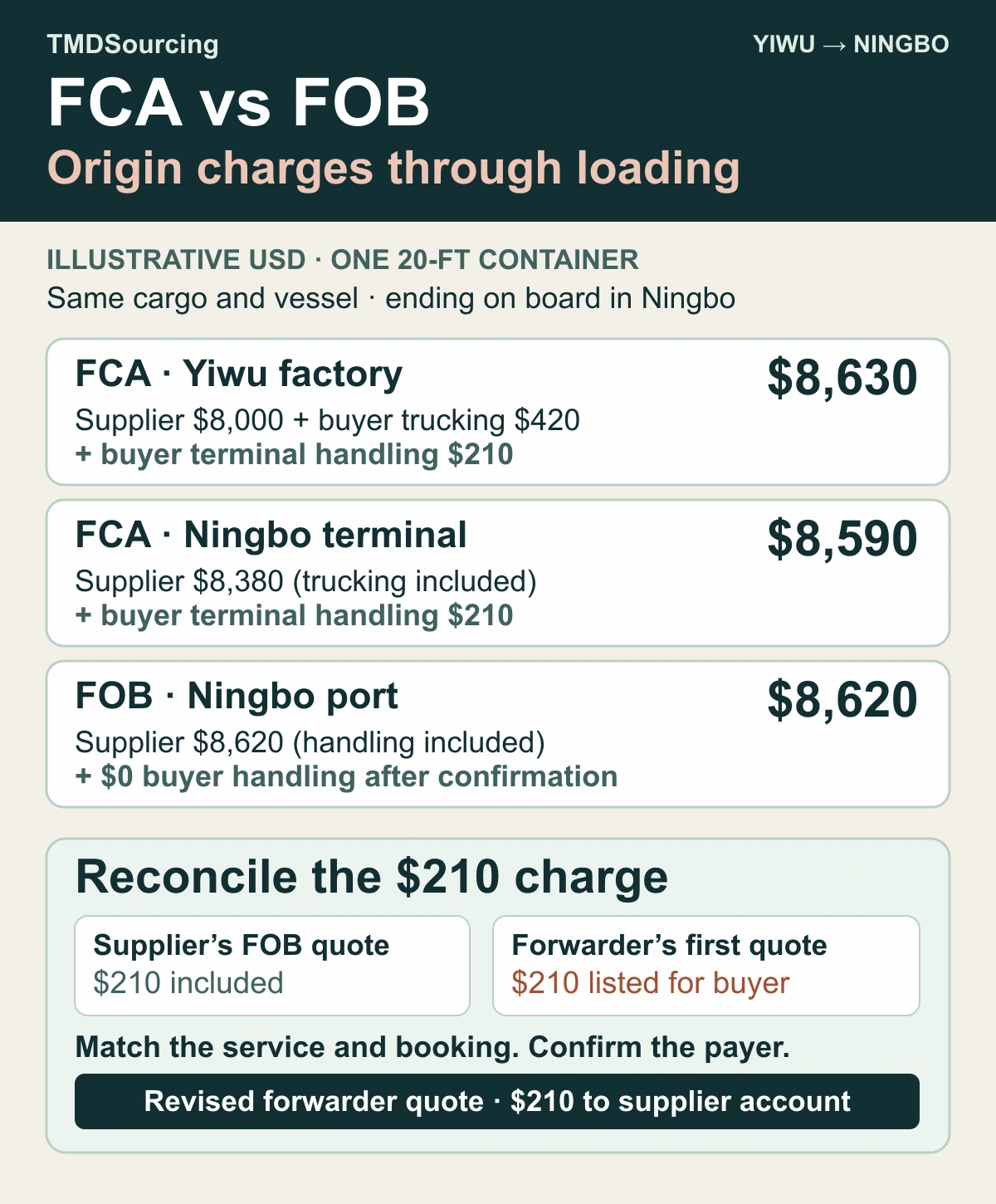
Use the same calculation for your quotes. Add the supplier price and the charges you pay to reach the common endpoint. If the supplier quotes per unit, multiply by the same order quantity first. Pair that with the forwarder’s charges for the same number and type of containers, using one currency for the comparison.
FCA terminal comes out $30 below FOB in this comparison. If the terminal option has another confirmed $75 buyer-paid origin charge for a separate service, its total rises to $8,665. FOB would then be $45 lower. The lesson for comparing live quotes is to confirm the lines that can change your decision before you place the order.
All figures are illustrative. Price international freight, insurance, import charges and delivery separately for your destination. That also lets you account for any cost of insuring the cargo from an earlier FCA handover. How to calculate landed cost from China
How to Check Overlapping Origin Charges
Suppose the first forwarder quote for the FOB offer shows $210 in origin terminal handling charges (THC) billed to the buyer. Adding it without checking would put the offer at $8,830. Mark the line as pending and ask both parties to confirm the scope.
- Match the service. Compare the charge code or description, terminal, container size, booking and unit of billing. Ask what the line covers. A gate service and a load-side service can appear under similar names.
- Trace the bill. Ask who is invoiced and who bears the cost under the sale. The carrier’s customer for billing can differ from the party responsible for the charge between buyer and seller.
- Confirm the correction. In the example, the supplier confirms in writing that it covers that service and the forwarder reissues the quote showing the supplier as payer. Use the revised quote for the $8,620 total. If the parties identify a separate service, add it to the buyer’s total when the buyer bears it.
If your forwarder has to invoice your account and the supplier agrees to reimburse you, keep two lines. Record what you’ll owe the forwarder and what the supplier has agreed to repay, with the settlement date. Use the confirmed credit in the cost comparison and keep the original amount in your payment plan.
Use the same check for documentation, truck waiting and special handling. Compare the rates in the same currency and confirm validity, where each charge applies and any exceptions before booking. Carrier guidance on China export procedures and fees
Which Term Fits Your China Shipment?
If a supplier quotes FOB while your forwarder plans to collect the loaded container inland, ask how the seller will fulfill its on-board obligation. Have the supplier and forwarder confirm the origin services and records they expect from one another. Request an FCA quote at the actual handover point if that is the arrangement they can carry out.
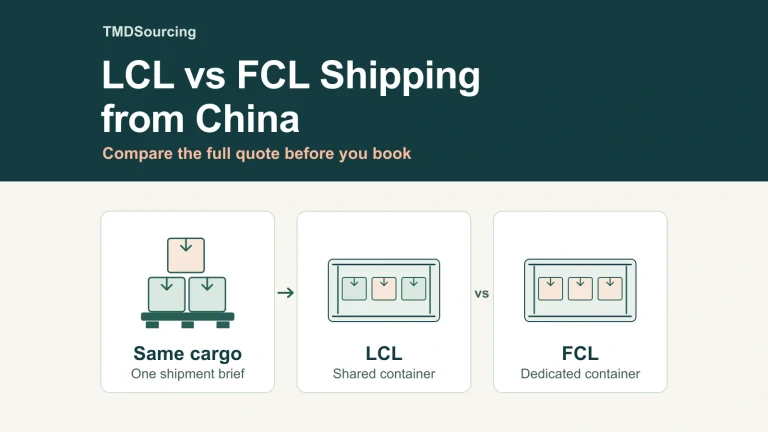
For air or rail, FCA can cover an agreed carrier handover. For less than container load (LCL), the named point may be a consolidation warehouse with its own receiving rules. For full container load (FCL), plan how you’ll match the packing list, booked container and seal record. Compare LCL and FCL · Container loading supervision guide
What to Confirm on the PO and with Your Forwarder
Use the same description of the handover on the PO and in the forwarder’s instructions. For FCA, fill in the address and exact loading or receiving point. For FOB, name the port of shipment and communicate the nominated vessel and any agreed loading point.
FCA at seller’s premises
FCA [factory address and loading point], Yiwu, China, Incoterms® 2020
FCA at another place
FCA [terminal name and receiving point], Ningbo, China, Incoterms® 2020
FOB
FOB Ningbo, China, Incoterms® 2020
- Handover and timing. Share the receiver’s name, pickup or delivery window, required booking references and terminal cutoffs.
- Scope and export. Confirm the exporter or broker, who sends the packing list and invoice, which truck and loading services each side covers, and how extra charges get approved.
- Evidence. Agree who sends the receipt or actual loading record, when it is due and what references it carries. For FCA with an on-board B/L requirement, agree the document instructions in writing.
Please confirm whether origin terminal handling for this booking is included in the supplier price. If it also appears on the forwarder quote, please identify the exact service, the billing party and who will bear the cost. Send a revised itemized quote with those details before we confirm the booking.
Frequently Asked Questions
Can you use FOB for a container shipment?
Yes, if the seller can fulfill on-board delivery under the agreed arrangement. If the container is handed over to the buyer’s carrier at a terminal earlier, FCA can align the contractual delivery point with that handover.
Is FCA cheaper than FOB?
It depends on where the seller delivers and what each quote includes. Add the buyer-paid charges to the same endpoint for both offers. Then consider the timing of risk transfer and how you will insure the cargo.
Who clears the goods for export from China?
The seller handles the applicable export formalities under both terms. Confirm who will declare or act for the exporter and what information the forwarder needs, especially when the buyer nominated the forwarder.
What’s the difference between gate-in and loaded on board?
Gate-in records the container entering a terminal. Loaded on board records it going onto a vessel. Match the proof to the event specified by your contract and verify that it refers to the correct container and voyage.
Can an FCA shipment have an on-board bill of lading?
Yes. If the parties agree to use the FCA A6/B6 option, the buyer instructs the carrier to issue it to the seller after loading. Confirm the carrier’s process and any bank requirements early.
Review Your FCA or FOB Quote
Share the supplier and forwarder prices, the named handover point, carton count or volume, and destination. TMDSourcing can help you compare the origin charges and plan the handover for your China sourcing project.
Share Your Quote Details