SOURCING GUIDES / MANUFACTURING OPTIONS
OEM vs ODM: How to Choose a Manufacturing Model in China
Compare design responsibilities, costs, tooling and approval steps before you choose a manufacturing route.
What is the difference between OEM and ODM?
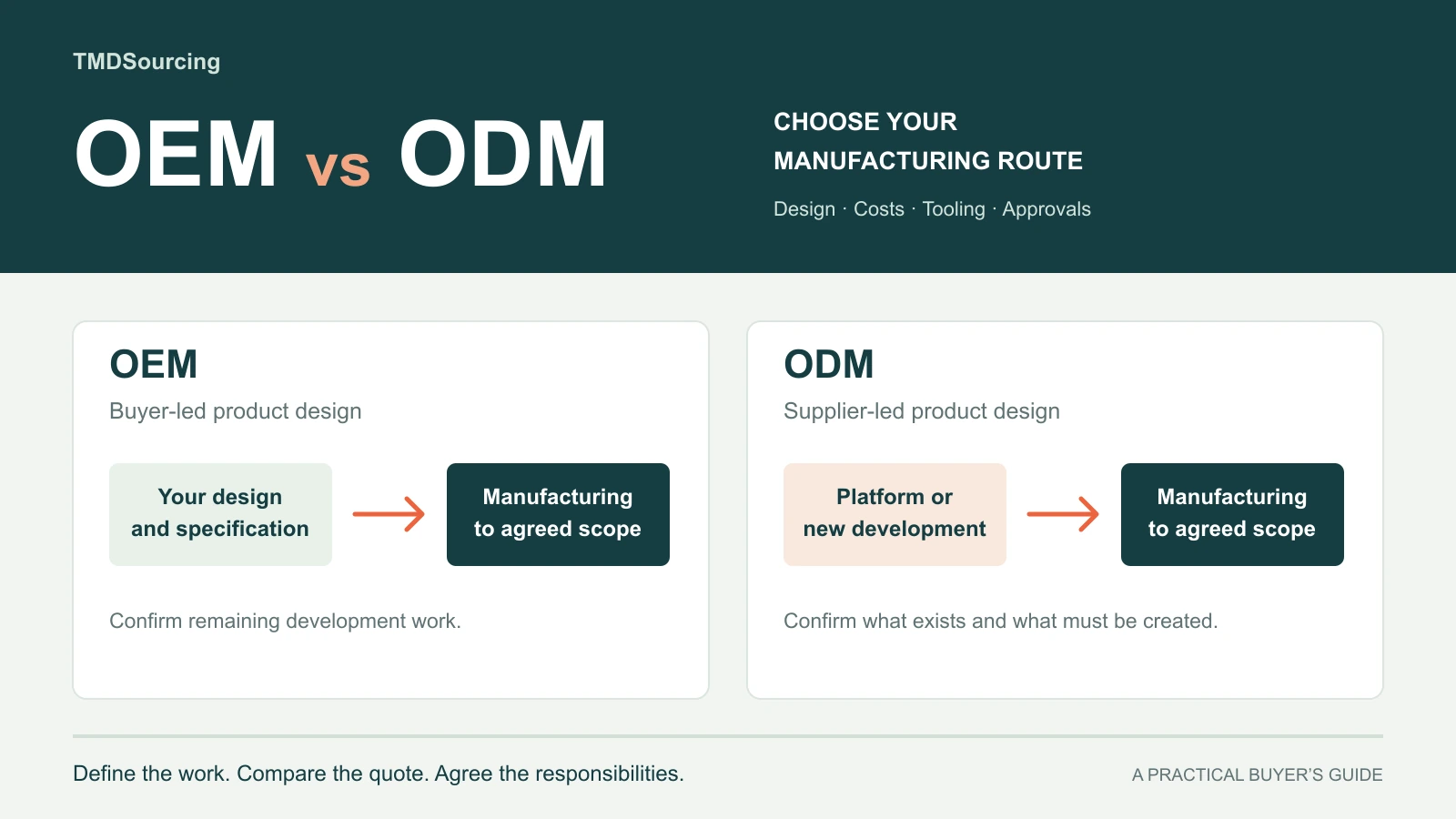
OEM usually means a manufacturer produces to the buyer’s design or specification. ODM means the supplier takes responsibility for product design as well as manufacturing. An ODM project may adapt an existing product or involve new development. The label alone does not settle design ownership, tooling rights, exclusivity, cost or delivery time.
When sourcing from China, start by explaining what already exists, what must change and what you need the supplier to deliver. You can then compare workable manufacturing routes against the same requirements. This guide covers manufacturing relationships for commercial buyers and brands.
OEM vs ODM manufacturing at a glance
The useful comparison is who does the work and what you receive. These are common starting points, not fixed contract terms.
Compare the scope behind the manufacturing label
| Factor | OEM: buyer-led design | ODM: supplier-led design |
|---|---|---|
| Starting point | Your existing design, specifications or production requirements. | A supplier platform or a brief requiring supplier design work. |
| Development work | Manufacturability reviews or revisions may still be needed. | Ranges from adapting an existing model to developing a new product. |
| Upfront costs | Depend on design readiness, samples, setup and tooling. | Existing designs may reduce development costs; new development can add them. |
| MOQ | Depends on materials, processes and the proposed order. | Shared platforms do not guarantee a low MOQ for every customization. |
| Lead time | Depends on remaining development and production steps. | An existing platform may shorten development; a new design may not. |
| Design and file rights | Clarify existing rights, supplier changes and deliverable files. | Clarify rights to the base design, new work and permitted use. |
| Tooling and exclusivity | Confirm ownership, use, custody and transfer separately. | Confirm existing tooling, any new tools and any agreed exclusivity. |
| Quality and compliance | Define requirements, checks, evidence and responsibilities. | The same is necessary; a catalog product is not automatic proof of compliance. |
If two suppliers use the same label, ask whether they are quoting the same work.
What OEM and ODM mean in practice
OEM: manufacturing from your design
OEM stands for Original Equipment Manufacturer. In a typical sourcing arrangement, you provide the product design or agreed specifications, and the factory supplies manufacturing capability. Depending on the product, your inputs might include drawings, dimensions, materials, tolerances, a bill of materials, a reference sample or packaging artwork.
The factory may suggest changes to improve manufacturability or cost. Decide who reviews those suggestions and how an approved change reaches production. Having your own drawing does not mean every production detail has already been resolved.
ODM: design and manufacturing from the supplier
ODM stands for Original Design Manufacturer. The supplier contributes the product design, but that contribution can take different forms. You might select an established model and adapt the color, branding or configuration. Alternatively, the supplier may develop a new design around your functional and commercial requirements.
Those projects have different budgets and schedules. Ask whether the proposed product already exists, which parts are standard and which require design, prototypes, tooling or validation. “We offer ODM” is not a complete description of the work.
Adapt an existing model
Choose a supplier platform and confirm available changes. Review the exact configuration before approving production.
Produce your design
Share an authorized design or specification. Resolve manufacturability and sampling requirements before release.
Develop from a brief
Define the outcome and commission the missing design work. Agree on development stages, outputs and approvals.
Hypothetical example: a brand needs a desk organizer. It could add its logo to an existing model, provide its own compartment dimensions and structure, or ask a supplier to develop a new modular system. The product category is the same; the work is different. Confirm the deliverables before debating which acronym describes them.
Where private label and joint design fit
Private label describes a branding arrangement. It does not, by itself, establish who created the product or who owns its design. Likewise, adding a logo does not automatically make a design exclusive. Joint design arrangements share development work between buyer and supplier; specify each party’s contribution and the treatment of resulting work.
Which manufacturing route fits your product?
Choose around the product’s requirements and the resources available to deliver them. A new business can have a production-ready design, while an established retailer may prefer an existing platform for an additional product line.
- Have a workable design? Look for a manufacturer with relevant process capability. Identify any remaining engineering or production preparation rather than paying to restart completed work.
- Have a suitable existing product reference? Ask which requirements the platform already meets and whether your changes fit its materials, components and tooling.
- Have an idea but no buildable design? Define a development scope. You may need supplier-led design, an independent designer or a combination of both before production can be quoted firmly.
- Need a distinctive feature? Describe the feature and the control you require. Evaluate technical feasibility and rights explicitly instead of relying on “custom OEM” in a quotation.
- Have a fixed launch date? Work backward through approvals, materials, validation and production. Confirm which route can meet the requirement, including unresolved dependencies.
Your company does not need one permanent model. Different products may justify different arrangements. An existing platform can suit one SKU while another needs original development. Moving between routes later requires a fresh review of specifications, rights, tooling and validation; it is not simply changing the label on a purchase order.
Write down your non-negotiable requirements first. If neither proposal meets them, ask for another technical or commercial option before choosing the cheaper quotation.
Compare costs, MOQ and lead times on the same basis
Separate development costs from unit prices
A unit price cannot tell you the cost of reaching an approved product. Compare the same specification, revision, quantity, packaging and delivery assumptions. Ask suppliers to separate one-time development or setup charges—sometimes called NRE—from sample rounds, tooling and production prices. Identify costs included in another line so you do not count them twice.
Also record inspection, testing, packaging, freight and destination costs where relevant. Keep missing items marked “to confirm.” Our supplier quotation comparison guide explains how to compare the whole offer.
A hypothetical cost comparison
Assume two routes can deliver the same agreed product requirements. Route A quotes US$500 in one-time development, sample and setup charges plus US$5.80 per unit. Route B quotes US$2,300 in those one-time charges plus US$4.90 per unit. These are teaching figures, not market averages or TMDSourcing quotations.
Quoted development and goods subtotal only
| Quantity | Route A | Route B | Difference |
|---|---|---|---|
| 500 units | US$3,400 | US$4,750 | A is US$1,350 lower. |
| 2,000 units | US$12,100 | US$12,100 | Subtotals are equal. |
| 3,000 units | US$17,900 | US$17,000 | B is US$900 lower. |
The equal-cost quantity is (2,300 − 500) ÷ (5.80 − 4.90) = 2,000 units. This only holds if both quotes remain valid across those quantities and their scopes are equivalent. Price tiers, extra development or missing charges change the result.
This is not a sales forecast or a business break-even calculation. It excludes freight, duties, inspections, financing, losses and other unquoted work. Nor does it establish that OEM becomes cheaper at a particular universal order size. For import budgeting, build a separate landed cost calculation.
Identify what drives each MOQ
Ask separately about finished-product, material, component, color, printing and packaging minimums. A standard item may be available in modest quantities while a special color or printed carton requires a larger run. Confirm whether surplus materials or packaging must be purchased, stored or paid for separately.
Use the specific constraint to discuss alternatives: standard materials, fewer variants or another packaging method. See our guide to negotiating MOQ with Chinese suppliers for the detailed process.
Compare milestone dates, not one delivery number
Ask when design review, samples, tooling, validation, trial production and bulk production begin and finish. Establish what starts each stage: receipt of files, approval of a sample, a material decision or an agreed payment.
A production-ready buyer design can need less remaining development than a new supplier-designed product. An existing platform may save time, but an unavailable component or substantial change can remove that advantage. Confirm capacity and dependencies before relying on a launch date.
Separate design rights, files, tooling and exclusivity
Ask four different questions: who may use the design, which files you receive, who owns and holds physical tooling, and what exclusivity is agreed. One answer does not settle the others.
Existing designs and new project work
Identify what each party already brings and what will be created for the project. Your artwork, the supplier’s platform, a new housing and a production-process improvement may need different treatment. Account for any third-party technology or licensed material too.
WIPO distinguishes assignment from licensing: transferring ownership is different from permitting use. Record the intended rights, scope and restrictions rather than assuming the phrase “OEM product” assigns everything to you.
Design files and physical tooling
Specify which files are deliverables, their formats, the delivery stage and how you may use them. A drawing PDF, an editable CAD file and the supplier’s production knowledge are different resources.
For molds, dies, jigs or fixtures, record the tools involved, the proposed ownership arrangement, custody, maintenance, permitted use and transfer conditions. Paying a tooling invoice should not be your only record of the arrangement. WIPO’s guidance on working with suppliers also emphasizes clarifying deliverables, future use and what happens when the relationship ends.
If second sourcing matters, assess whether another factory can use the tools and files and what setup or validation it would require. Access to a mold does not guarantee an immediate production transfer.
Define exclusivity precisely
Ask which product or feature is covered, in which territory or field, for how long and under what commercial conditions. Clarify whether a supplier may sell the base platform while reserving a particular modification for you. Confirm that it can grant the proposed rights.
A logo, a paid development charge or a confidentiality agreement does not answer every ownership or exclusivity question. Obtain advice for the relevant jurisdictions when valuable designs or significant rights are involved.
Approve samples, changes and production requirements
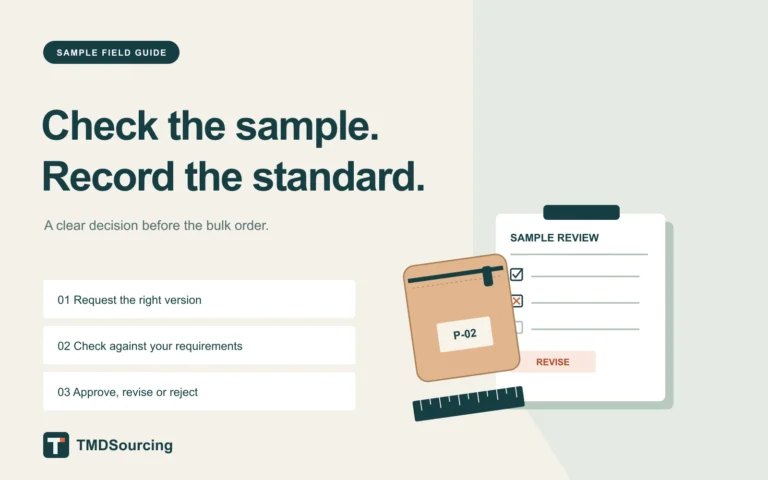
Define what each sample demonstrates. A catalog reference shows an existing product. An appearance prototype may demonstrate shape or finish without proving function. A production sample may use the intended materials and process, but you still need to know which requirements have been checked.
Keep the approved product specification, sample reference, packaging artwork and unresolved items together. State which version production must follow and who can approve changes. Our guide to ordering and approving samples from China covers the wider sampling process.
Follow the effect of a requested change
Suppose you select an existing organizer, then request another plastic material and a different connecting part. Treat this as a change to review, even if the product looks similar.
- Describe the change and the performance it must preserve or improve.
- Ask the appropriate technical party to assess manufacturability, fit, tooling and validation implications.
- Confirm the revised price, quantity constraints and schedule before authorizing the work.
- Review the required sample and evidence against the updated specification.
- Record approval, the effective production version and any remaining conditions.
The exact checks depend on the product. Do not assume the original sample, test report or production instructions cover every new configuration.
Manufacturing labels do not determine compliance
Both routes need agreed quality requirements and a review of the rules relevant to the product and destination. Inspection and laboratory testing serve different purposes; an approved-looking sample does not establish every safety requirement.
For example, the U.S. CPSC explains that manufacturers or importers of general-use consumer products subject to applicable rules have certification responsibilities, even when a third party assists. This is a specific U.S. example, not a rule for every product or country.
Confirm applicable requirements, evidence and responsible parties before production. Contractual task allocation does not automatically remove statutory obligations. Plan the order’s checks using a product-specific brief and, where appropriate, a pre-shipment inspection checklist.
Six questions to ask an OEM or ODM supplier
Use these questions to clarify a proposal, alongside verification of the supplier’s business and capabilities.
- What already exists? Identify the base model, design source and work needed for the requested changes.
- Who delivers and approves each output? List specifications, drawings, samples and the production-release reference.
- What is included in the quotation? Separate one-time costs, unit prices, quantity conditions and exclusions.
- What starts each lead-time stage? Record required inputs, approvals and unresolved dependencies.
- What rights and assets are available? Clarify design use, project outputs, files, tooling and any exclusivity.
- How are changes and quality requirements handled? Confirm the review process, evidence and approval authority.
Keep the answers in one project record
Separate a supplier’s proposal from your approval. A quotation, a sample photo and a message saying “OK” may refer to different versions. Use a short record to connect each decision to its actual reference.
A record to complete before authorizing the relevant stage
| Decision | Reference to record | Status |
|---|---|---|
| Product configuration | Specification revision, materials and requested changes. | To confirm / approved |
| Development work | Deliverables, responsible party, charges and milestone. | To confirm / approved |
| Sample release | Sample identifier, checks completed and open conditions. | To confirm / approved |
| Production scope | Quantity, packaging, quotation and delivery assumptions. | To confirm / approved |
Add the approver and date to each decision. An unresolved field stays open; approval of a sample’s appearance does not silently approve its material, price or production quantity.
A simple first message
Hello [contact],
We are reviewing manufacturing options for [product/reference]. We already have [model, sample, sketch or design files] and need [specific changes or development]. Our estimated quantity is [quantity] for [destination/intended market].
Please explain which parts are standard and which require new work. Could you separate development, samples and tooling from unit pricing, state quantity conditions, and describe the approval stages and information needed for a firm quotation?
We would also like to clarify the proposed design, file and tooling arrangements before authorizing development. Please identify any open requirements or separately quoted work.
You can begin with a clear reference rather than a complete technical package. Share only information you are entitled to use, and agree on appropriate confidentiality arrangements before disclosing sensitive detail. If you need coordination support, our guide to choosing a China sourcing agent explains how to assess the service scope.
OEM vs ODM FAQs
Does ODM always mean buying a catalog product?
No. Some suppliers use ODM for adapting their existing platforms; others provide new design and development. Ask which design already exists and which outputs must be created. The difference affects samples, charges and time. A supplier-designed product is not necessarily ready for immediate production.
Is ODM cheaper than OEM?
An existing platform can avoid some new development costs, but a new ODM design may require substantial work. Compare equivalent requirements at your planned quantities, including one-time charges and exclusions. Neither the acronym nor the lowest unit price establishes which route costs less overall.
Which model has a lower MOQ?
There is no universal order-quantity rule. Ask what drives the minimum for the product, material, color, components and packaging. The most restrictive item may determine your practical starting quantity. A supplier’s general “low MOQ” claim may apply only to a standard configuration.
Does paying for a mold mean I own it?
Do not rely on payment alone to answer that question. Confirm the arrangement in writing, including tool identity, ownership, custody, use, maintenance and transfer. Design rights and access to editable files are separate questions. Review the practical and legal position before treating tooling as transferable.
Can an ODM product be exclusive to my brand?
It may be possible to negotiate exclusivity for a defined product, modification, market or period. Confirm the supplier’s ability to grant it and any volume or fee conditions. Branding alone does not make the base design exclusive, and exclusivity is different from owning the underlying design.
Are OEM products better quality?
The model is not a quality grade. Results depend on the requirements, product design, materials, manufacturing controls and verification. A mature platform may perform well; a custom product may meet a more demanding specification. Assess the actual product and process rather than choosing by the label.
Can I switch from ODM to OEM later?
You can explore a different manufacturing route as requirements change. Review whether you may use the existing design, which new work is needed and what happens to files, tools and validation. A successful first order does not automatically give you rights to reproduce the product at another factory.
Can I start without complete technical drawings?
Yes, for an initial discussion. Share a product reference, intended use, changes, quantity and destination. Then establish what is needed for feasibility, a firm quote and production approval. If design work is missing, identify who will provide it, its outputs and its cost before starting.
Discuss your product requirements with TMDSourcing
Have a product reference, an existing design or a customization idea? Our Zhejiang-based team can help clarify the sourcing brief, compare suppliers and quotations, and coordinate samples and purchasing around the agreed scope.
Send your reference, the changes you need, estimated quantity and destination. You do not need to choose the correct manufacturing acronym before contacting us.
Discuss My ProductInitial consultation and quotation are free. We confirm feasibility, responsibilities and separately quoted work before you commit. See our product sourcing service and service fees.