During Production Inspection in China: Timing, Checklist and Follow-Up
Decide when to inspect work in progress, what to check on the factory floor, and how to verify corrections before the next production step.
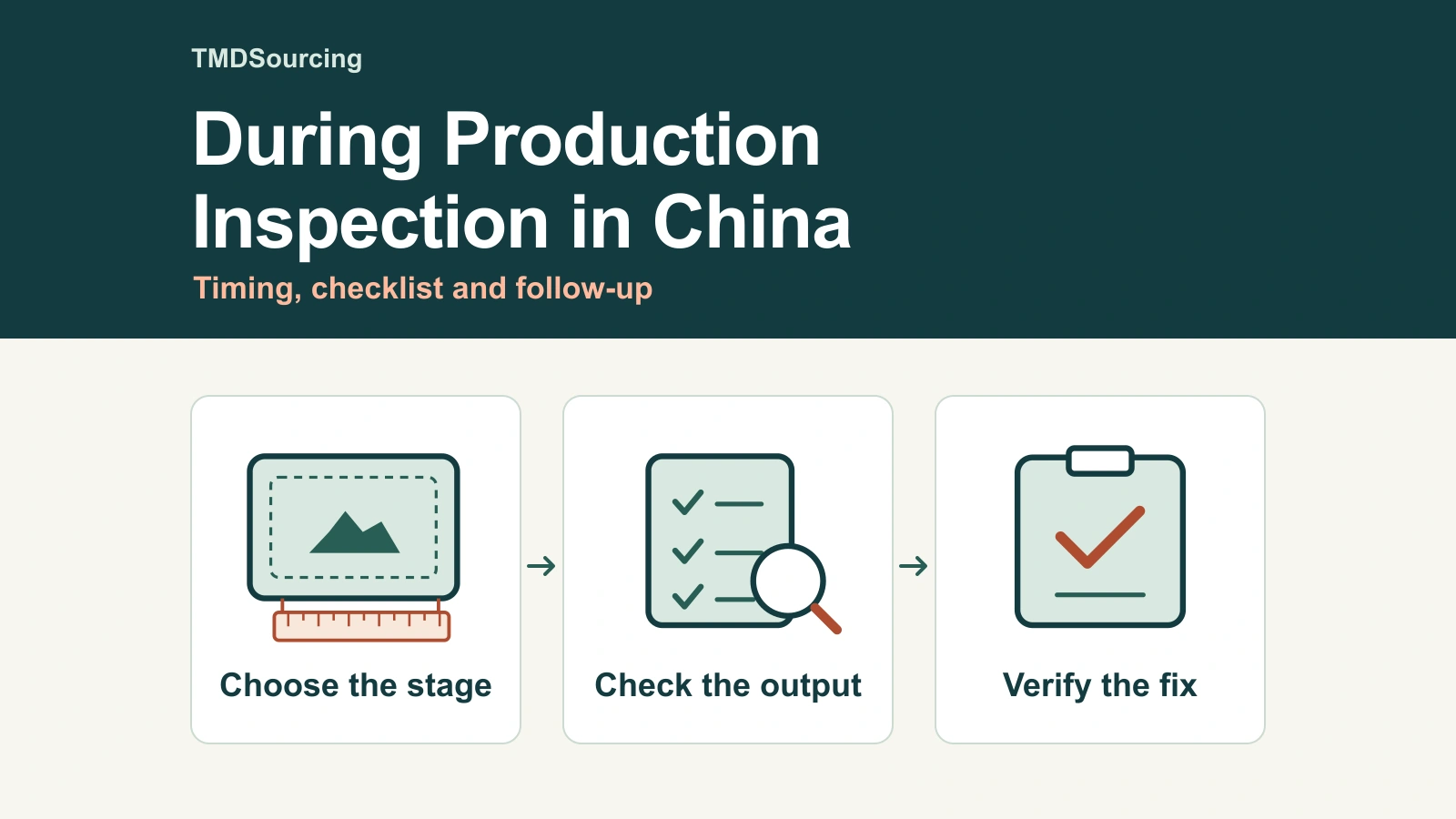
A during production inspection (DPI), also called a DUPRO inspection, checks selected goods and production steps while a factory order is still underway. Book the visit once the factory has traceable output from the process you need to check and there is time to correct a problem before the next step. Confirm what the inspector can access, which requirements apply and who can decide what happens if a check fails.
What Is a During Production Inspection?
A during production inspection is an on-site check at an agreed point in manufacturing. An inspector might measure a printed component before assembly, check the workmanship of early finished units or verify labels on the first packed units. The report covers the products, batches and checks available during that visit.
Swipe to see all columns.
| Check | When it takes place | What it helps the buyer decide |
|---|---|---|
| Pre-production check | Before bulk manufacturing starts | Are the specified materials, components and references ready for production? |
| During production inspection | While the order is underway and relevant output is available | Can the inspected work move to the next step, or does the supplier need to correct something first? |
| Ongoing production monitoring | Across agreed dates or stages while manufacturing continues | Does the factory need further follow-up as output, processes or batches change? |
| Pre-shipment inspection (PSI) | When the agreed quantity of finished and packed goods is ready for inspection | Does the finished lot meet the agreed inspection criteria before dispatch? |
Service names and coverage can vary. Confirm the actual checks when booking. Pre-shipment inspection checklist
When Should You Book a DUPRO Inspection?
Start with the process where a mistake could spread or become harder to correct. Print placement is easier to measure and correct before sewing. A label on an inner pack is easier to verify before cartons are sealed. Work backward from the next operation and allow enough time to review the report, isolate suspect output and check the correction.
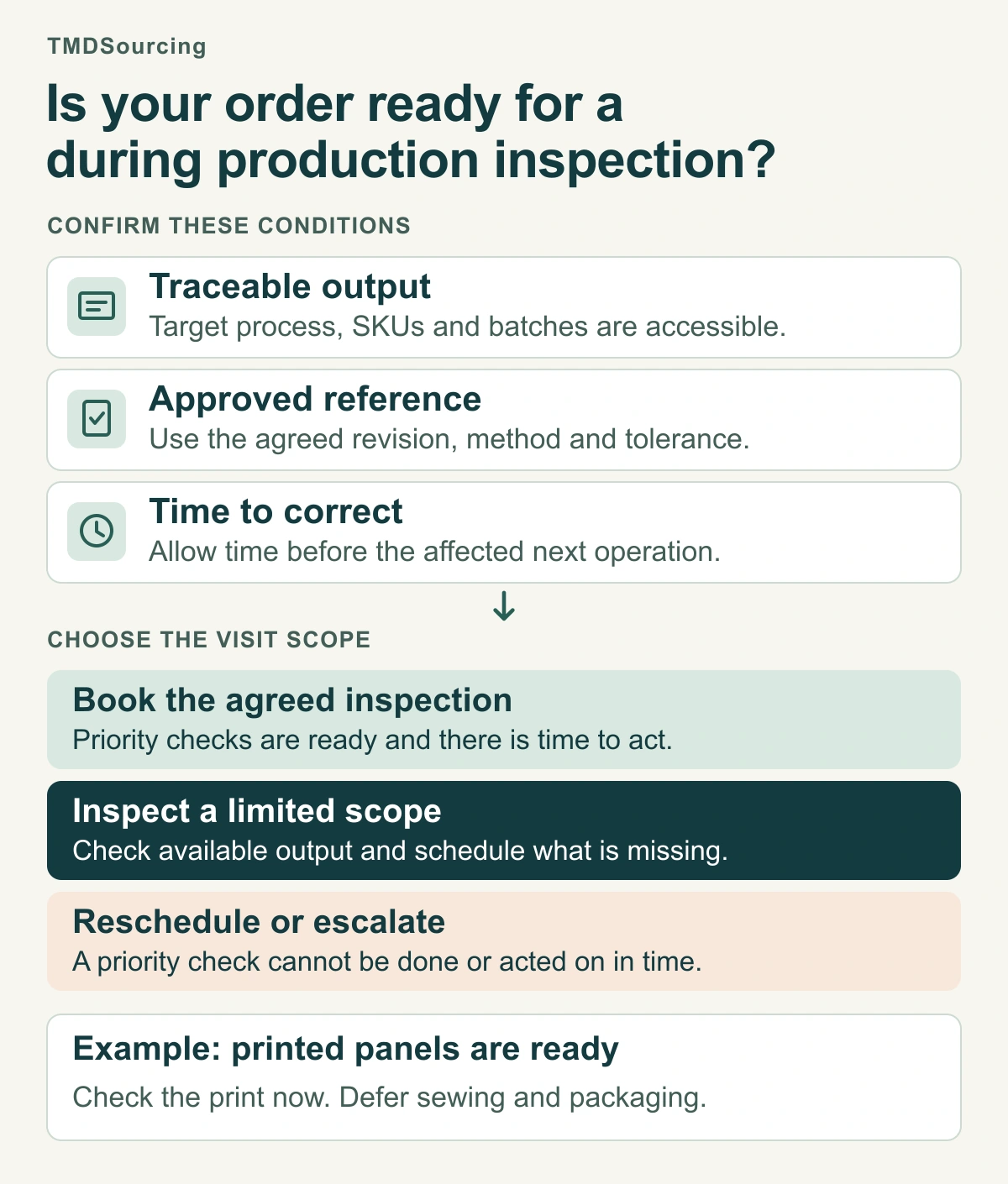
Ask the factory for three things before you commit to a date:
- Traceable output. Which site has the goods? Ask for quantities by SKU, batch and stage, including how many items have passed the operation you want to check.
- A usable reference. Confirm the current approved sample, drawing or artwork version, the tolerance and the method the inspector should use.
- Time to act. Confirm when the next operation begins and who can keep affected goods from moving forward while an issue is reviewed.
A progress figure needs a unit and a stage. Four hundred printed panels for a 2,000-pouch order tell you how far printing has progressed. Finished pouch and packed-unit counts may still be zero. Check any minimum production requirement with your inspection provider.
Book the agreed scope when the required output, access, tools and references are ready. Narrow the scope if an earlier operation can be checked and later checks can be scheduled separately. Reschedule or escalate if the priority batch is unavailable, the approved version is unresolved or the factory plans to move goods forward before you can act on the results.
During Production Inspection Checklist
Send the inspector and the factory the same visit brief. Define each priority check by the item, the reference and the result you need to record. If the sewing site and print shop are different, specify which facility the inspector will visit and which evidence the other site will supply.
- Order and access. Include the purchase order, SKUs, colorways, batch IDs, factory address and site contact. Confirm permission to access the goods and take measurements or photos.
- Approved references. Share the product specification, current drawing or artwork revision, tolerances and approved sample. Give an agreed way to measure or judge each priority point. Ordering and approving samples from China
- Quantities by stage. Ask how many components have completed the priority process, how many units are assembled and how many are packed. Record the same unit of measure against each planned quantity and keep overlapping stage counts separate.
- Sampling and tools. Agree which batches and variants the checks cover, how samples will be selected and what equipment is available. For a functional check, confirm the test setup and the pass criteria in advance.
- Timing and contacts. Share the next process date, the latest time to report an issue, the factory contact who can isolate goods and the buyer representative authorized to decide the next step.
Swipe to see all columns.
| Available at the visit | Possible checks | Record for follow-up |
|---|---|---|
| Components ready for assembly | Batch identification, component dimensions, artwork version or print placement against the approved reference | Assembly quality, finished dimensions and product function when finished units are available |
| Early assembled units | Workmanship, fit, dimensions and agreed functional checks | Later batches or variants that have yet to reach this stage |
| Packed units | Label content and placement, packing configuration and carton details within scope | Remaining packing and final quantities at the agreed shipment checkpoint |
What Should a DUPRO Report Include?
Begin with the visit date, factory, PO, SKU, batch and approved reference version. For each check, capture the quantity available, quantity examined, method, criteria and result. Attach photos or measurements that can be traced back to the relevant sample or batch.
Use Not checked for any agreed item the inspector could not examine. Give the reason, who will arrange the next check and the date or production milestone that makes it possible. For an out-of-spec finding, record the known facts and identify any additional batches the supplier needs to investigate.
If you use an acceptance sampling plan, agree on the lot, standard, sample size and acceptance criteria beforehand. Report findings within the scope of the check. The number of issues in a small process sample gives no reliable defect rate for the entire order. Use separate lab testing where a material, safety or regulatory requirement calls for it. NIST guidance on acceptance sampling · TMDSourcing quality control
Worked Example: A Logo Placement Error Before Sewing
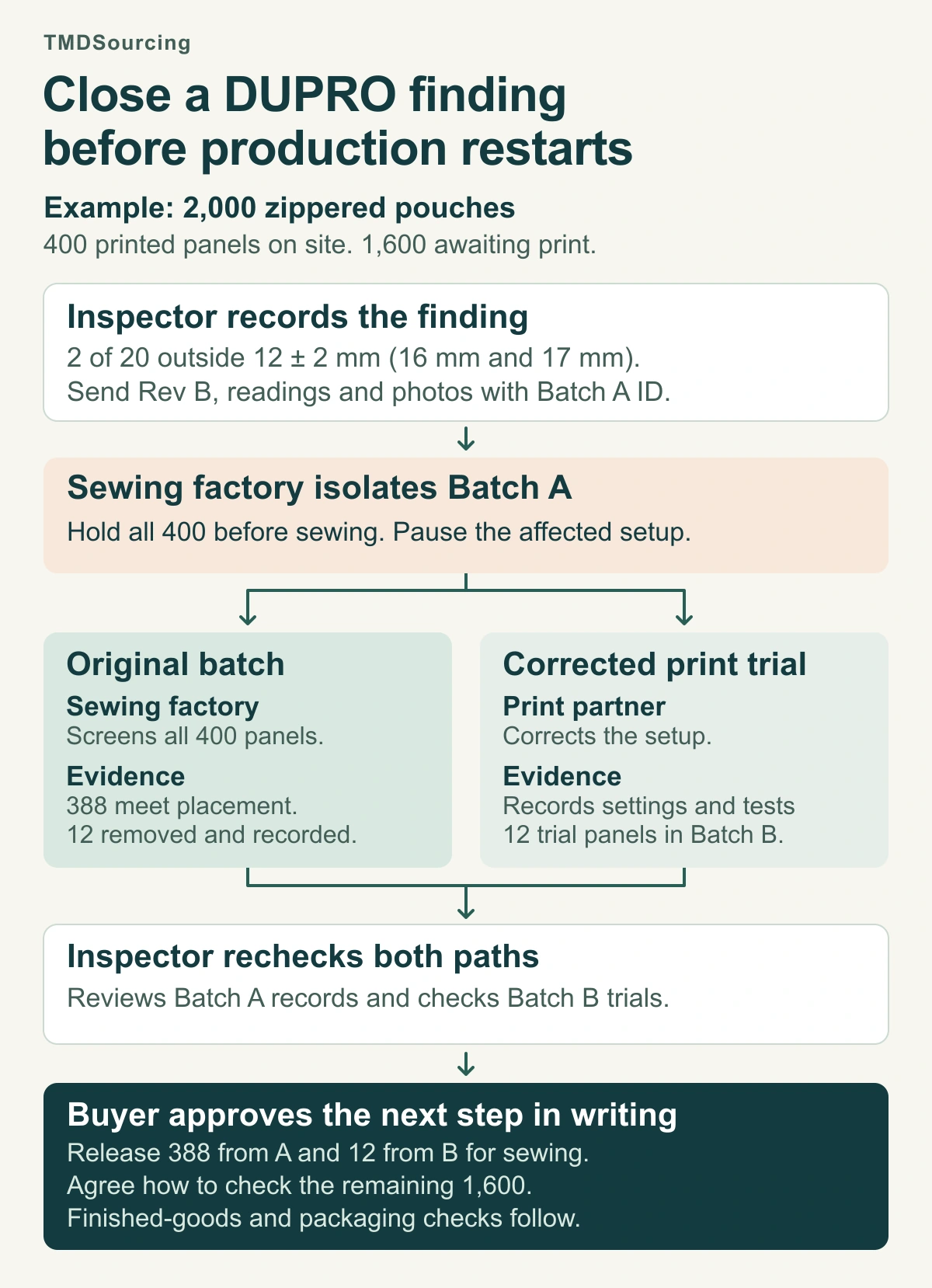
Suppose the buyer in our manufacturer guide places an illustrative order for 2,000 zippered fabric pouches, each requiring one printed front panel. The sewing factory has received 400 panels from print batch A. Another 1,600 await printing, with zero pouches sewn or packed. The agreed visit covers logo placement at the sewing factory. The print partner will supply production records if an issue comes up. Manufacturer selection and subcontracted process checks
- Document the finding. Artwork Rev B specifies 12 ± 2 mm between the left cut edge and the logo reference line shown on the drawing. The inspector checks 20 panels across labeled bundles. Two measure 16 mm and 17 mm. The inspector records both readings, sample IDs, the method and photographs tied to batch A.
- Isolate potentially affected work. The sewing factory tags and holds all 400 panels. Its production coordinator confirms the hold with the print partner, which pauses the affected setup. The 20-panel check establishes two observed failures. The factory screens the full batch to determine its actual disposition.
- Address the original batch and the print setup. The sewing factory's screen identifies 388 panels that meet the placement requirement and 12 that it removes from production. The print partner verifies a fixture setting error, corrects the setup and produces 12 trial panels under a new batch ID, B. It records the change and measures the trial output.
- Recheck before approving the next step. The inspector reviews batch A's screening and segregation records, checks an agreed subset of the 388 and measures all 12 trial panels from batch B. With that evidence, the buyer approves 388 panels from A and 12 from B for sewing. The buyer also authorizes printing the remaining 1,600 panels with the corrected setup and an agreed follow-up check. Finished workmanship, function and packing remain open.
The findings log keeps the two lines of evidence together. The original batch needs a documented disposition and the new setup needs evidence from corrected output. ASQ guidance on containment and corrective action
Copyable DUPRO issue record
Swipe to see all columns.
| Field | Example entry |
|---|---|
| Issue, order and checkpoint | DPI-01. PO-2000, SKU POUCH-01, sewing factory, print placement before sewing. |
| Requirement and evidence | Artwork Rev B, 12 ± 2 mm. Samples A-07 and A-14 read 16 and 17 mm. Photos P01–P02. |
| Containment and owner | Sewing coordinator holds batch A, 400 panels. Print partner pauses affected setup. |
| Corrective action and due point | Screen A, segregate rejects and verify the fixture correction before sewing or resuming bulk printing. |
| Original batch disposition | 388 eligible for review. 12 removed, with identifiers and disposition logged. |
| Corrected output and verification | Trial B, 12 panels. Inspector reviews A records, remeasures agreed A subset and checks all 12 B panels. |
| Decision and open checks | Buyer approval on record before restart. Release A 388 + B 12 to sewing. Print 1,600 with follow-up. Sewing, function and packing checks remain open. |
Blank issue record
PO:
SKU:
site:
checkpoint:
batch:
approved reference:
finding and evidence:
quantity held:
owner and due point:
original batch disposition:
corrected output:
recheck scope:
approver and date:
authorized next step:
open checks:
For a reusable file, see the quality inspection record template.
How Do You Decide Whether Production Can Continue?
Before the visit, identify who is authorized to release goods to the next operation under your purchase terms or written agreement. The inspector supplies observations and verification evidence. The factory identifies affected output, carries out the agreed action and records the quantities. The buyer or authorized delegate makes the release decision.
If only part of the batch is ready, specify the quantities and batch IDs eligible to move. If evidence remains incomplete, keep the affected goods on hold or agree a revised check. Document any separate work the factory can continue while the issue is open. Record each authorization against a process and scope, and set the trigger for later checks on new production and finished goods. Supplier follow-up and corrective actions
Frequently Asked Questions
Is 20% production completion enough for a DUPRO inspection?
It depends on what that percentage counts, which SKU and batch are available and what the provider requires. Confirm that the target operation has inspectable output and that there is time to respond before the next operation.
What can the inspector check if there are no finished units?
The inspector can check accessible in-process output against the approved reference, such as component dimensions, material identifiers or print positioning. Plan checks that need assembled or packed units for the stage when those goods are available.
Do I still need a pre-shipment inspection after DUPRO?
A DPI report describes the agreed in-process checks on the goods available that day. If your order requires final verification of finished workmanship, quantities or packaging, schedule those checks against the finished lot before shipment. Pre-shipment inspection checklist
How is a during production inspection quoted?
TMDSourcing quotes inspections separately. The quote depends on the site, product variants, agreed checks, time on site and any follow-up visits. Share what the factory has ready and which operation you need checked so the scope can be confirmed.
Plan Your Production Inspection
Send your product, order quantity, factory city, current production stage and target ship date. Include the main issue you want to catch. TMDSourcing can review the visit scope with you and quote against the agreed checks.