SOURCING GUIDES / FINDING MANUFACTURERS
How to Find a Manufacturer in China: From Search to Shortlist
Build a useful factory shortlist with a clear brief, relevant sourcing channels and evidence you can follow up.
How do you find a manufacturer in China?
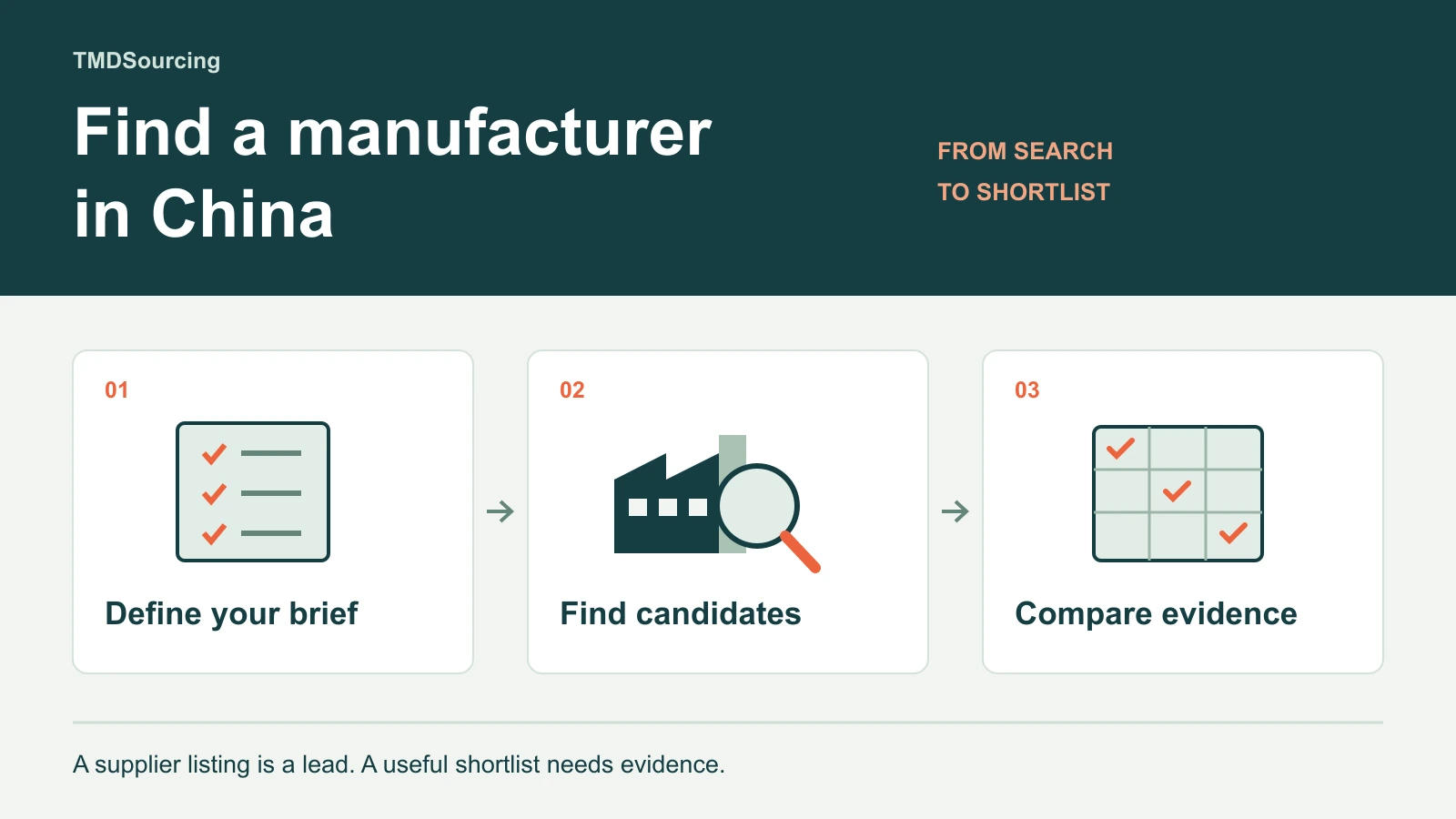
Start with a clear product brief, find candidates through several relevant channels, and send each one the same enquiry. Compare their production processes, specification gaps and supporting evidence before paying for samples. A listing, introduction or attractive quotation gives you a lead; it does not establish that a factory can make your product consistently.
This guide takes you from an initial search to a working shortlist. It applies to commercial buyers sourcing existing products, branded variations or custom manufacturing—not only to first-time importers or low-volume orders.
Decide what kind of manufacturer your product needs
“A factory that makes bags” is a broad search. A supplier producing basic promotional totes may have different equipment, materials and commercial priorities from one producing structured travel bags. Define the work before choosing the channel.
- An existing item with branding: look for a suitable current product, then confirm which colors, logos and packaging can change without new development.
- A modified product: identify the features that must change and ask how they affect materials, tooling, samples and minimum quantities.
- A product made to your specification: search for the relevant manufacturing processes and comparable work. Clarify whether you need production only or also design and engineering support.
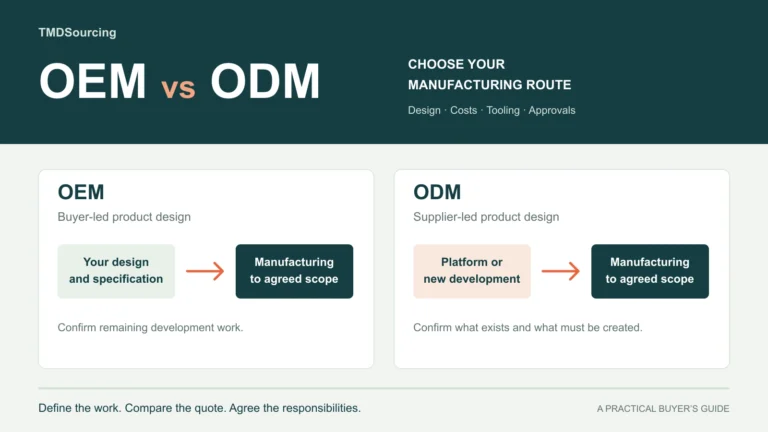
Our OEM vs ODM guide explains these arrangements in more detail. For the search itself, describe what you already have: a reference item, drawings, a prototype or an early concept.
Also distinguish the seller from the production site. A factory may subcontract printing or surface finishing; a trading company may coordinate several manufacturers. Neither arrangement should be judged by its label alone. You need a transparent explanation of who does the work, who controls it and who will be responsible for your order.
Prepare a manufacturing search brief
Give candidates the same starting information. If one assumes a lightweight material and another allows for a reinforced construction, their prices and minimum quantities will not describe the same job.
A brief does not need to be a finished engineering pack for every product. It should identify the essential requirements, the decisions still open and the help you expect. Mark each item as confirmed, open for discussion or not acceptable to change.
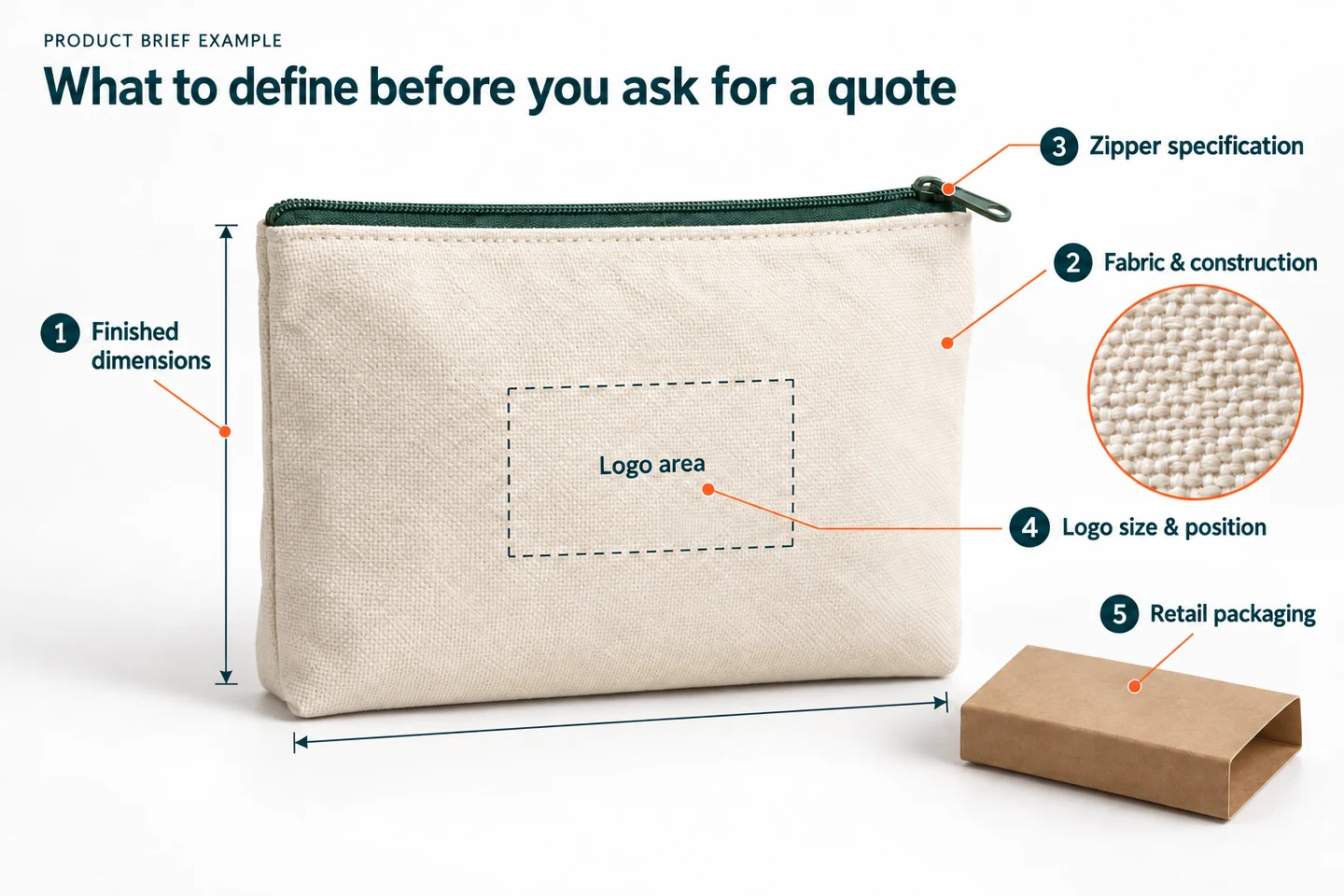
What to include before asking factories to quote
| Field | Useful detail | If it is not decided |
|---|---|---|
| Product and use | Reference images, intended function, user and sales channel. | Explain the problem the product must solve. |
| Specification | Dimensions, materials, construction, finish and important tolerances. | Ask for feasible options and their differences. |
| Customization | Logo method, artwork, colors and any changed components. | Separate essential features from preferences. |
| Quantity | Initial quantity, variants and a realistic reorder expectation. | Request feasible trial and production options. |
| Market requirements | Destination, intended use and applicable requirements already identified. | Flag the review needed before committing. |
| Packaging and delivery | Pack contents, protection, destination and required delivery milestone. | Distinguish a target date from a confirmed schedule. |
| References | Drawing, sample or specification version and date. | Identify provisional information explicitly. |
On a smaller screen, swipe the table sideways to read all columns.
The logic is to match technical requirements with commercial expectations. For example, NIST’s supplier-scouting brief asks for both types of information. That is a useful procurement principle; NIST’s program serves US domestic sourcing, not searches for Chinese factories.
If you have an uncertain material or performance requirement, record the uncertainty instead of copying a certification list from another product. Product and destination requirements need their own review. A manufacturer’s willingness to quote does not settle them.
Where to find manufacturers in China
Use channels that suit the product and combine their results. There is little benefit in collecting hundreds of names if none can explain the processes your order requires.
1. B2B platforms and supplier websites
Alibaba, Made-in-China and Global Sources can help you discover suppliers and compare the language used for similar products. Search a specific product or process rather than a broad category: “zippered canvas pouch manufacturer” is more useful than “bag supplier.”
Read company profiles and available assessment reports. Alibaba’s official Verified Supplier explanation describes checks covering areas such as business type, production processes, machinery and subcontractors. Look at the report’s entity, site, date and actual scope. A badge does not guarantee that the supplier can meet your specification, current schedule or product requirements.
For Chinese-language discovery, 1688 can add candidates, but confirm their export and communication arrangements. Our guide to buying from 1688 outside China covers the additional purchasing steps.
2. Trade-fair exhibitor directories
You can research an exhibitor list before deciding to travel. The official Canton Fair app supports finding exhibitors and products by category and keyword. Use the organizer’s official resources to collect names and product references, then contact relevant businesses with your brief.
A booth or past appearance is a discovery lead. Ask which company is selling, where production takes place and whether the displayed product reflects work the supplier can perform for you. Check the current edition if you are planning meetings; an old directory does not establish present availability.
3. Process searches, industry contacts and production clusters
Search for the capability behind the product: sewing and printing, plastic injection molding, metal stamping or another relevant process. Add a location when it helps narrow a search, but treat an industrial cluster as a starting point rather than proof of quality.
A supplier outside a familiar province is not automatically a trader, and an address inside a cluster does not prove that the company operates a factory. Ask contacts or industry networks for introductions, then apply the same checks to referred businesses as to unfamiliar listings.
4. A sourcing partner
A sourcing agent can help turn an incomplete brief into supplier questions, communicate with candidates and coordinate follow-up. Discuss the product scope, fees, factory information you will receive and the work included. “We have many factories” is less useful than an explanation of how candidates will be compared for your specific requirements.
TMDSourcing’s product sourcing service supports this search and coordination. The appropriate route depends on your product, available information and the level of help you need.
Send candidates the same first enquiry
The first message should reveal suitability, not simply request the lowest price. Attach your current brief and ask the recipient to identify exceptions. A clear “we cannot meet this requirement” can save more time than an unqualified “yes.”
Subject: Manufacturing enquiry — [product], [quantity], [destination]
Hello [name],
We are looking for a manufacturer for [product and intended use]. Our initial requirement is [quantity and variants], for delivery to [destination]. Attached is brief [version/date], with reference images or drawings.
Please confirm:
- Which similar products and manufacturing processes do you currently handle?
- Which operations would be in-house, which would be subcontracted, and where would production take place?
- Can you meet each confirmed requirement? Please list any proposed substitutions or unresolved points.
- What are your minimum quantity, sample route, sample charges and estimated production lead time? Please state assumptions.
- What supporting information can you share about the relevant capability and quality checks?
Please separate product, customization, tooling and packaging costs where applicable, and state the delivery basis and quotation validity.
Our target milestone is [date/event]. Please tell us what needs to be confirmed before you can commit to it.
Thank you,
[name / company]
Use filenames and version references that make attachments easy to identify. Keep changes in one updated brief and ask candidates to acknowledge them. Otherwise, a later reply may still refer to a specification you have already replaced.
If responses are vague, check the brief before sending more messages. A target date without a quantity, or a reference photo without the feature you want to reproduce, may leave important assumptions open. Ask one focused follow-up: for example, “Which fabric construction does this quotation include, and does it match the attached brief?” If a candidate repeatedly avoids a necessary question, record that gap and reconsider the discussion. Faster replies are useful, but the quality and relevance of the answers matter more than speed alone.
Compare capability, evidence and open questions
Build one candidate sheet rather than trying to remember several chat histories. Record what a supplier claims, what supports it and what still needs an answer. Add a next action for each unresolved item.
A working manufacturer shortlist
| Check | Ask for | What remains to establish | Next action |
|---|---|---|---|
| Company and site | Selling entity, production address and their relationship. | Whether documents and the actual arrangement are consistent. | Resolve discrepancies before approval. |
| Relevant processes | Similar work, equipment and an explanation of the production steps. | Suitability for your material, dimensions and finish. | Ask targeted questions or arrange a review. |
| Outsourced work | Operations performed elsewhere and who controls them. | Responsibility for quality, changes and timing. | Confirm the proposed production route. |
| Specification fit | A reply against the brief, including exceptions. | Whether a proposed substitution is acceptable. | Clarify or reject changes explicitly. |
| Order fit | Quantity, variant, material and scheduling assumptions. | Whether the order is workable at the quoted scope. | Confirm open commercial conditions. |
| Quality controls | Relevant check methods, records or report examples. | How your requirements would actually be checked. | Agree the sample and inspection plan. |
On a smaller screen, swipe the table sideways to compare the columns.
A business document supports identity; a process explanation supports a capability claim; a sample supports an assessment of that sample. None answers every question. Check report dates, product coverage and site details rather than collecting documents without reading them.
For a live video call, agree what you need to see: relevant machinery, work in progress, material handling or a specific quality check. A showroom tour alone cannot establish who will make the order. Follow up on anything the call leaves unclear.
Subcontracting deserves questions, not automatic rejection. A sewing factory may use a separate printer with a suitable process. Establish how artwork revisions, incoming checks and rejected work would be managed. An unexplained change of site or process should pause the decision until the arrangement is understood.
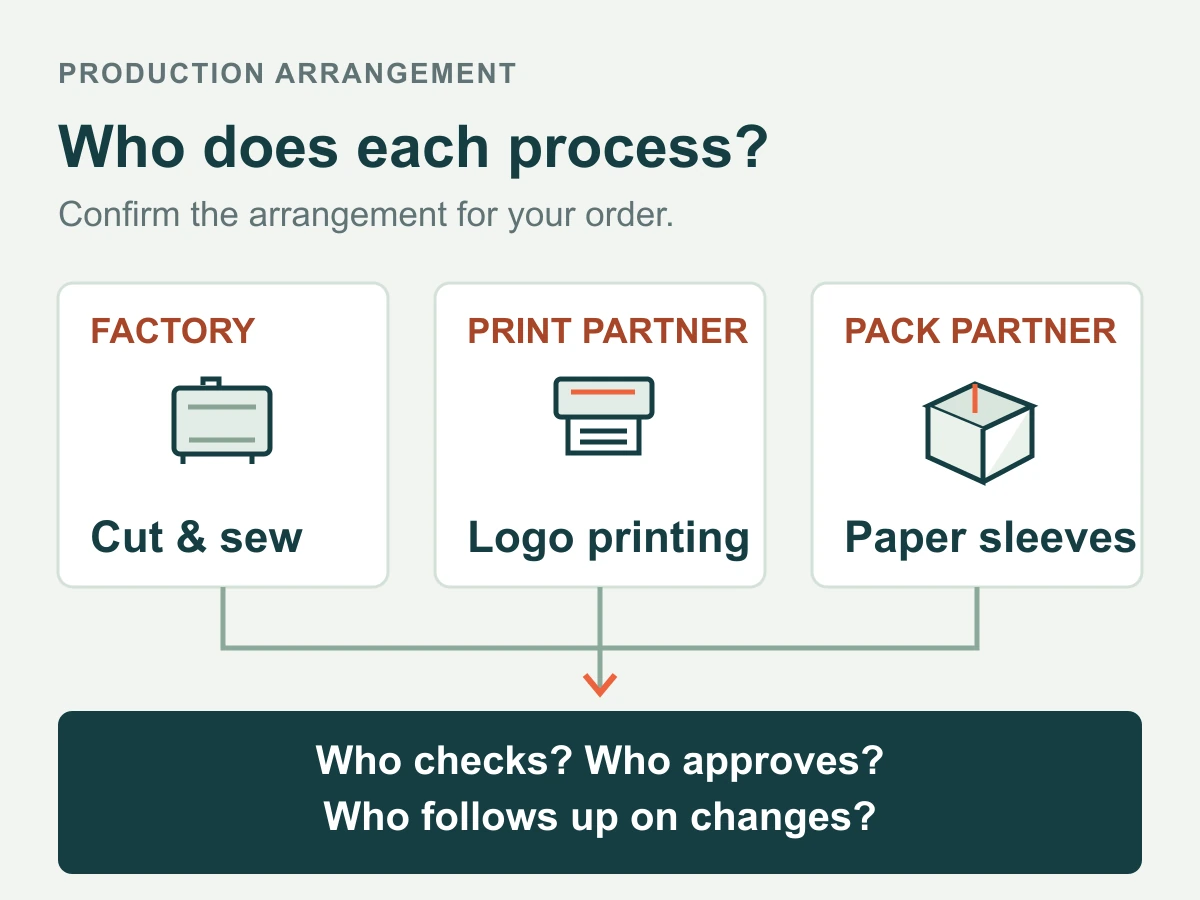
Do not let a high overall score hide a missing essential requirement. If the product needs a particular construction and the supplier proposes a different one, resolve that issue before progressing. A factory that answers precisely but cannot meet your needs may simply be the wrong fit.
For deeper identity, site and payment checks, use our Chinese supplier verification guide. Once the specifications are aligned, compare supplier quotations on the same commercial basis.
Worked example: shortlisting factories for a custom fabric pouch
This is a fictional planning example, not a TMDSourcing customer case or a market quotation. A brand wants 2,000 zippered fabric pouches with a printed logo and retail paper sleeve. Its brief fixes the finished dimensions and fabric construction, while the exact print method remains open for discussion.
Three candidates reply to the same brief:
What the replies tell the buyer—and what they do not
| Candidate | First response | Open question | Useful next step |
|---|---|---|---|
| A: sewing factory | Describes cutting and sewing in-house, with printing by a partner. | Who approves the print and checks it before sewing? | Review print options and ask for a sample plan covering both stages. |
| B: trading company | Identifies its role and proposes coordinating the pouch and sleeve suppliers. | How will production sites and responsibilities be documented? | Clarify the arrangement and compare its total scope. |
| C: claimed factory | Offers a lower price but quotes lighter fabric and a standard pouch size. | Can it meet the original construction and dimensions? | Request a corrected response before comparing price or ordering samples. |
On a smaller screen, swipe the example sideways to read all columns.
A’s factory status does not settle its print control. B’s trading role does not automatically disqualify it. C’s lower price is not yet comparable. The buyer first resolves the scope and capability questions, then chooses which candidates merit samples and further verification. No supplier is approved solely from these replies.
Move from the shortlist to samples and a first order
Before commissioning a custom sample, confirm its purpose, specification version, charges, delivery arrangements and what it can demonstrate. An existing showroom item can help assess workmanship, but it does not approve a changed material, new logo or complete retail pack.
Use the sample ordering guide to plan the review. Record accepted features and required changes, then confirm whether the sample method reflects the proposed production method. Do not approve an undocumented substitution simply because the sample looks attractive.
If quantities prevent progress, ask which component or setup drives the minimum. Our MOQ negotiation guide explains options to discuss without assuming the factory can accept every requested quantity.
Before a production order, bring the agreed specification, commercial terms, manufacturing responsibilities, checks and release decisions together in writing. Follow up on outstanding requirements before the relevant commitment. Assess the first production result against what was agreed, and use that evidence when deciding whether to continue or expand the relationship.
Keep a record of why a candidate was retained, deferred or rejected. It makes a later search more useful and prevents another team member from restarting discussions around an unsuitable proposal.
Finding Chinese manufacturers: FAQs
How do I find a manufacturer in China?
Describe the product and manufacturing work, search relevant platforms, exhibitor directories and industry contacts, then compare candidates against one brief. Ask about production location, in-house and outsourced processes, specification exceptions and supporting evidence. Move suitable candidates to verification and samples. A long list of company names is only the beginning.
Can I find a factory without visiting China?
Yes, candidate discovery and initial discussions can happen remotely. Profiles, documents, relevant reports and targeted video calls help you decide what to investigate next. Where an on-site review is warranted, agree its scope with a suitable local representative or service provider. Remote communication does not remove the need to check the actual production arrangement.
How can I tell a factory from a trading company?
Ask which entity sells the goods, where they are produced, which processes it operates and which are performed elsewhere. Cross-check the explanation against relevant documents and site evidence. Company names, product ranges and location are clues rather than conclusive tests. A transparent trading company may still suit the order; an undisclosed arrangement needs clarification.
What should I send in my first enquiry?
Send the product reference, intended use, important specifications, quantity and variants, customization, destination and target timing. Identify provisional details and ask the supplier to state exceptions and assumptions. Include a brief version or date so replies can be compared. The enquiry template above gives you a practical starting point.
Do I need CAD drawings before contacting a manufacturer?
Not for every product. For an existing item with limited changes, reference samples, annotated images and clear specifications may start the discussion. Custom components or new tooling can require detailed drawings and technical development. Tell the supplier what exists and what support is needed; do not treat an early concept as a production-ready specification.
How many manufacturers should I compare before ordering samples?
There is no universal number. Compare enough relevant candidates to understand feasible processes and commercial differences, while keeping the review manageable. Order samples only from those with a plausible route to meeting your essential requirements. Several vague quotes do not provide better coverage than fewer well-understood proposals, and one response alone offers little comparison.
Need help turning your product brief into a supplier search?
Send TMDSourcing your product reference or current specification, estimated quantity and destination. Tell us what is decided and where you need help. We can discuss supplier sourcing, candidate follow-up and the next steps for your project.
Discuss Your ProductA product link or reference image is enough to start the conversation.