SOURCING GUIDES / PRODUCT SELECTION
Best Products to Import from China: 12 Categories to Evaluate
Explore specific product ideas, compare sample checks and shipping costs, and build a shortlist that fits your customers.
The best products to import from China are products you can sell to a defined customer, check against a clear specification and deliver at a workable total cost. Home organization accessories, manual cleaning tools, travel bags, stationery and retail packaging are useful places to begin a shortlist. The right choice depends on your market, sales channel and ability to manage the product.
Below are 12 categories to evaluate, with specific examples, sample checks and reasons to reject an unsuitable item. This is an editorial shortlist, not a ranking of bestsellers or guaranteed profits.
12 product categories to import from China
Compare products at SKU level. Two items in the same category can have very different materials, shipping costs and legal requirements. Use this table to find candidates, then check the details below.
On smaller screens, scroll the table sideways.
| Category | Examples | Main buying check |
|---|---|---|
| Home organization | Drawer dividers, fabric organizers | Actual fit and packed volume |
| Manual cleaning | Microfiber cloths, detail brushes | Performance after repeated use |
| Beauty and hair tools | Makeup brushes, heatless curling ribbons | Material, shedding and finish |
| Adult fashion accessories | Claw clips, scrunchies, bucket hats | Comfort, construction and variants |
| Travel accessories | Packing cubes, toiletry bags | Zippers, seams and usable capacity |
| Pet grooming accessories | Grooming mitts, brushes | Suitability for the animal and use |
| Stationery and desk storage | Notebooks, document pouches | Paper, binding and printing |
| Non-powered tech accessories | Phone stands, laptop sleeves | Compatibility and stability |
| Home textile accessories | Cushion covers, table runners | Fabric consistency and wash behavior |
| Manual fitness accessories | Yoga straps, resistance bands | Strength, durability and failure risk |
| Garden organization | Plant labels, soft plant ties | Seasonality and outdoor performance |
| Retail packaging and display | Gift boxes, jewelry display cards | Fit, print quality and assembly |
1. Home organization accessories
Products to consider: adjustable drawer dividers, fold-flat fabric organizers and compact cable storage boxes.

These suit homeware retailers and brands that solve a specific storage problem. A divider sized for common local drawers, or an organizer with useful compartments, gives customers a clearer reason to buy than a generic “storage solution.” Check the dimensions your customers actually need before choosing a mold or size range.
Measure samples, inspect edges and joints, and test the intended load and folding action. Ask for packed carton dimensions: a lightweight item can still be expensive to ship if it contains mostly empty space. Nesting or flat packing may help, provided it does not damage the product. Reject an item if fit is uncertain or freight removes the value advantage. Food-contact or children’s applications need their own requirements review.
2. Manual cleaning tools and cloths
Products to consider: microfiber cloth sets, detail cleaning brushes and reusable lint brushes.
There are distinct buying needs in household cleaning, automotive detailing and commercial cleaning. Specify the surface and task rather than asking for the supplier’s “best quality.” Cloth size, fiber composition, weight, edge finish and pack quantity all affect the quote. Color coding or a well-chosen tool set can make a practical difference.
Check absorbency, lint, color transfer and performance after washing. For brushes, examine bristle retention and test on the intended surface for scratching. A very low unit price may leave little room for fulfillment and customer acquisition costs. Do not add antibacterial, disinfecting or chemical-resistance claims without checking the evidence and rules that apply. A manual cleaning accessory is a different sourcing project from a cleaning chemical.
3. Non-electric beauty and hair tools
Products to consider: makeup brush sets, heatless curling ribbons and cosmetic tool travel cases.

Beauty retailers can differentiate through brush shape, handle feel, softness and a useful selection of tools. A smaller, coherent set may serve a customer better than a large set with repetitive pieces. Define materials and construction, and check whether the supplier can maintain the approved finish across production.
Look for shedding, loose handles, rough edges, dye transfer and problems after cleaning. For a curling ribbon, assess stitching, fastening and comfort under its intended use; avoid promises of results you have not substantiated. Custom handles, colors and presentation boxes can create separate minimum quantities and setup costs. Keep this shortlist separate from cosmetic formulas, adhesives, powered devices and treatment claims, which require different technical and regulatory preparation.
4. Adult fashion and hair accessories
Products to consider: hair claw clips, fabric scrunchies and adult bucket hats.
These can fit fashion boutiques, accessory collections and seasonal retail. Choose an identifiable use or style: a clip suitable for a particular hair type, a comfortable scrunchie or an original fabric collection. Confirm your rights to designs and artwork; changing a logo does not resolve another company’s design rights.
Test clip springs, hinges and edges; check scrunchie elasticity and seams; inspect hat sizing and shape. Photograph approved colors under consistent lighting. Too many colors and sizes can split purchasing quantities and leave slow stock, even when the combined order looks manageable. Check applicable material, labeling and safety obligations for the destination. An item marketed for children can introduce requirements that do not apply to an adult version. Reject samples that look good but fail everyday handling.
5. Travel bags and packing accessories
Products to consider: packing cubes, toiletry bags and shoe bags.

Travel accessories work best when the design has a clear purpose: fitting a common suitcase, separating shoes or making toiletries easy to access. Compare actual internal capacity, not only external dimensions. Fabric weight, lining, zipper quality, handles and stitching should be specified before comparing prices.
Load a sample as a customer would, operate the zippers repeatedly and inspect seams and stress points. Ask how bags will be folded and packed for transport, and whether this causes creasing or deformation. Custom fabric and packaging may have different minimums from stock bags. Claims such as waterproof, flame-resistant or antimicrobial need appropriate support. A travel bag with a battery or charging function belongs in a more complex sourcing assessment than a simple sewn bag.
6. Non-electric pet grooming accessories
Products to consider: grooming mitts, pet brushes and pet-hair removal tools.
Start with the animal, coat type and intended task. A brush suitable for one use can be uncomfortable or ineffective for another. Pet shops and specialist retailers may have useful customer feedback about grip, cleaning and storage that can guide a better specification.
Check rounded tips, secure parts, handle strength and ease of cleaning. Consider foreseeable licking or chewing and whether a detached part could create a hazard. Material descriptions and product-use instructions should be clear. Pet accessories are not automatically low risk simply because they are not children’s products. Exclude pet food, medicines and powered equipment from this basic shortlist. Stop if the supplier cannot explain the materials or support the intended use, and arrange suitable technical review where the product requires it.
7. Stationery and desk organization
Products to consider: notebooks, pen holders and document pouches.

These can serve office retailers, gift businesses and corporate purchasing. Original layouts, useful paper formats and coordinated desk sets offer more meaningful differentiation than adding a logo alone. For notebooks, specify page count, paper weight, ruling, binding and cover finish. Check that quoted page and sheet counts mean the same thing.
Test common writing instruments for bleed-through, inspect binding and compare print colors with an approved reference. Paper products can be heavy, so include carton weight in the cost comparison. Printing setup and artwork changes can affect both price and lead time. Products intended for children need a separate age and materials assessment. Do not order a wide collection before confirming which formats your customers need and how well the supplier reproduces the sample.
8. Non-powered phone and laptop accessories
Products to consider: phone stands, laptop sleeves and cable clips.
Focus on compatibility and everyday function. A stand should support the intended device and case; a sleeve needs usable internal dimensions and adequate protection. Cable clips need an opening and adhesive suitable for the intended cable and mounting surface. Ask which variations are genuinely necessary rather than stocking every device model.
Check stability, hinges, finish, stitching and adhesive behavior. Metal parts can increase weight; oversized packaging can increase freight. Model-specific inventory can become obsolete, and unusual designs may require an intellectual-property check. Adding charging, wireless connectivity or a battery changes the technical and shipping scope. Reject unsupported “universal fit” claims and confirm fit with representative devices before approving the order.
9. Home textile accessories
Products to consider: cushion covers, adult table runners and fabric storage baskets.

Home textile brands can build a collection around texture, dimensions and coordinated colors. Specify fiber composition, fabric weight, weave, finish and construction. A photograph cannot reliably show fabric feel, opacity or the quality of a zipper. Decide whether you need covers only: shipping inserts or filling can substantially increase volume.
Wash samples according to the proposed care instructions and check shrinkage, colorfastness, seams and closures. Ask how production color variation will be controlled. Review labeling and any applicable flammability or safety requirements for the exact product and market. The FTC textile labeling guide illustrates why covered items and exemptions must be checked individually. Infant sleep products and items with weighted or therapeutic positioning need a separate assessment.
10. Manual fitness and yoga accessories
Products to consider: yoga straps, resistance bands and yoga blocks.
Fitness studios and retailers may know the dimensions, grip and resistance their customers want. That knowledge helps create a specification, but these products need careful evaluation because failure during exercise can cause injury. They are conditional candidates, rather than an automatic easy first import.
Define intended use, material, load or resistance requirements, and an appropriate durability test plan with competent support. Inspect seams, joints, buckles and material consistency. A casual stretch test is not evidence of long-term performance, and unsafe live testing should not replace suitable testing. Consider latex-related material information, instructions and product liability. Bulky yoga blocks also need a freight calculation. Reject a supplier that cannot support the agreed performance requirements, and avoid unsubstantiated medical or health claims.
11. Garden organization accessories
Products to consider: plant labels, soft plant ties and garden tool storage bags.
These suit garden retailers and businesses serving a defined growing season. Useful differentiation might include legible labels, ties in practical lengths or a storage bag that fits the customer’s tools. Forecast the required arrival date before accepting production and shipping lead times; missing the season can matter more than saving a little on the unit price.
Check edges, fastening, marking retention and the evidence behind outdoor durability claims. Confirm material and packaging requirements, particularly if natural materials are involved. This shortlist does not include seeds, pesticides or sharp cutting tools. Do not describe an item as weatherproof or UV-resistant solely because a listing does. Reject a product if its claimed service life cannot be supported or the delivery schedule misses your selling window.
12. Retail packaging and display accessories
Products to consider: flat-pack gift boxes, jewelry display cards and small non-powered display stands.

These may suit retailers, brands and wholesale packaging businesses with repeat requirements. Start with the actual item to be packed or displayed. Record dimensions, weight, print artwork, color reference and assembly method. A box that looks impressive but takes too long to assemble can add labor costs at every order.
Approve fit, folds, print registration, surface finish and stand stability using physical samples. Ask about die, plate and setup charges, repeat-order costs and packed volume. Food-contact packaging needs a separate materials assessment; local packaging and producer-responsibility rules may also apply. Be specific about environmental claims: the FTC Green Guides summary explains the problems with broad, unsupported green claims. Avoid committing to large quantities of branded packaging before the product and artwork are finalized.
Have a product shortlist already? Send TMDSourcing your references, quantities and destination so we can discuss sourcing feasibility and the information needed for a quote.
Products that need more preparation before importing
More complex products can work for a prepared importer. They simply need a different budget, documentation and support plan.
- Electronics and battery products: assess electrical safety, radio requirements where relevant, technical documents, warranty support and transport acceptance. Battery shipping has specific conditions; check current carrier requirements and the IATA battery transport guidance before arranging air shipment.
- Toys and children’s products: age, small parts, magnets, testing and traceability can change the project. For example, US requirements under the CPSIA need to be assessed against the actual children’s product and applicable rules.
- Cosmetics and products with therapeutic claims: review the formula, labeling and intended claims for the destination. Registration is not a blanket approval of a cosmetic product.
- Food-contact items: identify the material, food type, contact time and temperature. The European Commission’s food-contact overview provides a starting point for EU requirements. A generic “food grade” certificate is not enough to answer every use case.
- Heavy, fragile or highly customized goods: model breakage, protective packing, storage, tooling and replacement costs. A workable container order may have very different economics from a parcel shipment.
There is no universal import certificate. For example, CE marking applies to specified product groups, rather than every item sold in Europe. Establish the requirements for your exact product before paying for production.
How to choose the best products for your market
Define the customer before the supplier
Write down your destination country, sales channel, target customer and intended selling price. Then state the problem the product solves. “Travel accessories” is too broad; “packing cubes sized for our customers’ carry-on luggage” gives you something to validate and specify.
Use your own enquiries, repeat orders and customer feedback where available. Compare current local listings, actual selling prices, promotion frequency and recurring complaints. Review counts can reveal issues but do not prove current sales. Record the market and date of your observations.
Validate demand without confusing the signals
Use search trends to investigate seasonality and compare interest in your region. Google Trends normalizes interest on a 0–100 scale; it does not report absolute monthly searches or units sold. A rising trend is a reason to investigate demand, not a purchase forecast.
Shortlist three specific products. For each, record the target buyer, proposed price, competing alternatives and a reason someone would choose yours. Avoid treating a popular category as evidence that another undifferentiated SKU will sell.
Apply the buying gates before scoring the opportunity
Check intellectual-property concerns, applicable product requirements and shipping feasibility first. A strong margin estimate cannot compensate for an unresolved safety requirement or an item your carrier will not accept.
Request matching specifications from two or three suitable suppliers. Confirm minimum quantities per product, color and packaging design. Use our MOQ negotiation guide when a workable adjustment could reduce unnecessary variants. Follow the Chinese supplier verification checklist before committing funds.
Approve a sample, then test your assumptions
Record the approved specification and defects you will reject. Our guide to ordering samples from China explains what to confirm before production. Choose an initial order you can support with cash, storage and a credible sales plan. Measure actual selling costs, complaints, returns and stock movement before expanding. The best reorder candidate is supported by your results.
Calculate contribution, not just the factory-price markup
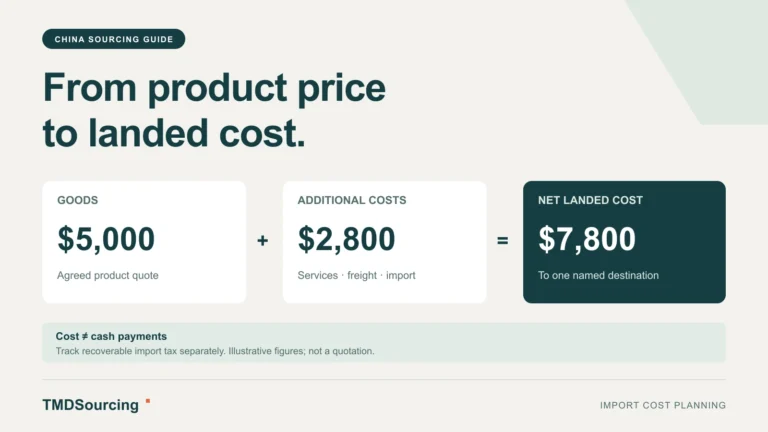
A product can appear profitable at the supplier’s price and leave little money after delivery and selling costs. First calculate its landed cost from China, including the relevant purchasing, inspection, packing, freight and import charges. Count each charge once.
Contribution per unit = net sales revenue − landed product cost − variable selling costs
Variable selling costs can include channel and payment fees, fulfillment, advertising and expected net losses from returns.
Hypothetical example in USD: these figures illustrate the calculation. They are not a supplier quote, a real customer order or a market-average margin.
| Per-unit amount | USD |
|---|---|
| Net sales revenue, excluding collected sales tax/VAT | $20 |
| Landed product cost | −$6 |
| Channel and payment fees | −$3 |
| Fulfillment | −$4 |
| Advertising | −$2 |
| Expected net return losses | −$1 |
| Contribution before fixed overhead and income tax | $4 / 20% |
Using the $6 landed cost, the gross margin is 70% and the markup is about 233%. Neither is net profit. If landed cost rises by $2 and advertising by $1, contribution falls to $1, or 5%.
Check a less favorable scenario before ordering. Allow for net return losses without double-counting costs already included elsewhere. Recoverable import VAT can tie up cash even when it is not ultimately an expense. Include fixed operating costs separately when assessing whether the business can make a profit.
What to send a supplier or sourcing agent
A clear brief helps suppliers identify the right product and explain trade-offs. Use the following fields for each shortlisted SKU; leave unknowns as questions rather than letting different suppliers make different assumptions.
- Product: reference image or link, intended use and target customer.
- Specification: dimensions, materials, construction, color and performance requirements.
- Order: quantity per variant, sample needs and expected reorder pattern.
- Branding: artwork, logo method, individual packaging and carton requirements.
- Market: destination country, sales channel and requirements already identified.
- Quote scope: price basis, what is included, setup charges, minimum quantities and lead time.
- Delivery: required arrival date, carton dimensions and weight, shipping responsibilities.
Keep a comparison sheet with your target price, sample result, estimated landed cost, contribution and unresolved questions. Ask suppliers to identify substitutions explicitly. Do not compare one quote for a stock item with another for a fully customized version and call the difference a saving.
Frequently asked questions
What are the best products to import from China?
Products that match a defined demand, can be checked consistently and leave a viable contribution after delivery and selling costs. The 12 categories above provide starting points; the best choice depends on the exact SKU and destination market.
Which products are the most profitable to import?
There is no universally most profitable category. Selling price, differentiation, freight, acquisition costs and returns determine the result. Compare contribution using realistic costs and test demand before scaling.
Are cheap products always cheaper to import?
No. Bulky packing, heavy materials, inspection, minimum quantities and fulfillment can outweigh a low factory price. Compare costs per sellable unit delivered to the point where you need the stock.
Which products are easier to evaluate for a first order?
Products with clear dimensions, visible construction and straightforward intended use can be easier to specify and compare. This does not remove safety or labeling obligations. Avoid unresolved technical requirements or performance claims you cannot substantiate.
Can I import these products with my own brand?
Often, suppliers can offer some customization. Confirm the minimum quantity, artwork rights, setup cost and sample approval for each method. Branding also brings responsibilities; determine the requirements for your role and market before ordering.
How do I choose products for Amazon or my local market?
Start with that market’s customer needs, competing offers, channel fees, fulfillment rules and product restrictions. Check current platform requirements for the specific item. A product’s popularity in another country does not establish demand or eligibility in yours.
Turn a product idea into a sourcing brief
TMDSourcing helps businesses assess supplier options, coordinate samples, define quality checks and arrange purchasing, packing and logistics. Share your product references, quantities, destination, sales channel and branding needs so we can discuss the next practical step.
Discuss your sourcing projectAlready have several ideas? Send your shortlist and tell us which requirements are still undecided.