SOURCING GUIDES / LANDED COST
How to Calculate Landed Cost When Importing from China
Build a complete import budget, compare delivery terms and calculate cost per sellable unit—with worked examples and a copyable cost request.
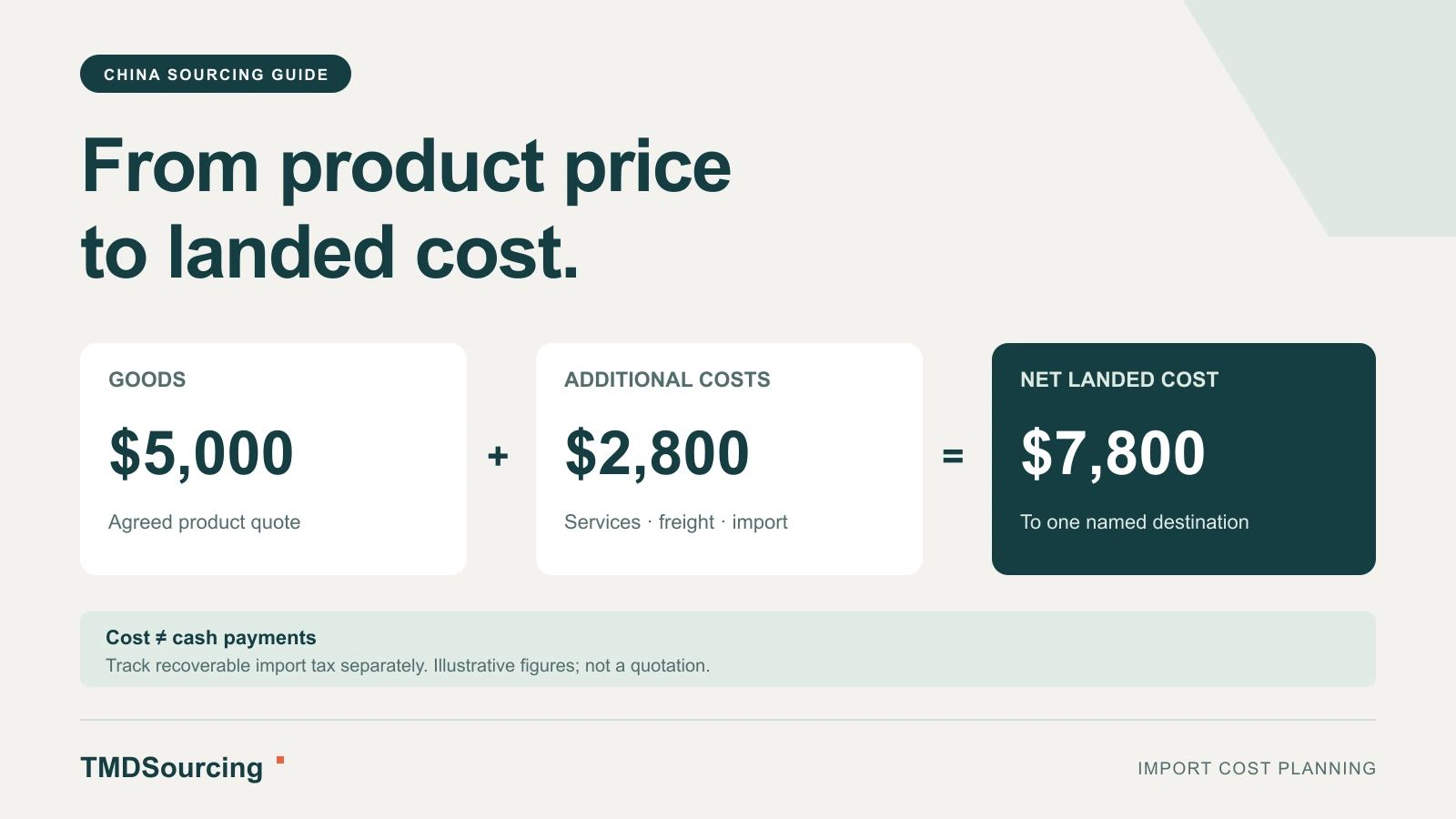
To calculate landed cost from China, start with the product price and add the costs required to bring the goods to one named destination: sourcing services, origin charges, freight, insurance, customs charges, nonrecoverable import taxes and final delivery. Count each charge once. Then divide the total by the quantity you expect to sell.
Keep recoverable import VAT or GST separate from your net cost, but include it in your cash plan if you must pay it upfront. A factory price, a freight quote and a duty estimate are different pieces of the calculation.
1. Set the cost boundary before comparing prices
Choose a precise endpoint, such as your warehouse or fulfillment center, rather than “your country.” Record the destination postcode, currency, product specification, packaging, quantity and quote date. Otherwise, a port-only quotation can appear cheaper than a complete delivery simply because it stops earlier.
Product cost + additional procurement and delivery costs + duties and nonrecoverable taxes − confirmed credits
Landed cost per sellable unitTotal landed cost ÷ sellable units
Maintain three separate figures:
- Net operating cost: your commercial budget after excluding genuinely recoverable taxes.
- Cash payments: what you must pay, and when, including recoverable tax paid upfront.
- Customs value: the valuation used under the destination’s customs rules. It is not automatically your total delivered cost.
This guide uses landed cost for purchasing and pricing decisions. Statutory inventory valuation follows applicable accounting rules; financing costs, abnormal waste and unusual storage charges should not automatically be added to inventory. Advertising, selling commissions and customer delivery after your chosen endpoint belong in a separate profitability calculation.
2. Find the costs missing from your quote
Build a cost record with one row per charge. For each row, save its amount, currency, provider, supporting quote or invoice, validity date and payment stage. Use these statuses: included, separate, estimated, pending or not applicable. Pending is not zero.
| Cost group | What to check | Where to get the figure |
|---|---|---|
| Goods and packaging | Exact specifications, labels, export cartons and any tooling | Supplier quotation and approved specification |
| Procurement and quality | Sourcing, samples, inspection, testing and rework; avoid counting a bundled service twice | Agreed service scope and inspection or laboratory quote |
| Origin operations | Pickup, consolidation, storage, export documentation and terminal charges | Supplier and forwarder’s responsibility breakdown |
| International transport | Freight, applicable surcharges, chargeable weight or volume, insurance and exclusions | Dated freight quotation using packed cargo data |
| Import clearance | Duty, additional duties, import taxes, brokerage and government fees | Destination customs information and broker’s calculation |
| Destination and delivery | Terminal handling, examination, storage, appointments, unloading and final delivery | Destination agent and delivery provider |
| Payments | Bank charges, conversion charges and the exchange rate actually available to you | Payment provider’s quote or transaction record |
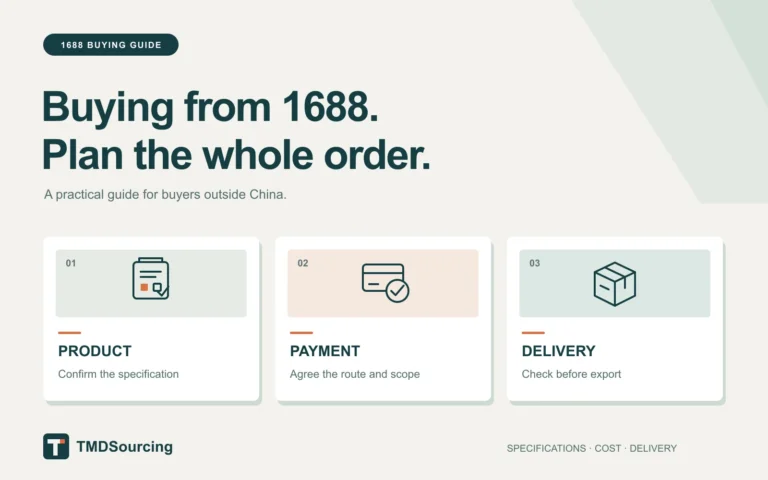
Do not treat every possible charge as inevitable. A customs examination or storage bill may be conditional. Record the trigger and rate, then keep any contingency separate from confirmed costs. For orders placed through 1688, check who handles domestic receipt, payment and export arrangements; the listing price does not establish the full delivery scope.
Final packing data matters. Bulky cargo can be charged using volumetric rather than actual weight, as explained in DHL’s size and weight guidance. Ask your carrier for its applicable calculation and rounding rules instead of applying one divisor to every shipping method.
3. Put EXW, FOB, CIF and DDP quotes on the same basis
Write the delivery term, named place and version together—for example, “FOB Ningbo, Incoterms® 2020.” An Incoterm allocates responsibilities, costs and risk; it does not replace a detailed quotation or determine every tax treatment.
| Term | Budget implication | Check before adding costs |
|---|---|---|
| EXW | The price generally starts with goods made available at the named premises. | Loading, pickup, export arrangements and onward transport. |
| FOB | The seller delivers goods on board at the named shipment port. | International freight, insurance arrangements, import costs and destination delivery. |
| CIF | The seller pays freight and required insurance to the named destination port. | Import clearance, destination charges and onward delivery. Risk transfers at shipment, not arrival. |
| DDP | The seller handles transport and import clearance, including applicable duties and taxes, to the named destination. | Exact endpoint, importer arrangements, tax documents, unloading and conditional exceptions. |
FOB and CIF apply to sea or inland waterway transport. Where container cargo is handed to a carrier before vessel loading, discuss whether FCA better describes the delivery arrangement. See ICC Academy’s FOB explanation.
For a simple comparison, assume identical goods and packaging: an EXW quote of $4,800 plus $350 of agreed origin costs becomes $5,150 on the same shipment-port basis. A $5,000 FOB quotation is then $150 lower at that stage. You still need comparable onward freight, customs and delivery figures before choosing the complete order.
DDP does not itself require the seller to purchase cargo insurance. Delivery is normally ready for unloading; confirm unloading costs and the transport contract. ICC Academy’s DAP and DDP comparison explains these responsibilities and why local import arrangements matter.
4. Confirm customs value, duties and import taxes
There is no single worldwide “China import tax rate.” Your calculation depends on the destination, full local tariff classification, origin, product characteristics, valuation adjustments and rules in force when the goods enter. Additional duties or trade measures may apply separately.
Ask your destination broker to identify the classification, value basis, rates and fixed fees used. The first six HS digits are internationally harmonized, but countries add further digits; a supplier’s export code may not be your complete import code. The USITC tariff FAQ explains this distinction for the US tariff schedule.
Customs valuation also differs. EU guidance describes adjustments to transaction value, including relevant transport to the border and certain assists or royalties. UK guidance explains which delivery costs enter customs value. Do not assume every country taxes a FOB or CIF invoice without adjustments. For an EU starting point, see the European Commission’s customs valuation overview.
Import VAT or GST can use a different base from customs duty. For example, UK import VAT guidance includes relevant duties and incidental expenses in addition to customs value. Do not apply a VAT percentage only to the factory price unless the applicable rules support that basis.
Tax recovery depends on your business, use of the goods, registration and supporting documents. A seller describing a service as DDP does not establish your right to reclaim tax. Confirm whose name appears on the import declaration and which evidence you receive.
Cash timing is another question. Eligible UK businesses may use postponed VAT accounting, subject to the rules. Other arrangements may require upfront payment. Keep the tax treatment and payment schedule visible rather than simply deleting recoverable tax from the budget.
5. Calculate one complete order
Illustrative example: 1,000 units, a $5,000 FOB Ningbo goods quote, one destination warehouse and all amounts in USD. Packaging and the agreed origin scope are already included. These are teaching figures, not a freight quote, tariff estimate or TMDSourcing service offer.
| Cost item | Amount | Assumption |
|---|---|---|
| Goods | $5,000 | FOB scope already included |
| Procurement coordination and inspection budget | $400 | Combined illustrative allowance; count once |
| International freight | $1,100 | Agreed route and packing assumptions |
| Insurance | $50 | Separately quoted |
| Duty and government charges | $500 | Hypothetical broker input; no tax rate implied |
| Brokerage | $180 | Not included elsewhere |
| Destination handling | $220 | Not included elsewhere |
| Final delivery | $300 | To the named warehouse |
| Payment charges | $50 | All payments covered by this assumption |
| Net landed cost | $7,800 | Before recoverable import tax |
| Import tax paid upfront | $1,200 | Assumed fully recoverable with eligibility confirmed |
| Total cash payments | $9,000 | Paid across the order’s payment stages |
Assume 20 units cannot be sold, with no credit or salvage recovery. Sellable quantity is 980, so the net cost is $7,800 ÷ 980 = $7.96 per sellable unit. The 20-unit loss is an explicit scenario, not a standard defect allowance. Dividing by all 1,000 ordered units would produce $7.80 and hide the effect on saleable stock.
If the $1,200 tax cannot be recovered, cost rises to $9,000, or $9.18 per sellable unit. If tax payment is validly deferred, the timing of cash payments changes. Neither result can be selected just because it makes the margin look better.
A bundled bill: avoid adding the same charge twice
Rearrange exactly the same example: a hypothetical $8,550 bundle includes goods, freight, insurance, duty, brokerage, destination handling, delivery and the $1,200 import tax. Add only the separate $400 coordination/inspection allowance and $50 payment charge: cash payments are still $9,000. Subtract the tax only if recovery is genuinely available; net cost is then $7,800.
This is an arithmetic demonstration, not a market DDP price. Do not add freight and duty again merely because your worksheet has separate rows for them. Mark those rows “included in bundle,” retain the breakdown and confirm the import documents. TMDSourcing’s actual sourcing fees and separately quoted services depend on agreed scope; the example does not imply inspection is included in the standard sourcing percentage.
6. Allocate shared costs across different products
A shipment average can distort individual product margins. Assign product-specific costs directly, then allocate each shared cost using an appropriate driver. For a volume-priced shipment, packed cubic meters may be more useful than unit count. Weight-driven freight calls for a different basis.
This simplified two-SKU example includes only goods, duty, freight and one fixed fee pool. All units are sellable. It is an allocation exercise, not a complete import budget.
| Item | A: bulky storage product | B: compact accessory | Total |
|---|---|---|---|
| Units | 200 | 800 | 1,000 |
| Packed volume | 8 m³ | 2 m³ | 10 m³ |
| Goods | $4,000 | $4,000 | $8,000 |
| Direct duty amount | $200 | $400 | $600 |
| Freight by volume | $800 | $200 | $1,000 |
| Fixed fees by goods value | $150 | $150 | $300 |
| Allocated total | $5,150 | $4,750 | $9,900 |
| Cost per unit | $25.75 | $5.94 | Rounded after allocation |
Product A occupies 80% of the volume, so receives 80% of the $1,000 freight bill. Allocating freight by unit count instead would assign it only $200 and shift $600 onto product B. The fixed fee allocation by goods value is an explicit management choice; the duty amounts are directly assigned, not a single shared rate.
Check that allocated totals reconcile to the original cost pools and round only at the end. These commercial allocations do not establish the legal customs or tax treatment. If goods come from several factories, our China order consolidation guide explains the receiving and packing arrangements that affect the underlying costs.
7. Update the estimate before paying and after delivery
Keep an estimate version and a final actual version. Before the production deposit, confirm the specifications, quote scope and major unknowns. Before shipment, replace provisional carton dimensions, weights and freight with current figures. After delivery, reconcile invoices, customs documents, credits and received quantities.
Use a short sensitivity check when an input can materially change your decision. In the $7,800 example:
- Freight increases by $300: $8,100 ÷ 980 = $8.27.
- Sellable quantity falls to 970: $7,800 ÷ 970 = $8.04.
- Both occur: $8,100 ÷ 970 = $8.35.
Keep a planning buffer outside invoiced costs. Do not add a generic loss allowance and also reduce the denominator for the same lost units. If financing, delay or storage changes the business decision, show those effects separately with their assumptions.
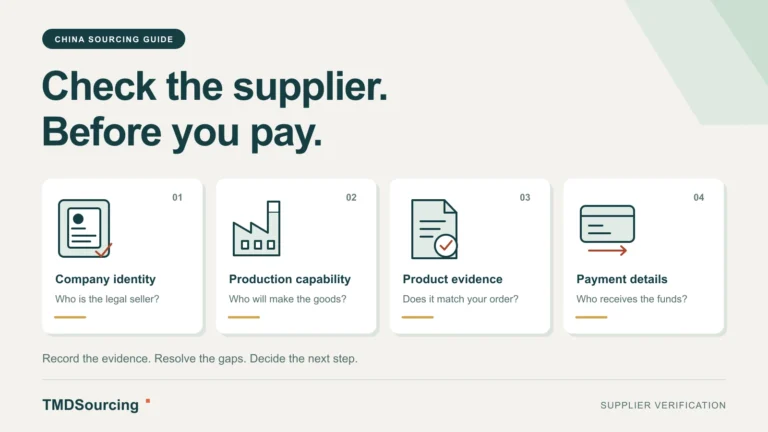
Good cost data still needs a reliable transaction. Verify the Chinese supplier and payment recipient before transferring funds, and use a consistent specification when comparing suppliers.
8. Request the missing figures
You can start with a product link, quantity and destination. If final packing data is unavailable, ask for a provisional estimate with explicit assumptions and a revision point. Send the relevant sections of this request to your supplier, sourcing coordinator and destination broker:
Subject: Cost breakdown for our China sourcing order

Product / links:
Specification and packaging requirements:
Quantity by SKU:
Destination country and city / postcode:
Target delivery date:
Existing supplier quote and its Incoterm / named place, if available:

Please confirm:
1. The product price, currency, validity, packaging and exact delivery scope.
2. Carton count, packed dimensions and gross weight, or when these will be available.
3. Origin pickup, export handling, freight, insurance, destination handling and final delivery: what is included, separate or still pending?
4. Procurement, inspection, repacking and consolidation: which services are in the quote and which need separate approval?
5. Who will arrange import clearance, who is the importer of record, and who confirms classification, customs value, duties, taxes and any product requirements?
6. If the quote is described as DDP, which duties/taxes are included, which documents will be provided, and which exceptions or unloading charges remain?
7. Payment stages, minimum charges, storage/free-time limits and conditions that would change the quote.

Please mark unavailable figures as pending rather than zero. If final packing data is not ready, state the assumptions and when the estimate will be revised.
Attach the existing quotation rather than asking for an unexplained “all-in price.” A useful reply identifies what is included, who pays the remaining charges and which figures are still pending.
Frequently asked questions
Is landed cost the same as the FOB price?
No. FOB generally takes the seller’s delivery responsibility to on-board delivery at the shipment port. A warehouse landed-cost budget also needs the applicable freight, import clearance and destination costs, plus other services outside the goods quote.
Does landed cost include import VAT or GST?
Include nonrecoverable tax in cost. Keep recoverable tax separate from net operating cost, but include upfront payments in your cash schedule. Confirm eligibility and documents; “recoverable” is not an assumption to make from a shipping label.
Should I add duty and freight to a DDP quote?
Only add charges that genuinely fall outside the agreed quote. Get its written scope first. Freight and duty already included in a bundle should not be added again; tax recovery and unloading still need clarification.
Do I divide by ordered, received or sellable units?
Use sellable units for a commercial pricing decision, and label that denominator. Keep ordered and received quantities for reconciliation. Show any rejected goods, credits or recovery separately rather than silently treating every ordered unit as sellable.
Can I estimate cost without final carton dimensions?
Yes, provisionally. Record assumed carton count, dimensions, weight and route. Ask when confirmed data will be available and rerun the calculation before accepting the final freight booking. An estimate with pending inputs is not a final delivered quote.
How should I treat tooling, samples and one-time costs?
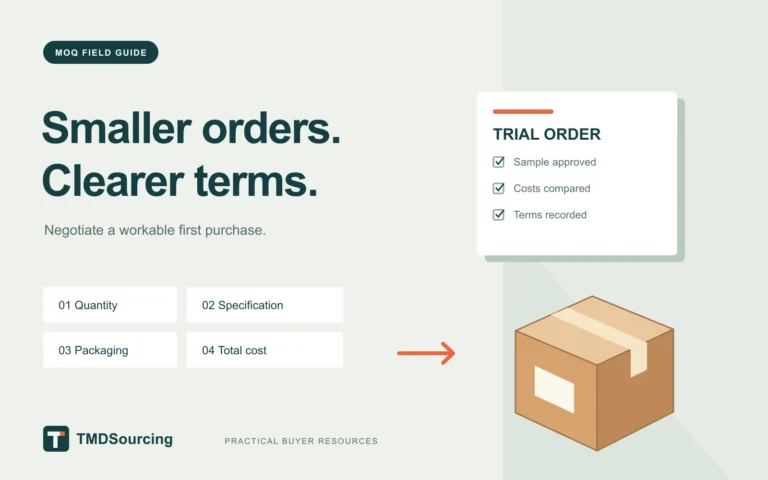
Keep the full payment in the cash plan. For management pricing, show whether you charge it to the first order or allocate it across an explicitly stated volume. That choice does not determine customs or accounting treatment. See our guide to ordering samples from China for sample planning.
PLAN YOUR CHINA ORDER
Need help filling the gaps in your sourcing budget?
Send TMDSourcing your product link, estimated quantity and destination. If you already have a supplier quote, include it. We can review the sourcing and logistics scope, identify information still needed and explain applicable service charges before you commit.
Discuss your sourcing project →Free consultation and initial quote. No obligation to place an order.