SOURCING GUIDES / PACKAGING & APPROVAL
Custom Packaging from China: Specs, Samples, MOQ and Quality Checks
Turn your packaging brief into comparable quotes, clear sample approvals and a coordinated packed order.
How do you source custom packaging from China?
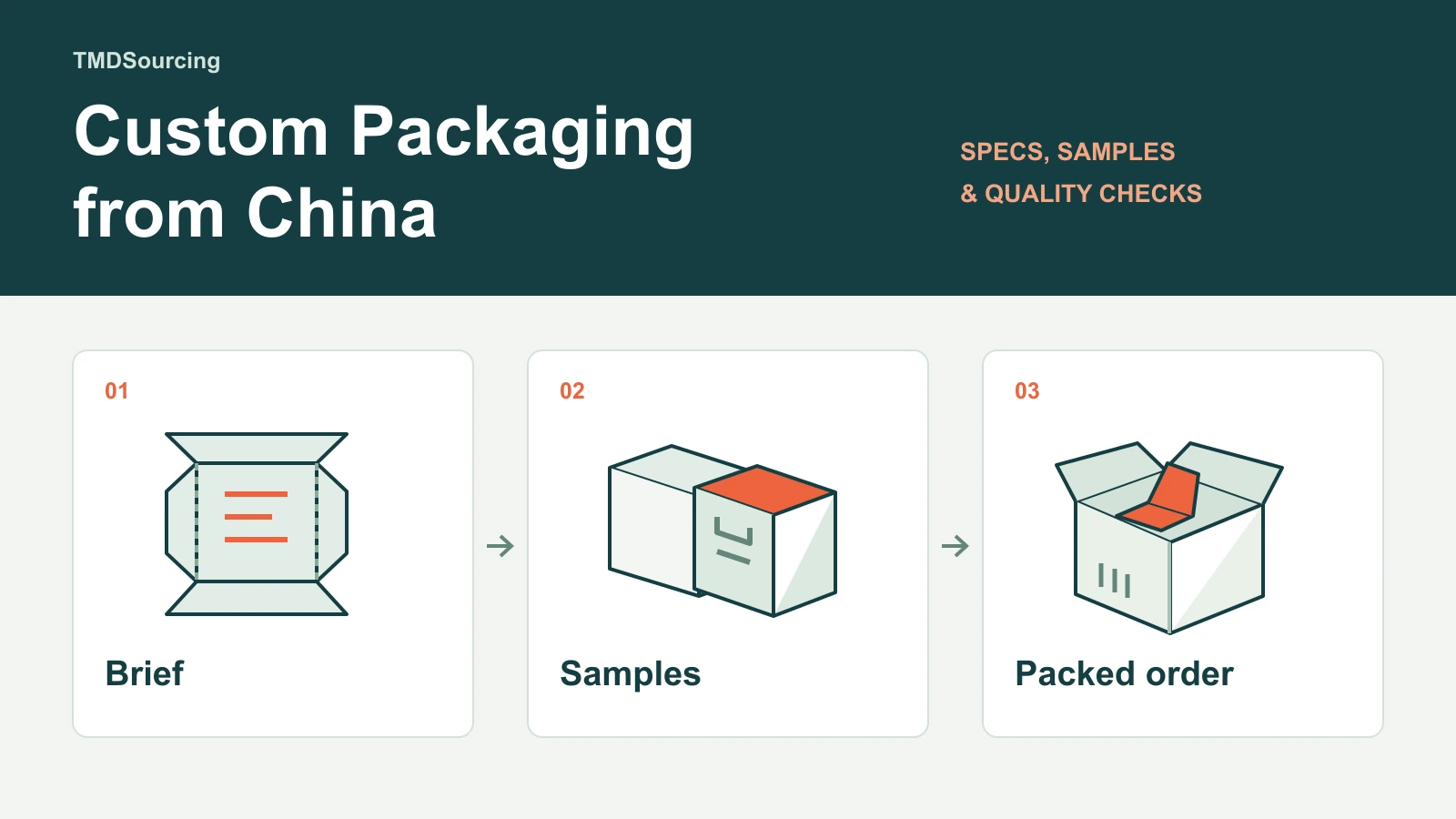
Start with the product, its sales channel and the protection it needs. Send suitable suppliers the same packaging brief, compare the complete scope and quantities, then approve the relevant structure, print and packed sample before releasing production. Agree who receives components, assembles the packs, checks quality and manages changes or unused packaging.
This guide helps you turn a packaging idea into an order you can specify and follow up—from a branded sleeve to a complete retail pack and shipping carton.
1. Choose the packaging job and supply route
A retail box presents the product; an insert holds it in position; an outer shipping carton protects and groups packed units. One pack may perform several jobs. Decide what must arrive together, how the customer will receive it and which parts are visible at sale.
A folding carton, corrugated mailer and rigid gift box are different starting points. Labels, sleeves and inserts can add branding or organization without replacing every component. Choose a structure around the actual contents, handling and presentation requirements, rather than copying an attractive box of unknown size or material.
Packaging with the goods
The product supplier coordinates the pack. Confirm who makes each component, which costs are included and who approves the finished configuration.
A separate specialist
A packaging supplier develops or manufactures the pack. Arrange product references, delivery of components and responsibility for final assembly.
Pack at a receiving site
Goods and packaging meet at a warehouse or partner site. Agree receiving checks, work instructions, stock records and outgoing inspections.
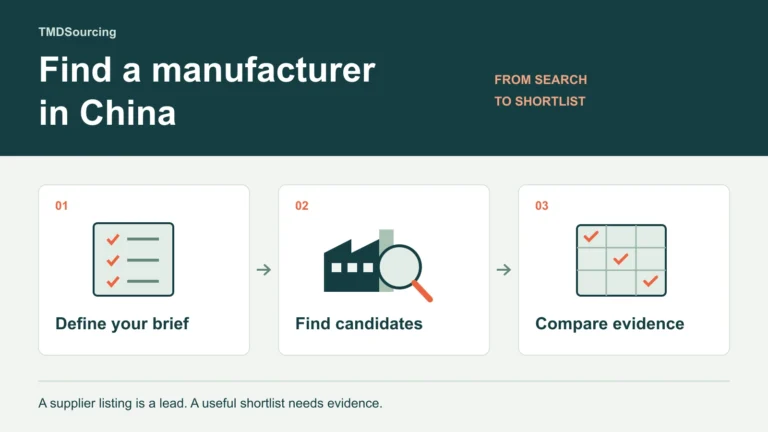
No route removes the need for clear responsibilities. A product factory may outsource printing; a separate box supplier may never see the product. Ask where the work happens and which party resolves a mismatch. Our manufacturer search guide explains how to build a suitable shortlist.
2. Prepare a packaging RFQ suppliers can quote against
An RFQ is a request for quotation. Its purpose is to give every candidate the same requirements and expose assumptions before prices are compared. Start with product references, dimensions, weight, accessories and quantity by SKU—the reference used for each distinct item.
State whether a dimension is internal or external. Include the space needed for the product, insert and removal; ask the supplier to propose a workable allowance. A dieline shows the flat cut, fold and artwork layout. Keep its version connected to the intended assembled dimensions and current product.
Separate material, construction and finish. “Thick cardboard” leaves too much open. Record the proposed board, thickness or grammage where relevant, printing method, color reference, coating, insert and closure. Mark provisional choices so a supplier can suggest alternatives without silently changing a confirmed requirement.
Packaging quotation request
Copy this brief and replace the bracketed fields.
Project / SKU / brief version / date: [ ]
Product reference, dimensions, weight and pack contents: [ ]
Sales market, channel and destination: [ ]
Product quantity by SKU: [ ]
Packaging structure and reference images: [ ]
Dimensions: [internal/external, units, fit requirements]
Material, construction and required protection: [ ]
Artwork version, color reference, print and finish: [ ]
Insert, labels, barcode data and instructions: [ ]
Assembly location and units per outer carton: [ ]
Required documents, checks and sample purpose: [ ]
Target milestone and decisions still open: [ ]

Please state MOQ by component, size and design; identify
exceptions or substitutions; and itemize samples, setup,
production, assembly, transfer, storage and shipping scope.
Confirm approval steps and what triggers the lead time.
Ask who owns and may reuse the artwork, dieline and any tooling; do not assume payment automatically settles those rights. Obtain a quotation validity period and identify which changes require a revised price or sample. The supplier’s response should refer to the same brief version you sent.
3. Compare component MOQ and the complete cost
Minimum order quantity may apply separately to the product, printed box, insert and label. It may also apply per size, design, color or SKU rather than across the total order. Ask for that basis in writing, including permitted over-runs or under-runs and how delivered quantities are charged.
Worked example: 1,000 desk-organizer packs
This is a fictional planning example, not a TMDSourcing customer order or a supplier quotation. Each sellable unit needs one product, one printed retail carton and one label. The quantities below are assumptions used to explain coordination.
| Component | Ordered | Current pack requirement | Planned surplus |
|---|---|---|---|
| Product | 1,000 | 1,000 | 0 |
| Printed retail carton | 1,500 | 1,000 | 500 |
| Printed label | 2,000 | 1,000 | 1,000 |
On a smaller screen, swipe the table sideways to read all columns.
The surplus is inventory to manage. Ask whether a lower first quantity or simpler printing route is available. If you accept extra components, agree ownership, storage charges, identification and future use. Do not increase the product order solely to match a packaging MOQ without reviewing demand and total cost.
Next, compare the same packed unit. Supplier A includes the specified carton and insert but has not priced assembly or transfer. Supplier B includes assembly but proposes a different insert and an unconfirmed board. Neither total is ready for a like-for-like comparison. Resolve the scope gaps, then request revised quotations.
Separate recurring unit costs from samples, artwork preparation, dies or other setup, revisions, assembly, domestic transfers and storage. Add transport and applicable import costs to your budget. Our landed-cost guide covers the wider calculation. Confirm whether a sample charge can be credited against production and on what conditions; a future credit is not an immediate refund.
If MOQ remains the constraint, discuss the component driving it using our MOQ negotiation guide. No single minimum quantity fits every structure, material and print process.
4. Approve what each packaging sample actually demonstrates
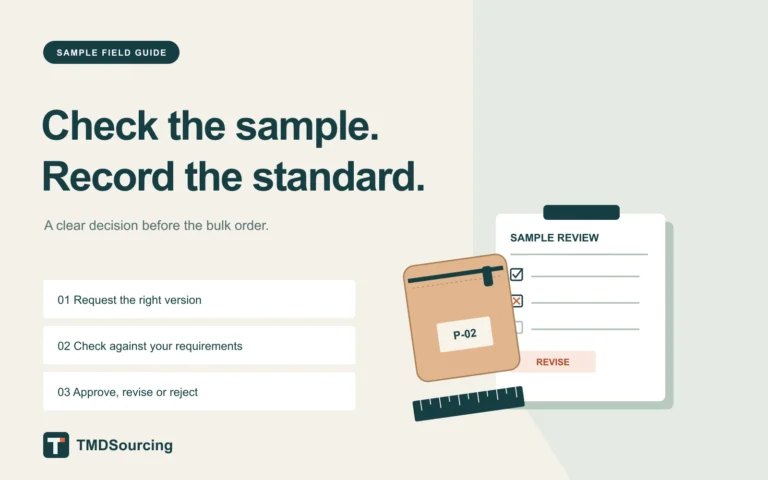
Sample names vary. Agree the purpose, materials and manufacturing method before paying. The following approval scopes can be combined or repeated as needed; they are not a requirement to buy exactly three rounds on every order.
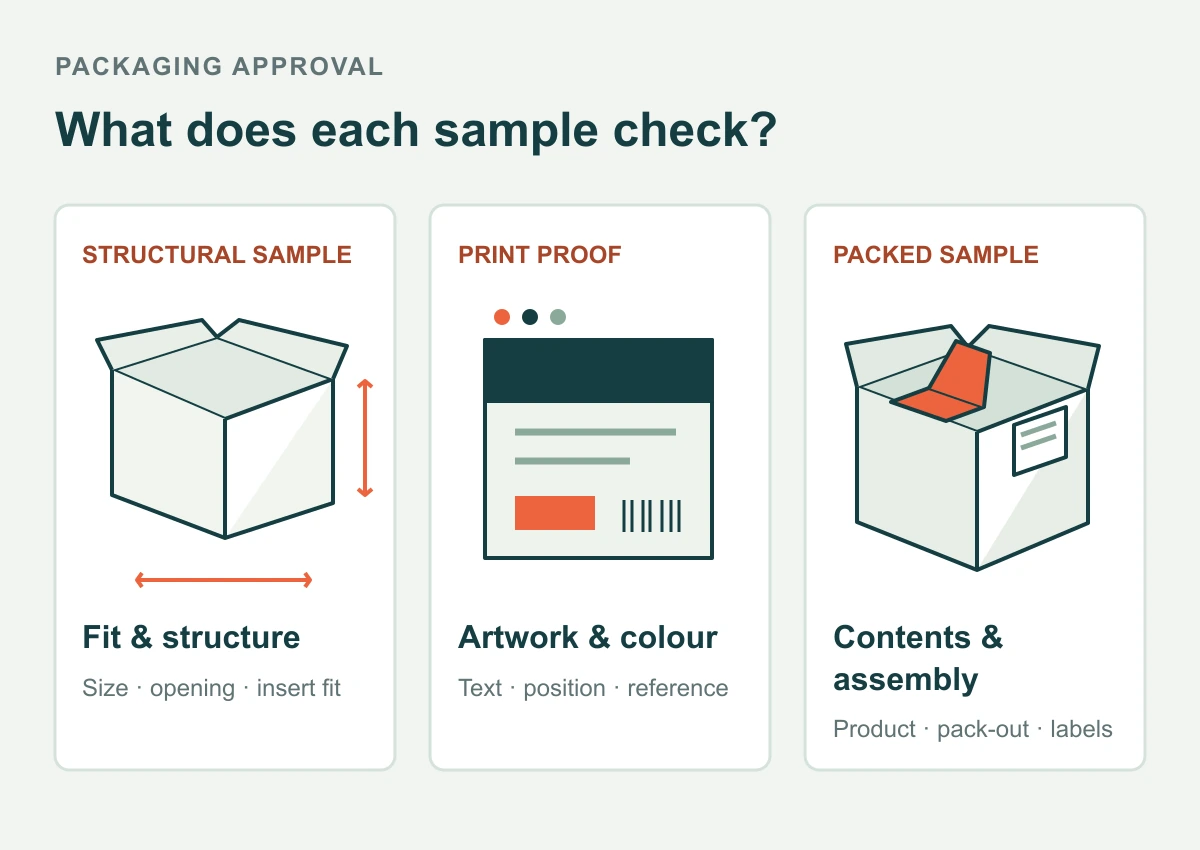
| Sample or proof | Useful review | Still to establish |
|---|---|---|
| Blank structural sample | Dimensions, opening, fit, insert position and assembly concept. | Final material, printed appearance and protection if temporary materials or methods were used. |
| Print proof or printed sample | Artwork revision, text, placement and the stated color/finish reference. | A screen proof alone cannot approve production color, construction or the full pack. |
| Complete packed sample | Actual product, accessories, insert, labels, closure and assembly together. | Bulk consistency and any separately specified distribution or laboratory tests. |
On a smaller screen, swipe the table sideways to compare the scopes.
For the desk-organizer example, a blank box may fit the product while using temporary board. Record fit approval only; final material and protection remain open. If the printed proof has the correct artwork but the insert changes, review the affected fit and packed configuration again.
A compact packaging approval record
Project / SKU / sample ID / date:
Product, packaging and artwork versions:
Sample purpose and known differences from bulk:
Requirement / observation / evidence / result:
Approved scope:
Open items / required correction / owner / due date:
Decision: Approve scope / Revise and resubmit / Reject
Production release: Not authorized / Authorized separately
Approver / supplier acknowledgment / retained reference:
Keep an identified reference and the written requirements together. Separate sample approval from permission to start production. See our sample ordering and approval guide for a fuller review process.
5. Coordinate production, assembly and unused stock
Put the handover plan in the order record. Assign a named owner for each task: provide final product dimensions, approve packaging files, receive components, assemble the unit, inspect the result and authorize dispatch. The buyer should know whom to contact when two suppliers disagree about the cause of a fit problem.
At receipt, record component reference, version, ordered quantity, received quantity and accepted usable quantity. These figures are not interchangeable. Ask the assembly site to record packaging consumed, completed packs, rejected units and remaining components. In the example, the planned 500 spare cartons will be fewer if some are used for tests or damaged during assembly.
Keep different artwork revisions and SKUs identifiable in storage. Agree who pays for storage, how long stock is kept, when its condition is checked and who authorizes disposal or replacement. Before a reorder, confirm the stored packaging still matches the current product, artwork and required label information.
Plan milestones around approved files, material availability, sample review, production, assembly and inspection. Include time for corrections. A supplier’s lead time should state its starting conditions; “20 days” means little if artwork or the product dimensions are still changing. Our supplier consolidation guide explains the wider receiving and shipment handover.
6. Agree packaging quality checks before production
Turn requirements into checks that can be recorded. “Premium quality” cannot resolve a disagreement about fit, print position or missing contents. Confirm the method, tolerance or reference, coverage and action for a failed requirement before the goods are ready.
| Area | Record against the agreed requirement | Useful evidence |
|---|---|---|
| Structure and fit | Identified dimensions, closure operation, insert position and product movement. | Measurements, packed-sample reference and photographs. |
| Material and finish | Specified construction, surface condition, print position and agreed appearance. | Material records and comparisons using the defined method. |
| Text, labels and barcode | Correct revision, encoded item data, placement and required print quality. | Approved artwork, data comparison and verification where specified. |
| Contents and pack-out | Accessories, instructions, unit count, carton identification, weight and outer dimensions. | Count record, packing list and inspection findings. |
On a smaller screen, swipe the checklist sideways to read the evidence column.
Paper weight is not a complete strength specification. GSM describes grammage. FEFCO’s testing overview distinguishes paper/board properties from finished-packaging checks such as compression, dropping and vibration. Agree relevant performance requirements; a higher GSM alone does not establish that the packed product will survive its route.
A successful phone scan is not formal barcode verification. Confirm the code maps to the correct item, then address the required symbol quality separately. GS1 explains barcode verification as measurement of multiple parameters using a suitable verifier. The applicable grade and specification depend on the use; do not choose a universal target from an unrelated product.
Select transport testing for the actual distribution environment. ISTA’s procedure overview distinguishes different test purposes and shipment types. Confirm the product/pack configuration, procedure, sample requirements, acceptance criteria and report with the appropriate specialist or customer. A generic factory drop test is not automatically an ISTA-tested configuration.
For bulk checks, state the quantity examined and any tests not performed. Use our pre-shipment inspection checklist to plan coverage, findings and corrective actions. Inspecting a sample does not establish that every unit is defect-free.
7. Check packed volume, destination requirements and release
Compare packaging changes using the finished configuration and agreed units per carton. Flat-shipped packaging can have different transport and assembly costs from already assembled packs. Smaller outer dimensions may reduce shipping exposure, but only if fit, protection and handling remain acceptable.
For a carrier-specific illustration, DHL Express UK’s dimensional-weight explanation uses external centimeters multiplied together and divided by 5,000. Chargeable weight is the greater of actual and volumetric weight.
| Assumed outer carton | Volume | Volumetric weight | Chargeable weight before rounding |
|---|---|---|---|
| A: 40 × 30 × 30 cm | 0.036 m³ | 7.2 kg | 7.2 kg |
| B: 40 × 30 × 20 cm | 0.024 m³ | 4.8 kg | 5 kg |
On a smaller screen, swipe the example sideways to read all columns.
The volume falls by one third; the chargeable weight does not fall by the same proportion. Neither figure establishes the freight-price saving. Confirm the actual carrier, service, rounding, surcharges and destination quotation. This comparison assumes acceptable contents and protection; it is not evidence that either carton suits a particular product.
Identify destination requirements before printing. Direct food-contact packaging needs a different review from ordinary secondary packaging. Environmental claims also need specific scope: forest sourcing, recycled content and finished-pack recyclability are different questions. If FSC is required, confirm the applicable claim, product scope, authorized parties and transaction documents; FSC’s chain-of-custody guidance explains the role of claims and labels. Do not treat a logo or a visual sample as proof of every required property.
Before release, bring together the approved specifications, artwork, component counts, packed-sample reference, inspection actions and dispatch instructions. Resolve any substitution that affects fit, appearance, required evidence or cost. Confirm who authorizes shipment, rather than letting a completed box automatically become an approved order.
Questions about custom packaging from China
What information do I need for a custom packaging quote?
Send the product reference, dimensions, weight, contents, packaging direction, quantity by SKU and destination. Add artwork status, materials or finishes already decided, assembly requirements and target timing. Identify open decisions and ask suppliers to state their assumptions and exceptions against the same brief.
Can I order fewer products than the packaging MOQ?
Possibly, but the packaging quantity and unused stock must be agreed separately. Ask whether a lower quantity, simpler print route or standard component is workable. If you buy surplus packaging, include its cost, ownership, storage and future usability in the decision.
Can my product factory use boxes from another supplier?
It may be possible if the factory agrees. Confirm product dimensions, component delivery, receiving checks, assembly work and responsibility for errors. Send the current packing instruction and approve a complete packed sample before authorizing the proposed arrangement.
Can I approve packaging from a digital mockup?
You can approve the stated artwork scope, but a mockup cannot establish every physical property. Record what remains open, such as fit, material, closure, actual print appearance and protection. Arrange physical checks or relevant testing for the requirements the mockup cannot demonstrate.
How much does custom packaging from China cost?
There is no useful universal price. Structure, dimensions, material, decoration, quantity, samples, setup and assembly change the scope. Request itemized quotations and compare the same packed unit, including transfers, storage and shipping assumptions. Keep one-time and recurring costs separate.
How long does custom packaging production take?
Ask for a schedule tied to approved files, samples and material readiness. Include revisions, production, assembly, inspection and delivery. Confirm the milestone the supplier is quoting—factory completion and arrival at your warehouse are different dates.
Does FSC-certified packaging mean it is recyclable or food safe?
FSC relates to specified forest-based sourcing and chain-of-custody claims. Recyclability, food-contact suitability and transport protection require their own evidence for the actual configuration and intended use. Confirm the exact claim rather than treating certification as approval of every packaging property.
Need help coordinating your product and packaging?
Send TMDSourcing your product reference or dimensions, packaging ideas, quantity by SKU and destination. We can discuss supplier sourcing, sample coordination, and packaging and fulfillment for your project.
Discuss Your Packaging Requirements
Your initial consultation and quote are free. Samples, development, checks, assembly and shipping are confirmed and quoted separately.