SOURCING GUIDES / SAMPLES & APPROVAL
How to Order Samples from China: Costs, Checks and Approval
Know what to request, what the sample bill includes and what to record before you approve a bulk order.
How do you order samples from China?
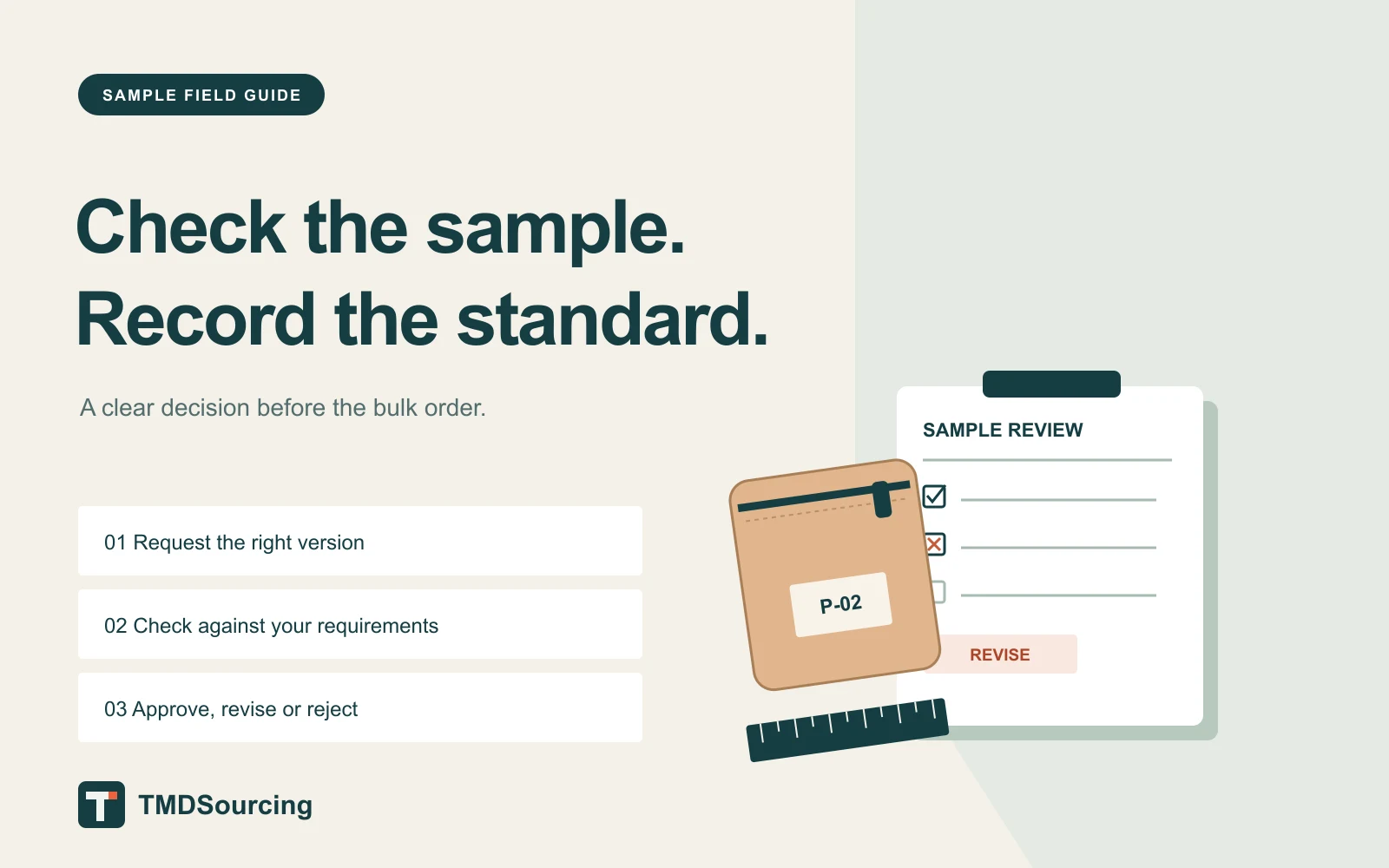
Choose what you need to verify, request the right sample and agree the full cost before paying. Send the supplier a written specification, label the sample when it arrives and check it against measurable requirements. Record whether you approve it, need a revision or reject it. Carry the approved version into your bulk order; one acceptable sample does not establish the quality of the whole production batch.
1. Choose a sample that answers your buying question
A sample is useful when it resolves a specific uncertainty. A stock pouch can help you assess stitching and zipper operation. It cannot confirm your custom print if that print is absent. Before ordering, decide which features must match the product you intend to buy.
Sample names vary between suppliers — confirm what will actually be supplied
| Sample type | Useful for | Confirm the limitation |
|---|---|---|
| Stock sample | Reviewing an existing model, construction or finish. | Your color, logo, material or packaging may differ. |
| Customized or development sample | Checking a proposed change, prototype or new design. | It may use temporary tooling, hand finishing or substitute components. |
| Pre-production sample | Reviewing the intended specification before a production release. | Ask which materials, tooling and processes match the planned bulk run. |
| Production sample | Reviewing a unit taken from a particular production batch. | One selected unit does not represent a complete batch inspection. |
An approved reference sample, sometimes called a golden sample, is the identified version you retain for comparison. The label alone says little: record which features were approved and which written requirements also apply. Use the sample approval record below to document the sample version, approved features and outstanding changes.
Shortlist suppliers before spending on samples. Confirm their identity, the proposed product and a realistic bulk quotation. Our supplier comparison guide helps organize that first screen. If the bulk MOQ is unworkable, discuss a smaller trial quantity before paying to customize a product you cannot order.
2. Ask for the complete sample cost
There is no useful universal sample price. An available stock item and a prototype requiring new tooling involve different work. A sample can cost more than the advertised wholesale unit price because the quotation covers a very small quantity, preparation or customization rather than an efficient bulk run.
Request separate lines for the sample itself, artwork or setup, tooling, packaging, revisions, delivery within China, international freight and any coordination or testing work. Ask whether a price covers one attempt or an agreed number of revisions. If a new mold is involved, confirm its specification, ownership and future use separately.
Illustrative sampling budget in US dollars — assumptions, not market rates or a TMDSourcing quote
| Item | Planning amount |
|---|---|
| Two stock samples from different suppliers | $24 |
| Domestic delivery to a receiving point | $12 |
| Agreed receiving and repacking work | $18 |
| Combined international courier allowance | $46 |
| Illustrative subtotal | $100 |
The two samples cost $24, but obtaining them in this example commits $100 before any applicable duties, taxes, payment charges, testing or extra revisions. The example does not prove consolidation is cheaper: obtain a separate-shipping quotation and compare the complete scope. Keep a reserve for another sample round instead of treating the first attempt as guaranteed approval.
A sample-fee refund or credit is negotiable, not automatic. Record the eligible bulk quantity, deadline, amount and whether courier, tooling or revision fees are excluded. A credit against a future order is different from money returned immediately. Check our service-fee page for TMDSourcing’s scope; sample-related work and other separately quoted services should be agreed before spending.
3. Send a sample request the supplier can act on
Use the same specification for every supplier you compare. Include the intended use and destination market, as well as appearance. “Good quality” leaves too much open; a dimension, named material, reference finish and agreed function are easier to check.
Copy this email and replace the bracketed fields. Share the delivery details needed for an accurate quotation with the supplier handling your request.
Subject: Sample request for [product / model] — specification [version]

Hello [name],

We are evaluating [product] for sale in [destination market]. Please quote [number] samples against the attached specification [filename / version / date]. Our possible first bulk order is [quantity], subject to sample approval and a final quotation.

The sample must include:
• Material and dimensions: [requirements and tolerances]
• Color / finish: [physical or agreed reference]
• Logo and packaging: [artwork version or plain option]
• Function and intended use: [requirements]

Please identify anything that will differ from the proposed bulk product, including materials, manufacturing method, components or packaging.

Please itemize the sample, customization, tooling, revisions, packing and delivery charges. Confirm any sample-fee credit conditions separately.

We need the sample sent to [city / postcode / country]. Please confirm the preparation time, dispatch date, packed dimensions, gross weight and shipping scope. Tell us if you need further delivery details to quote accurately.

Before dispatch, please send labeled photos and confirm the sample ID. We will review the sample before authorizing bulk production; this request does not approve a bulk order.

Thank you,
[Name / business]
Ask the supplier to flag unclear or impractical requirements before making the sample. Save the agreed brief, itemized quote and sample-order confirmation together. A photograph before dispatch can catch an obvious wrong model or logo, but it cannot establish feel, fit or performance in your hands.
4. Arrange delivery without losing sample identity
For each parcel, record supplier, model, sample ID, quantity, tracking number and expected dispatch date. Put the ID on the item’s bag or tag and on its photos. Two similar unmarked samples become difficult to compare once packaging is removed.
If several suppliers send to one receiving point in China, agree who labels arrivals, checks quantities, records damage and repacks them. Confirm the handling fee and a cutoff date for late arrivals. Combining parcels may reduce some freight charges, but domestic transport, handling, waiting time and the final package size can offset the saving.
Ask for packed dimensions and gross weight. DHL’s 2026 Express shipping guide explains that large, lightweight packages may be charged by volumetric weight and that shipment paperwork depends on the goods and route. Obtain a quotation for your actual destination; calling an item a sample does not by itself settle charges or documentation.
For batteries, liquids or other items requiring special handling, tell the carrier the exact contents before booking. Separate sample preparation time from courier transit time and allow for your own review and any revision. Ask for dates tied to confirmed steps rather than a single optimistic arrival promise.
5. Check the sample against written requirements
Photograph the unopened parcel and any damage, then identify the sample before testing it. Check the same features in the same way for every candidate. Record measurements and observations; a total score should never hide a failure on an essential requirement.
A starting checklist — adapt the methods and limits to your product
| Check | What to record | Do not assume |
|---|---|---|
| Identity and dimensions | Model, sample ID, measured dimensions and agreed tolerances. | A similar-looking model is the quoted version. |
| Material and finish | Specified material, surface condition and comparison with the agreed reference. | Appearance alone proves material composition. |
| Construction and function | Assembly, moving parts and results of the agreed use checks. | A brief successful test proves long-term durability. |
| Branding and packing | Artwork version, print position, text, accessories and protection. | A plain sample approves later custom printing. |
| Required testing or documents | Applicable requirement, product identity, report scope and any outstanding work. | A visual review or unrelated report establishes compliance. |
Agree suitable tests before ordering if a feature cannot be checked by ordinary inspection. Define the inspection scope using our pre-shipment inspection checklist, and identify any laboratory testing separately. A sample review does not replace product-specific testing, and destructive tests may require extra units.
Compare a supplier’s response to problems alongside the product. A useful reply identifies the cause, proposed change, revised cost and delivery date. If the specification changes, update it for all suppliers still being considered so your comparison remains fair.
6. Approve, revise or reject — and keep the record
Make the decision explicit. Approve the defined scope when its requirements are met. Revise and resubmit when a specific correction is needed. Reject when the sample cannot support the intended purchase. A message saying “looks fine” does not explain what was checked or whether production may start.
Illustrative review: a zippered travel pouch
Sample P-02 is checked against specification v2. The agreed finished width is 200 ± 3 mm, measured flat without stretching; the sample measures 202 mm and passes that check. The artwork requires the logo center 25 ± 2 mm below the top seam; it measures 34 mm and fails. Zipper operation passes the agreed basic check, while the retail label has not been supplied.
Decision: revise and resubmit. Keep the width and construction, correct the logo position and supply the label proof. Reference photos P02-01 to P02-04. Bulk production remains on hold until the outstanding items and final version are approved. These dimensions are example criteria, not an industry standard or customer case.
Copy the blank record below into your project document. Use one record for each sample version; retain earlier decisions so the supplier can see what changed.
SAMPLE REVIEW & APPROVAL RECORD
Product / model:
Supplier / contact:
Sample ID / quantity / date received:
Specification filename / version / date:
Artwork / packaging reference:
Purpose of this sample:
Known differences from proposed bulk product:

CHECKS (repeat a row for each requirement)
Requirement and tolerance:
Check method / equipment:
Observed result / measurement:
Photo or report reference:
Result: Pass / Fail / Not checked / Not applicable

DECISION: Approve / Revise and resubmit / Reject
Approved features and scope:
Unresolved items and required changes:
Evidence or new sample needed:
Person responsible / due date:
Buyer decision-maker / date:
Supplier acknowledgment / date:
Retained reference sample location and ID:

BULK PRODUCTION RELEASE: Not authorized / Authorized separately
Related purchase order and specification version:
Release approver / date:
Planned production or pre-shipment checks:
If you approve only a material or color, state that limited scope. List what still needs approval and what evidence will close each item. Do not describe the whole product as approved while an essential feature remains unresolved.
7. Carry the approved version into the bulk order
Identify the retained reference sample with its ID, supplier, specification version and approval date. Agree where matching references will be kept and who can access them for checks. Keep the written specification and approved artwork with the reference; a physical sample cannot communicate every tolerance or test requirement.
Reference those exact files in the purchase order. Require written agreement before changing a material, component, process or packaging version. Confirm the production-release decision separately from the sample review, including the final quantity, price, timing and quality-check arrangements.
Plan how the bulk goods will be assessed before shipment. Use our pre-shipment inspection checklist to define what is checked and who decides on corrections. Sampling helps define what you expect; checking production addresses what was actually made.
Questions about ordering samples from China
Can I get a free sample?
A supplier may offer a stock sample without an item charge, but confirm freight and other work separately. Judge whether it answers your buying question. A free, different model may tell you little about the customized product you plan to order.
How many samples should I request?
Request enough for the checks you actually need, including variants, any destructive tests and retained references. Start with a shortlist rather than paying every supplier. There is no fixed number that is right for all products or budgets.
How long does a sample order take?
Confirm preparation, customization, dispatch and transit separately. Stock availability does not establish a custom sample’s lead time. Include time to review the delivered item and, if necessary, correct and resend it before setting a bulk-order deadline.
Can I approve a sample from photos?
Photos can support checks such as visible artwork or an identified feature. They cannot establish every dimension, material property or function. State exactly what you are approving remotely and arrange physical checks or testing for the remaining requirements.