SOURCING GUIDES / MOQ & TRIAL ORDERS
How to Negotiate MOQ with Chinese Suppliers: A Small-Buyer Guide
A practical way to discuss smaller quantities, compare the real spending commitment and agree a trial order without losing control of the details.
Can you negotiate a supplier’s MOQ?
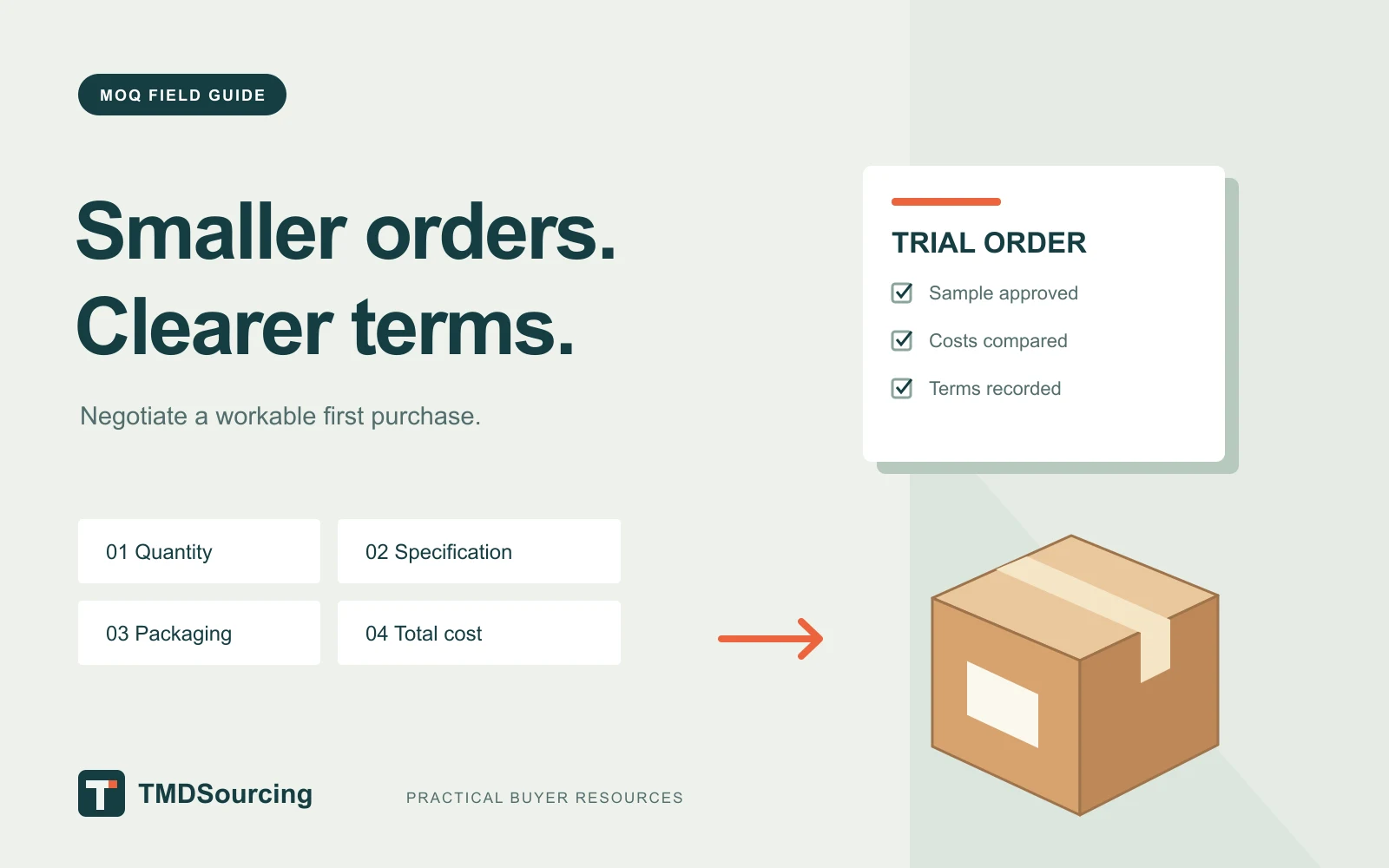
Often, but not for every product. To negotiate MOQ with Chinese suppliers, first identify what sets the minimum: the product, material, color, packaging or production setup. Then propose a specific change that makes a smaller run workable. Compare the resulting total cost, confirm a sample and record the revised terms before ordering. A lower quantity is useful only if the quality, timing and cash commitment still fit your business.
1. Find out which minimum you are negotiating
MOQ means minimum order quantity: the smallest quantity a supplier agrees to supply under specified conditions. A listing that says “500 pieces” may describe one version of an offer, rather than every option available from that supplier.
Ask the supplier to break down the minimum before asking for a discount. Material purchasing, tooling, color batches, setup and order-handling costs can each affect the minimum a supplier quotes. Ask which specific requirement sets the minimum for your product.
Questions that separate an order minimum from a customization minimum
| Minimum | Ask the supplier | Possible adjustment |
|---|---|---|
| Product or model | Does the minimum apply to each model or the whole order? | Start with one model or an available stock version. |
| Color or size | How many pieces are needed in each variant? | Reduce variants; confirm whether mixing is allowed. |
| Material | Is a new material batch required for this specification? | Ask about a suitable material already available. |
| Branding or tooling | Is there a separate logo, mold or setup minimum? | Price a simpler process or a separate setup charge. |
| Packaging | Are the product MOQ and printed-box MOQ different? | Consider plain packaging with an approved label. |
For example, 300 units per color means a three-color order could require 900 units. It does not mean you can automatically mix 100 of each. Ask for the proposed assortment in writing.
2. Prepare a request the supplier can price
A useful trial-order request states the exact product, target quantity, destination and intended delivery date. Include the material, dimensions, essential performance requirements and packaging. Distinguish details you can change from requirements you must keep.
Give a realistic budget and explain what the first batch will test. “We want to test this one design before adding colors” is more useful than “Please give your lowest MOQ.” Avoid promising a large second order simply to secure the first.
Request two comparable quantities, such as your target and the supplier’s nearest workable option. Keep the specification and delivery scope consistent so you can understand the price difference. Our supplier comparison guide explains how to organize competing quotations.
3. Six ways to make a smaller order workable
Use an existing product or available stock
Ask whether the supplier has the exact product available, or an existing design that meets your needs. This may avoid a new production run. Confirm actual quantities, condition, variant availability and whether the same specification can be reordered. A clearance batch can test demand, but it may be a poor foundation for a product you need to replenish consistently.
Reduce the number of variants
One color and one size can be easier to quote than several combinations. Ask whether variants share the same production batch or create separate minimums. If a mixed order is possible, list the quantity for every version. Do not accept a supplier-selected assortment unless it suits your sales plan: unwanted colors still consume your budget.
Simplify packaging before changing the product
Request a separate quotation for plain packaging, a printed label and a custom box. This shows whether the packaging is driving the minimum. Keep protective packing and required product information in the agreed scope. If you buy extra printed boxes for later use, confirm who owns them, where they are stored, storage charges and what happens if you change the design.
Ask for setup costs as a separate line
If the obstacle is a one-time setup charge, ask whether paying that charge separately allows a smaller run. The answer may still be no if material purchasing is the constraint. Confirm what the fee covers, whether it repeats and any ownership or reuse arrangements. A small unit price can look attractive when setup and tooling costs are missing from the quote.
Compare a higher unit price with less stock
A higher price per piece can be reasonable for an exploratory order, provided the full cost fits your margin and budget. Ask for the trial price and the price at a larger quantity separately. Do not assume the lower future price is guaranteed indefinitely; record quotation validity and the conditions for a repeat order. The calculation below shows why unit price alone can mislead.
Offer flexibility in production timing
Ask whether a smaller quantity can fit an existing run of the same specification or a less busy production slot. Treat this as an option to confirm, not a promised shortcut. Agree the latest acceptable completion date and what happens if the shared run is delayed. If your launch date cannot move, an uncertain schedule may cost more than the inventory you avoid.
Split delivery is not automatically a lower MOQ. Buying 500 units and receiving 100 at a time may leave you committed to all 500. Confirm the total purchase obligation, payment dates, storage costs and responsibility for the remaining goods.
4. Compare the cash commitment: 100 versus 500 units
The smaller order below has a higher cost per unit, but requires less money for the initial purchase. All product, sample, packing, checking and freight amounts are invented planning assumptions, not supplier quotes, market averages or a customer case.
The sourcing-fee row uses TMDSourcing’s current standard fee of 8% of product value, with a US$50 minimum, assuming both options qualify as standard projects. Other services are separate assumptions; actual scope and charges must be quoted.
Illustrative comparison in US dollars — same product specification, different quantities
| Cost item | 100 units | 500 units |
|---|---|---|
| Product unit price | $6.20 | $4.80 |
| Product value | $620 | $2,400 |
| Samples and setup | $90 | $90 |
| Packaging | $50 | $150 |
| Agreed checking work | $100 | $150 |
| Freight allowance | $180 | $420 |
| Standard sourcing fee | $50 | $192 |
| Illustrative subtotal | $1,090 | $3,402 |
| Subtotal per ordered unit | $10.90 | $6.80 |
These are planning subtotals, not complete landed costs. Add applicable duties, taxes, insurance, payment charges, destination handling and any other excluded services. Compare freight quotations for the same destination and delivery scope. Per-unit amounts are rounded.
The larger option commits an additional $2,312 before those excluded costs. At a hypothetical sales rate of 25 units a month, 100 units represent four months of stock; 500 represent twenty months. That is a scenario to test, not a sales forecast.
Choose the smaller option only if its higher per-unit cost still makes sense. Choose the larger option only if demand, storage and available cash support it. For the wider first-order budget, use our small-order sourcing guide.
5. Send a clear MOQ negotiation message
Replace the bracketed fields and remove options you cannot accept. The purpose is to obtain a workable counterproposal, rather than a yes-or-no reply to a vague request.
Subject: Trial-order quotation for [product / reference]

Hello [name],

We are evaluating [product] for our business in [country]. Our target first order is [quantity] units, with a total purchasing budget of [amount and currency]. Please see the attached specification or product link: [reference].

Please confirm whether your MOQ applies to the total order, each model, each color, or custom packaging. Which requirement sets the minimum?

For this trial, we can consider [one standard color / an existing material / plain packaging with a label / a flexible production date]. We need to keep [material, dimensions, performance and other essential requirements] unchanged.

Please quote [target quantity] and [one realistic higher quantity] separately, showing:
• Unit price and exact specification
• Sample cost and approval process
• Setup, printing or tooling charges
• Packaging quantity and cost
• Production lead time and what starts the clock
• Carton dimensions, gross weight and shipping quotation scope
• Payment schedule, quote validity and defect-handling terms

If the trial quantity is not possible, please suggest the closest workable option and explain what would need to change.

Further orders will depend on sample approval, product performance and demand. We cannot commit to a repeat quantity yet.

Thank you,
[Name / business]
If the reply only repeats the original MOQ, ask one follow-up: “Which specific condition would need to change for you to supply [quantity] units?” If the supplier identifies a constraint, request a revised quotation that shows the corresponding change.
Keep every quote version. A lower quantity accompanied by a different material or reduced packing is a new offer, so compare it against your requirements again.
6. Know when to pause the negotiation
Pause if a concession introduces an unresolved issue: an unapproved material substitution, unclear sample approval, missing charges, an unrealistic completion date or pressure to pay before the scope is recorded.
A request for a larger deposit deserves a separate decision. It increases the amount exposed before you receive acceptable goods; it is not just another way to lower MOQ. Avoid promising future purchases you cannot support.
For orders placed through Alibaba.com, check the current Trade Assurance conditions, the terms recorded in your order and the supported payment route. Platform protection should not be treated as a substitute for clear specifications or a plan to check the goods.
7. Record the final agreement before ordering
Bring the revised quotation and approval records together so both sides are referring to the same version. Confirm these items before committing to production:
- Product and assortment: model, specification version, materials and units per color or size.
- Samples: the approved sample reference, remaining changes and who authorizes production.
- Charges: unit price, setup, packaging, sample fees and every separately quoted service.
- Packaging: approved artwork, labels, carton specifications and any unused packaging.
- Timing: what starts the lead time, completion date and latest acceptable shipment date.
- Payment and delivery: milestones, named destination and the costs included in the delivery quotation.
- Quality decisions: checks, acceptance criteria, reporting, defect handling and shipment approval.
A small order still needs checks suited to the product, including specifications, quantities, workmanship and packing. Use our pre-shipment inspection checklist to prepare the scope with your supplier or inspection provider. Visual and functional checks do not replace any product-specific laboratory testing your order requires.
MOQ negotiation FAQs
Is MOQ per product or per color?
It can apply to either, or to several conditions at once. Ask for the minimum per model, color, size and packaging version. Confirm the exact assortment instead of relying on the headline quantity in a listing.
Can I pay more per unit to order fewer pieces?
Sometimes. It can help when the supplier needs to cover setup or order-handling costs, but it may not solve a raw-material minimum. Request a written small-batch quotation and compare the full spending commitment with the larger order.
Will custom packaging increase the MOQ?
It may create a separate minimum even when the product is available in a smaller quantity. Ask for plain and branded options separately. Check whether buying spare packaging creates extra costs or an obligation that continues beyond the trial.
What if the supplier refuses a trial order?
Ask about stock products, an existing specification or another feasible quantity. If none fits, compare a wholesaler or another manufacturer. A sourcing agent can investigate alternatives, but cannot guarantee that a particular factory will reduce its minimum.